Tuesday, November 14, 2017

'Logan Lucky' Review

[This review was originally written in August 2017 and is now being published to coincide with the digital home media release. For an explanation of this, visit my Fall 2017 Important Update post.] 

Logan Lucky pits audiences out in West Virginia, where tough times have convinced Jimmy Logan to team-up with his one-armed brother, his speed-demon sister, and a detained demolitions expert in order to break into the Charlotte Motor Speedway during a NASCAR race and pull off the gutsiest hillbilly heist of a lifetime. 
Despite announcing his retirement from directing four years ago, Steven Soderbergh races back into feature filmmaking with Logan Lucky. Unconventionally, Soderbergh decided to independently distribute the film because he wanted to ensure his vision made it into cinemas with no studio meddling. Another quirky fun-fact is that Soderbergh likes to handle the cinematography and editing himself under false pseudonyms (Peter Andrews and Marry Ann Bernard). I bring this up not only because it's interesting and informative, but because the film's credited screenwriter is Rebecca Blunt (who has no prior credits and is believed to be another pseudonym for either Soderbergh or his wife).
Steven Soderbergh had a tricky task ahead of him in trying to balance the dramatic heist elements with the comedic sensibilities, but across the board Soderbergh ensures Logan Lucky remains entertaining and inoffensive with a jovial tone and smart screenplay. This film could have easily veered into offensive areas by ridiculing rednecks, but Rebecca Blunt paints an authentic portrayal of the America's Deep-South instead. The characters are constructed in such a way that they don't come off as caricatures since the film takes great care to put everything into proper perspective. The situations these character find themselves in are real, so the characters are relatable to-a-degree.
One especially intriguing element to Logan Lucky is how it provides viewers a general sense of the heist, but enough information is withheld so the film never reaches a point of predictability. There are moments that seemingly meander, because the audience is kept in the dark at times, but the pay-off allows for plenty of pleasant surprises along the way. Oh, and the script is surprisingly sharp with tons of zany one-liners and hysterical moments all throughout.
Channing Tatum keeps it all together in his most venerable performance yet as the genuine family man Jimmy Logan. Alongside Tatum, Adam Driver imbues Jimmy's brother Clyde with a reserved nature and Riley Keough flexes her resilience as their sister Mellie. The one actor who took me completely off-guard was Farrah Mackenzie as Jimmy's daughter, Sadie. Mackenzie demonstrates a knack for playing out the sweetness and innocence associated with children, but takes it a step further by leaving a sizable impression for every moment she's onscreen.
Daniel Craig's the one who steals the show though as the outrageously eccentric Joe Bang. I'm really only familiar with watching Daniel Craig in the recent Bond flicks, so it was loads of fun to see such a drastic departure from the straight-laced, straight-faced gentleman spy. Bang's brothers are portrayed by Jack Quaid and Brian Gleeson, who are an absolute hoot as well. You'll also likely recognize much of the supporting talent sprinkled throughout the cast, but I won't ruin their inclusion here.
Steven Soderbergh's return to cinematic storytelling is immensely entertaining and easily of of the year's more unique entries. Logan Lucky doesn't totally transcend the heist genre, but it's a refreshing change of pace well-worth watching due to its fixed direction, some eccentric performances, and off-kilter humor.

Film Assessment: B+

Wednesday, November 8, 2017

Star Wars Speculation: Why the Anti-Ewok Sentiment is Hypocritical

To those wondering what they've just clicked on and all the readers who have returned for another entry in my weekly Star Wars series, welcome to my fifth installment of Star Wars Speculation! This week's post is essentially all about Ewoks and the other divisive Star Wars species! If you love these cuddly creatures, then this post is totally for you! Since I don't yet have a topic chosen for next week's Star Wars Speculation, I plan on taking a break from this and will instead upload some DC-related content to correlate with Justice League's release. 

Why the Anti-Ewok Sentiment is Hypocritical


To kick things off, some may be wondering "What the heck is he talking about?" Well, I'm very glad you asked. There have been a few creatures within the Star Wars galaxy that have managed to bitterly divide fans through their inclusion in the Star Wars films. The chief culprits are the Ewoks, but the list has since grown to include Gungans and Porgs, a species we've yet to even see onscreen... Essentially, it boils down to the fact some people find these creatures cute and adorable, simply don't have a problem with them, are mildly annoyed by them, or think they are an abomination to the franchise. The opinion varies from person-to-person, and I respect that some fans may completely disagree with everything I'm about to unpack, but this post largely pertains to any vehemently opposed to the Ewoks' existence and these are my thoughts on the matter. 

Common Complaints Against Ewoks:

1. "They're too kid-friendly"
2. "They're just around to sell toys"
3. "How the heck was a legion of Imperial troops beaten by teddy bears with sticks?"

Rebutting these points


"They're too kid-friendly"
For starters, the complaint against Ewoks for being too family-friendly is really ridiculous. Just remember that Star Wars is for everyone of all ages. Sure, there are occasionally some darker themes mixed in for older audience members, but for the most part the franchise has always incorporated elements to appease the younger viewers. It simply seems silly to me that anyone would complain that a film franchise made efforts to appeal to all ages when they themselves likely became Star Wars fans when they were children. Are they against the idea of expanding the fanbase or something?
On top of that, it's not like Ewoks were the first cute characters to be introduced to Star Wars. Are people actually forgetting R2D2, Jawas, or even Yoda? Every franchise makes a point to include some characters or creatures with nearly universal broad appeal at some point, and Ewoks were hardly the first of those in Star Wars. Also, what's even wrong with that? These characters have all played some role in the Star Wars narrative at some point or other. They aren't simply there BECAUSE they look cute. That's just an added bonus! Even the Ewoks have a purpose, believe it or not. George Lucas created them because he wanted an indigenous tribe of primitive creatures to help bring down the technologically advanced Empire, and I'll touch more on that in a second.

"They're just around to sell toys"
In conjunction with the entire "family-friendly, cute" belief, there's the idea that Ewoks were created purely for the purpose of selling toys. However, it's easy to forget that Star Wars revolutionized movie merchandising and revealed the massive market potential. There are literally toys that exist for every onscreen character, vehicle, and location, so by that logic, wouldn't everything in Star Wars have been made with the intention of merchandising it? Even then, I'm sure those complaining only fueled the retail boom by purchasing their own fair share of Star Wars merchandise. 

"How the heck was a legion of Imperial troops beaten by teddy bears with sticks?"
People tend to forget that these small space bears were able to capture a Wookie, a Jedi, a Rebellion General, and two droids with a simplistic trap. Oh, and there's always the fact they planned on roasting our favorite characters over a campfire and devouring their flesh once they were properly cooked. Just remember the words of the wise Jedi Master Yoda, "Size matters not. Look at me. Judge me by my size, do you?... And well you should not."
A central theme present in Star Wars is not to ever underestimate someone's strength on account of their appearance. I believe the same logic should apply to the Ewoks. Just because the Ewoks are primitive creatures doesn't mean they're not savage and resourceful. Plus, I'm pretty sure the Stormtrooper armor may be relatively resistant to being hit by rocks and sticks, but I bet the troopers still felt the vibrations and I'm sure that didn't feel too great. 
Even then, it's not like the Battle of Endor went entirely in the Ewok's favor... Ewoks died and many of their contraptions were destroyed in the Battle. The Ewoks also were aiding the Rebellion, they weren't acting independently. They had the great fortune of working alongside some of the greatest Rebellion heroes, and capturing an AT-ST proved critical in their victory. They didn't just beat the Empire with primitive weaponry. They emerged victorious thanks to their resourcefulness and teamwork alongside the Rebellion squadron present on Endor. It all ties into the Star Wars well of worthwhile themes about overcoming tyranny and doing the unthinkable through faith. Doesn't it seem silly to complain about something indicative of the entire franchise these people claim to be fans of?

Conclusion
I could talk about the other aforementioned creatures, but I honestly don't have enough information on Porgs to write anything too in-depth and I figured defending the Gungans would prove to be more controversial than the Ewoks. Regardless, many of the same rebuttals seem to carry over to all these space species as well. Ultimately, I feel a lot of the grievances can be silenced with basic Star Wars knowledge, and these complaints are largely hypocritical. 
Also, one last thing... #PORGLIFE4EVER

-May the force be with you, always!

Throwback Thursday Review: 'Inception'

Sorry for the extreme delay in publishing this review. Before I begin, I'd like to update my readers on what's been going on behind the scenes. First off, I came up with an interesting idea for this review, but it just never took off, so that got abandoned. Secondly, Hurricane Harvey struck the Houston area back in August. This threw me off, of course, and I scarcely had time to sit down and work on reviews, much less any of my delayed ones. However, a sense of normalcy has long since established itself so I'm getting on to publishing these dreadfully delayed reviews online ASAP. Reviews you can expect to see in the near future include a Triple-R for Interstellar and Throwback Thursday Reviews over Stand By Me, The World's End, The Shining, the 1990 It miniseries, Scott Pilgrim vs. the World, and Risky Business (1983).

'Inception' Review


Nominated For: Best Picture, Best Cinematography, Best Original Screenplay, Best Visual Effects, Best Art Direction, Best Sound Editing, Best Sound Mixing, and Best Original Score.
Won: Best Cinematography, Best Visual Effects, Best Sound Editing, and Best Sound Mixing.

Inception follows Dom Cobb, a thief who utilizes shared dream technology to enter people's minds and steal secrets from their subconscious. This skill makes him incredibly useful in the world of corporate espionage, but has also been accompanied by substantial personal consequences for Cobb. While on an assignment, he's offered a chance at redemption so that he can finally return home and see his children again. All Cobb has to do is assemble a team to infiltrate the mind of a CEO and implant an idea in his mind. The task seems inconceivable, but the reward far outweighs the risk for Cobb, so he accepts and the quest to pull off the most impractical mind heist begins.
Inception was written and directed by auteur filmmaker Christopher Nolan, standing as his seventh feature length film and first follow up to the massive success of The Dark Knight. I think every successful storyteller has a defining point in their career where they prove themselves capable of more than just making remarkable movies, but also expanding exceptional, original ideas into fantastic feature length projects. For Nolan, I believe Inception is his quintessential film. 
I'm not necessarily stating Inception is his best work, but I believe it to be one of the defining points of his phenomenal filmography. I still haven't seen Following, Memento, Insomnia, or The Prestige so I can't quite speak on how those films impacted his career trajectory, but I do believe Inception exemplifies all the aforementioned points. 
For starters, everything originated from one of the most unique ideas ever brought to film that presents infinite opportunity for elaboration and development. What if people were able to infiltrate one-another's dreams? What would the implications of that be? What are the rules? Nolan knows all, and the fact he thought this all up still astounds me. It's wonderful world-building from the group up, and Nolan realizes he's gotta break it down for the viewer so he cleverly incorporates exposition in an incredibly interesting way. He shows as he tells, explaining the fundamentals clearly and concisely for those providing their full attention and willingness to think.  
Nolan doesn't forget that the human mind is complex though. He remembers that the past haunts us and our personal trauma will always trail behind, so he brilliantly pushes that idea forward as the driving narrative for our protagonist. The base premise of Inception centers on a heist, but at its core the film is all about letting go of the past. The way Nolan integrates this thread with the overarching story is utterly exceptional. The stakes in Inception remain personal in spite of elevated spectacle. Rather than focusing the film's climax entirely on the heist at hand, Nolan pits Cobb against the personal demons of his past, and forces him to confront them in an intense, emotionally charged resolution. 
Like nearly all of Nolan's other films, Inception is a masterpiece on a technical level with splendid cinematography, impressive editing, proficient practical production design, absolutely authentic visual effects work, superb sound mixing and editing, and a booming score from Hans Zimmer. There's not a single technical category that slouches amidst Nolan's especially ambitious magnum opus, and absolutely all of these involved elements have gone on to be incredibly influential (just look to last year's Doctor Strange for evidence of that).
Time is a reoccurring element in virtually all of Nolan's work. Though the way Nolan compounds time within the layers of dreams in Inception's pivotal dream-heist is simply astounding. Every talked-about technical technique accentuates the tension and importance of the cerebral stickup, but the sense of urgency is only emphasized and amplified by these filmmaking instruments, not fabricated by it. This perception that time elongates within each layer is best communicated through the slo-motion sequencing and tempo fluctuations in Zimmer's score. 
As for Inception's illustrious ensemble, the all-star talent bring their A-game. Accomplished actors including Joseph Gordon-Levitt, Ellen Page, Tom Hardy, Ken Watanabe, Dileep Rao, Cillian Murphy, and Michael Caine each provide sufficient substance to their respective roles and make especially favorable impressions with every moment onscreen. 
However, it's Leonardo DiCaprio and Marion Cotillard who practically run away with the movie. DiCaprio absolutely authenticates Cobb's struggle to distinguish fiction from reality, and the fact his mind is constantly responsible for undermining his plans only strengthens the struggle. One outburst from him, in particular, is so powerful that you can feel Cobb's pain resonate through the screen. It's one of DiCaprio's few performances that exemplifies such a poignant balance between intellect, emotion, and subtle nuance. Cotillard is able to match him emotional beat-for-emotional beat though, demonstrating a strengthened resolve and etherealness to play Mel as a faint shadow of the woman Cobb remembers loving. She finds a strange sweet-spot between seeming real and unreal, so the viewer (like Cobb) will also have difficulty differentiating the hallucinations from flesh and blood.
Aside from expanding audience's minds in 2010, Inception stretched the limits of efficiently executing and innovating a director's most inconceivable abstraction. I realize I've used adjectives like "brilliant," "exceptional," and "astounding" quite often in this review, but there's simply no other way to describe Nolan's craftsmanship. He continually pushes the boundaries of every element of filmmaking to consistently deliver intellectually-stimulating entertainment. Inception remains to be ample evidence of just that, and so much more!

Film Assessment: A+

Thursday, November 2, 2017

Throwback Thursday Review: 'Thor: The Dark World'

This review may wind up being published a little late due to all the World Series games I stayed up watching, my binge through Stranger Things, homework and work. This week I'm reviewing Thor: The Dark World to tie into the release of Thor: Ragnarok this weekend. The remaining November reviews I have planned are Throwback Thursday Reviews for Murder on the Orient Express (1974), Batman (1989), Ratatouille, and Pitch Perfect to tie in with Murder on the Orient Express (2017), Justice League, Coco, and Pitch Perfect 3. In the meantime, I'll do what I can to make some progress on the delayed Throwback Thursday Reviews of Inception, Stand By Me, The World's End, The Shining, the It miniseries (1990), Scott Pilgrim vs. the World, Risky Business (1983), and the Triple-R for Interstellar.

'Thor: The Dark World' Review


Thor: The Dark World finds Thor working to restore peace throughout the Nine Realms as a result of the widespread chaos enabled by destruction of the Bifrost in Thor. After successfully capturing Loki and retrieving the Tesseract in The Avengers, Thor must also grapple with the decision of succeeding Odin as king of Asgard while a cosmic event known as the Convergence aligns the Nine Realms. Meanwhile on Earth, Jane Foster accidentally encounters an ancient weapon, known as the Aether, that takes her as its host. This event then awakens an ancient race of dastardly dark elves lead by Malekith the Accursed who intend to wield the Aether to unleash havoc across the nine realms.
Thor: The Dark World saw significant shifts behind the camera as directorial duties passed down from Kenneth Branagh to frequent Game of Thrones director Alan Taylor. You'd think the pairing of a director accustomed to medieval surroundings with the world of Asgard would be match made in heaven, but only to a degree... The change-off in directors is especially evident in the production design and cinematography, because The Dark World looks drastically different from Thor. Taylor trades out the regal, otherworldly interiors of Asgard for a grittier, lived-in environment. On top of that, Taylor threw some sci-fi elements in the mix to show off the technological advancements of Asgard. It's almost as though someone meshed Star Trek and Game of Thrones with the pre-existing Asgard aesthetic.
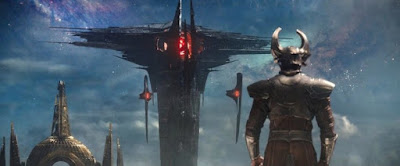
The Dark World was a well-intentioned experiment for Marvel that shines in regards to the expansive, conceptual world-building, but fails in fleshing it all out. There are so many interesting notions sprinkled throughout Thor: The Dark World in the form of the Dark Elves and Asgard's weaponry/technology. Most action sequences are enjoyable, excluding the thoroughly average third-act showdown, and the film mostly looks terrific from start-to-finish. 
The thing about The Dark World is that the film safely walks through the opening of the gate, finds its footing in the midst of its jog, and then stumbles again on its way out the door. My analogy essentially means that the first act's formulaic, the second livens things up with one of Marvel's more emotionally-moving sequences and an electrically-charged team-up between Thor and Loki, and then the third act undercuts it all with a typical third-act battle where the fate of the universe is in peril... again... The high stakes action sequences are undoubtedly entertaining, but I'm becoming apathetic to the whole "I want to destroy the world" thing when the villain's motions remain entirely unclear...
The Dark World is stuffed to the brim with a copious amount of characters and overarching storylines, and it's Malekith that suffers from it most of all. The screenplay penned by Christopher Yost, Christopher Markus, and Stephen McFeely paints Malekith in a manner that he has no defining characteristics... There's almost nothing of substance to his character aside from the fact he's a dark elf who wants to spread... darkness... Boring!!! 
The film doesn't really take off till it around when it un-cages Loki, as the trickster proves to still be a valuable asset to the Thor franchise. Once Algrim becomes Kurse and the prison break sequence initiates, the film is instantly invigorated, and everything suddenly becomes so much more interesting.

**Spoiler Warning**

It's sounds strange to say, but the moment the film goes from good-to-great is when Frigga (Thor's mother) dies. It's so weird because her character was such an outlying figure in the franchise, yet her death feels incredibly impactful because of Hemsworth and Hiddleston's exceptional acting. Loki's reaction to learning Frigga died reveals a lot of the character's inner workings, communicating so much emotion through the slightest scene, and Loki is set on the path of a marvelous redemption arc as an enrapturing antihero.
Unfortunately, that's all undone by the reveal Loki didn't actually die. I still have such mixed feeling about Loki's "fake-out" death. The twist that Loki is impersonating Odin remains one of Marvel's best cliff-hangers, and I'm absolutely excited to learn the inner workings of it all tonight when I watch Thor: Ragnarok. However, it completely undercuts his sacrifice, so his "death scene" loses its luster on rewatches. 

**End of spoilers**

Thankfully the cast are all-in though, as Chris Hemsworth proves once again to be terrific as Thor. Hemsworth is afforded more to do in terms of demonstrating his acting range with incredibly emotional outbursts, a cool, collected composure, and spurs of comedic fish-out-of-water moments. Opposite Hemsworth, Natalie Portman's certainly charming as Jane Foster, but the script doesn't really utilize the actress or the character to their fullest potential. Their romance also just comes across as bland, but the actors have convincing chemistry at least.
It's just so sad that Hemsworth can't catch a break from Tom Hiddleston's Loki though, because he once again is overshadowed in his own movie. All the while, Hiddleston makes a case that he only gets better in the role as time goes on as he invigorates the movie once he becomes more involved. I believe this to be Hiddleston's best stint as the God of Mischief yet, and his dynamic with Hemsworth is absolutely electrifying.
The other Asgardians are offered enough screen-time to impress audiences, but none of the characters are offered some radical role in the story. Anthony Hopkins' Odin walks with the weight and wisdom of a stately ruler, while Idris Elba gets one cool moment as Heimdall and once again gazes into the cosmos with the hope he'll get more to do in the sequel. Jaimie Alexander, Ray Stevenson, Tadanobu Asano, and Zachary Levi are each fun inclusions as Lady Sif and the Warriors Three, but also are only afforded with scarce screen-time in comparison to the other ensemble members.
On the Earth-bound side of things, Stellan SkarsgĂ„rd gets to go completely kooky as Erik Selvig this time around, Kat Denning's Darcy Lewis is grating, and Jonathan Howard feels like he's purely there for comedic purposes as the bumbling intern-to-the intern, Ian. Each of these characters have a few funny moments, but nothing funny enough to justify each character's inclusion. 
As I alluded to earlier, Thor: The Dark World falls prey to the plague of mediocre Marvel villains that's lately started to be turned around by a string of more interesting antagonists. Poor Christopher Eccleston does his darnedest to make extract some menace from Malekith, but he's unsuccessful in the end. Adewale Akinnuoye-Agbaje, who wound up over on the DC side of things as Killer Croc in Suicide Squad last year, leaves an impression as an intimidating henchman once he becomes Kurse, but he also isn't afforded much to work with.
Thor: The Dark World tried with all its might to be a worthy successor to Thor, and I feel it accomplished many of the goals Marvel had set for it, but the film just can't quite lift the metaphorical Mjionir with ease. The Dark World is buoyed by cool concepts, entertaining action sequences, a superb second act, and a capable cast made up of a likable lead, sturdy supporting players, and a scene-stealing God of mischief, but ultimately suffers from a slow start, an rather uninteresting central romance, an unexceptional antagonist, and a finicky finish.

Film Assessment: C+

Wednesday, November 1, 2017

Star Wars Speculation: Why 'Solo: A Star Wars Story' Is Gonna Be Ok

Welcome to my fourth installment of Star Wars Speculation! This installment will straying further away from my last three entries, and diving into the territory of dissecting rumors/reports rather than Star Wars itself. For those wondering, this isn't me assuaging my upmost confidence that there's no possible way Solo: A Star Wars Story could suck. The movie could come out and be terrible, but I don't really see that happening considering the latest news about Solo: A Star Wars Story reshoots that I'll breakdown in a second. The entire reason I'm publishing a post is that I feel there's been a toxic mindset about any reported reshoots these past few years. The panicked hive-mind mentality that a film is in trouble just because there were reshoots is a little absurd if you ask me, and I'll explain just why right now!

Why 'Solo: A Star Wars Story' Is Gonna Be Ok


The Scoop

For those who haven't heard, it was recently reported on Star Wars News Net‘s The Resistance Broadcast that Ron Howard (the replacement director for Solo: A Star Wars Story) reshot an estimated 80% or more of the film after taking over this summer and that the reshoots nearly doubled the film's budget. The Resistance Broadcast is a podcast put on by Star Wars fans, but they've had reliable scoops in the past so this news shouldn't be entirely discredited. In fact, it makes a lot of sense given the film just recently wrapped production after about four months of shooting. 


So, what even are reshoots?

I figure not all my readers may be up-to-speed on the process of a film's production, so I'm going to briefly explain the process and the concept of reshoots.

Film Production Process

The film production process can be broken up into about five stages depending on who you ask. The stages are development, pre-production, production, post-production, and distribution. Development essentially revolves around selecting a story, putting together a story treatment, the early stages of screenwriting, pitching the project, and getting it financed. Next, the pre-production goes into fleshing out the story with storyboards, concept art, etc. and hiring a cast and crew for the project. Then, the actual production is the process of creating props, sets, and shooting the film itself. Then, the post-production process typically involves editing the film, development of sound design/mixing, composition of the film's score, and adding any digital effects. Lastly, the film is distributed to theaters. The amount of time spent in each phase varies from project-to-project based on scale and the people involved.

Reshoots

Reshoots are exactly what the name implies, reshooting a movie. This typically happens during post-production when the director and studio decide that they need to rework part of the film, and so they coordinate reshooting certain scenes. As I said, reshoots normally fall into post-production, but Solo: A Star Wars Story's a very special case... 

Solo: A Star Wars Story Behind-The-Scenes Drama

So what makes Solo: A Star Wars Story so unique? If you didn't already know, directors Phil Lord and Chris Miller departed the project on account of creative differences on June 26, 2017. They were supposedly nearly 70% complete with filming before departing. This is where I have to cite rumors and reports as evidence rather than actual concrete facts, so don't rely on the all information I'm about to present as 100% factual. 

What We Do Know

This is the only information that we truly know is as follows:
-Lord & Miller left due to creative differences
-They were quickly replaced by Ron Howard with the announcement filming would resume on July 10th 
-Ron Howard wrapped filming and a title was announced on October 17th. 

The Uncertain Territory or Rumors/Reports 

According to The Hollywood Reporter, Lord & Miller were operating in a more relaxed manner and encouraged improvisation contrary to the wishes of screenwriter Lawrence Kasdan that they adhere to the script. Essentially, it seems that the filmmaking styles of the various parties were at odds. This report actually seems fairly believable considering Lord & Miller had previously only dealt with smaller-scaled comedy-oriented projects such as 21 Jump Street, 22 Jump Street, and The LEGO Movie. It seems like the problem was that Kennedy didn't properly vet the duo before hiring them on for the project, and even proceeding into production. There was clearly a huge misunderstanding, and I think Lucasfilm has learned their lesson about hiring hot talent after Colin Trevorrow recently left Episode IX. If you'd like to read more information about the report, just click on the "Hollywood Reporter" hyperlink to the article.

The Stigma Around Reshoots

As I attested to earlier, there's been a recent misconception that reshoots are a bad thing. Reports emerge from various sources, and almost every article presents the reshoots as a troublesome thing. Therefore, people read a report that a movie's under-going reshoots and anxiety almost instantly intensifies regarding the film's quality. However, it's worth noting that reshoots are totally normal for big-budget blockbuster movies. What's not normal, but is becoming increasingly more frequent, are extensive reshoots that rework large sections of the film. This isn't always a bad thing though... Just look at World War Z or Rogue One. The third acts of each of these films were apparently almost entirely reworked and I think it's fair to say both the finished project turned out well. It can even be argued that the third act of both films are the best part of each respective movie. In Solo: A Star Wars Story's case, it seems that almost the entire film has been reshot once Howard took over, and contrary to the popular belief, I don't believe this to be a bad thing...


Why These Reshoots Are For The Best

If Lord & Miller's creative process didn't align with Lucasfilm's, wouldn't it stand to reason that Lucasfilm would want something else entirely from someone else? I think Lucasfilm didn't approach this project with the intention of going through all of this, but it happened because they weren't careful when hiring a director for the job. It's certainly possible, and very likely, that some footage shot by Lord & Miller will wind up being part of the finished project because I highly doubt the two were incapable of shooting entirely un-useable footage in their five months working on the project... However, it does make sense that large portions of the film would need to be reshot for numerous reasons. 
During this period, a lot had to be changed on account of scheduling. For example, the removal of Michael K. William's character due to his unavailability. It stands to reason that they would then have to reshoot any scenes his character was involved in because he's no longer part of the story, and they had to rework another character (played by Paul Bettany) in his place to serve a similar story purpose in the grand narrative. Also, it should be remembered that much of the cast involved with Solo: A Star Wars Story are big-name actors. Emilia Clarke, Donald Glover, Woody Harrelson, and Thandie Newton are each apart of big television or film franchises, so therefore they probably had a tight schedule and it would have been difficult to bring together all the actors needed for unplanned, extensive reshoots. As for doubling the cost, it makes sense to me that if Howard shot about equally as long as Lord & Miller, then the reshoots would be about equal cost. Therefore, the film's budget probably doubled...
The reason I think this is for the best in the end is that it demonstrates Lucasfilm and Disney genuinely care about getting the best possible film out into the market. They're well-aware Star Wars is a very commercially-viable property, and they don't want to taint their IP with a mediocre movie. The fact they're willing to double the budget of a massive blockbuster shows me that they care about making this movie as great as they possibly can, and correcting any mistakes already made along the way. I suspect the long-standing impact of this debacle will be that Lucasfilm is going to be very cautious from this point on in regards to hiring writers and directors. They won't just hire a seemingly sure-fire director to make a quick buck. I think this is actually the reason that Lucasfilm still hasn't announced any projects beyond Episode IX, because they want to ensure they get the right director for the job.

I've said it before, but I'll say it again. I'm cautiously optimistic for Solo: A Star Wars Story's release on May 25, 2018. I'm prepared for the possibility that the film is not great, but am still holding out hope it will be! I think a guarded enthusiasm is a good approach for this film, although a great trailer could easily unbalance that mindset!

So that's about all I have to say on the matter. Otherwise, I hope you're enjoying the varied nature of this Star Wars Speculation series. I thank you for reading my thoughts on this topic, and I would love to receive any feedback via comments/messaging on any of my initial social media postings! 

-May the force be with you, always!