Showing posts with label Christopher Nolan. Show all posts

Wednesday, September 2, 2020

'Tenet' Review

It's been a while since I shared a review. So long, in fact, that there's a new interface to the backside of this site since I used it last. With movie theaters shut down from COVID-19, I haven't been motivated to write in months... Nearly six months now, but I knew Tenet would reinvigorate my interest. As you can tell, that intuition proved correct... even if the film was delayed two or three times along the way. In a fun viewing exercise, I watched Christopher Nolan's entire filmography in reverse chronological release order leading up to Tenet. I am delighted to finally fill a few blind spots. 

Regardless, theaters are reopened, and I'm ecstatic. I've watched many movies these last six months and will share reviews in good time, but I knew it would only be right to return with a review for my most anticipated film of 2020. 

'Tenet' Review


Nominated For: Best Production Design and Best Visual Effects.
Won: Best Visual Effects.

Synopsis: Armed with only one word - Tenet - and fighting for the survival of the entire world, the Protagonist journeys beyond a twilight world of international espionage on a mission that will unfold in something beyond real-time.

Runtime: 150 minutes

MPAA Rating: PG-13 (for intense sequences of violence/action, some suggestive references, & brief strong language)

Who should see it? Fans of Christopher Nolan and action movies.
As the latest addition to visionary writer-director Christopher Nolan's esteemed filmography, Tenet is Nolan's most expensive project to date, and he even regards it as his most ambitious. Considering that the filmmaker's tackled Batman, space exploration, dream heists, World War II, and storytelling in reverse chronology, this speaks volumes about Tenet's scale and scope. Spanning all of Nolan's work, the director's indicated a fascination with time, which he takes to a whole new level through the concept of "inversion." Inversion essentially means to experience events in reverse chronology. You move forward, but your surroundings move backward, and the same can happen vice-versa.
Coupled with intricate fight choreography, this plot device sets the stage for many impressive action sequences you'll be hard-pressed to forget. I'd dare say Tenet features the most exhilarating onscreen action I've seen since Mission: Impossible - Fallout, and Nolan's insistence on executing practical stunts certainly boded well for the final product. 
Atmospherically, the film is well supported behind the scenes by frequent collaborators and fresh blood. Nolan mainstays, such as cinematographer Hoyte Van Hoytema and production designer Nathan Crowley, continue to contribute masterful craftsmanship as one would expect. Meanwhile, Nolan had to part with two longtime peers. Editor Lee Smith was occupied seamlessly stitching 1917 together while composer Hans Zimmer opted to instead work with Denis Villeneuve on Dune due to his love of the source material. In light of this creative shake-up, Nolan turned to editor Jennifer Lame (HereditaryManchester By The SeaMarriage Story) and the recent Academy Award-winning composer of Black Panther, Ludwig Göransson. As an admirer of their work, I've been interested to see how they'd fit into Nolan's creative space, and I'm excited to report that the two pulled their respective weight a thousandfold.  
That said, the sound mix is one element of the film which was noticeably lacking. While I adored Göransson's propulsive score, it was sometimes overbearing, making it difficult to hear the expositional dialogue. This had to be a deliberate choice by Nolan, and I had no difficulty following along, so it's not a huge sticking point for me personally since the "more difficult to interpret" sections of dialogue were ultimately inconsequential. However, I can see how it would really annoy others, so be forewarned. I'm eagerly anticipating the Blu-Ray release so I can watch the film with subtitles and dive deep into the behind the scenes bonus features. In the meantime, I'll surely revisit Tenet in theaters.
Suppose his breakout performance in BlacKkKlansman somehow wasn't enough to convince you John David Washington has what it takes to headline a blockbuster. In that case, Tenet will alleviate any concerns in a matter of minutes. Washington possesses a natural magnetism and intensity befitting of The Protagonist, which instantly draws you into the character. Nolan effectively utilizes Washington's star power, ensuring all eyes remain glued to the screen.
Playing second fiddle, Robert Pattinson's Neil proves to be a welcome supporting presence. Pattinson is currently enjoying a substantial career resurgence, emerging hot off a streak of first-rate indie performances to work with Nolan and don the Dark Knight's cowl in Matt Reeves' The Batman. Here, the onscreen pairing of Pattinson and Washington electrifies the inverted insanity. I hope to see this dynamic duo reunited down the line, potentially in Gotham City.
Filling out the supporting cast are Elizabeth Debicki, Kenneth Branagh, Dimple Kapadia, Himesh Patel, Aaron Taylor-Johnson, and Michael Caine in a swath of varied roles. Debicki and Branagh are most impressionable, portraying an exasperated damsel and a nefarious arms dealer, but everyone hits their mark. Whether they exist to spout exposition, incite nuclear catastrophe, or captivate the Protagonist, each cast member makes the most of their screen time.
After months of anticipation amidst delays and a pandemic, all I have for Christopher Nolan and my readers is a word: "Wow." For a filmmaker whose work has explored the depths of dreams, space, Gotham City, and the second World War, I consider that high praise. An inverted compliment, some may say. Nolan's palindromic take on international espionage is an invigorating actioner that hopefully helps theaters bounce back from their most desperate hour. If you're able to see it and feel comfortable venturing out to the cinema, seek Tenet on the largest screen possible!

Film Assessment: A

Sunday, December 3, 2017

Recollection Reflection Review: 'Interstellar'

This review was originally supposed to be published the week Dunkirk was released, but it just got delayed and delayed and delayed due to extenuating circumstances... However, we can just pretend I'm publishing it now to coincide with Dunkirk's home media release and the upcoming Ultra HD 4K editions of Nolan's films next week. In other news, I'm all caught up with my draft reviews of more current releases (which I'll soon finally be able to share with you) and I'm currently overcoming an illness, so it seemed like the optimal time to finally work on this review.

'Interstellar' Review


Nominated for: Best Visual Effects, Best Production Design, Best Sound Editing, Best Sound Mixing, and Best Original Score.
Won: Best Visual Effects.

Recollection- 'Interstellar' Review

Reflection- I can recall seeing Interstellar in IMAX three years back and being blown away by Nolan's mastery of storytelling, both visually and narratively. I'd consider my older review of the film more simple in detailing my thoughts when compared to my more recent reviews, but that's exactly why I started doing these Triple-R Reviews! Anyways, since that review I've discovered more and more to love about Interstellar every time I watch it, so I suspect this review will come across as much more enthusiastic!

Review- Interstellar launches audiences into a future where Earth is experiencing a global crop blight and a second Dust Bowl that are rendering the planet to be uninhabitable. When mysterious forces lead former NASA pilot Cooper to the secluded remnants of NASA, physicist Professor Brand informs Cooper there may be a way to save mankind. Ten years prior, NASA sent twelve landing pods to twelve potentially habitable worlds through a wormhole on a series of missions known as the Lazarus missions. Of the twelve sent, three promising worlds were discovered in one system. Cooper then joins the crew of the Endurance to travel through the wormhole to that system and identify which of those three planets would be optimal for human colonization.
Interstellar was directed by Christopher Nolan, who also cowrote the film's screenplay with his brother Jonathan Nolan. Interstellar was Nolan's ninth feature length film and his first project following the completion of the Dark Knight Trilogy, but Nolan's auteur fingerprints can still be found all over Interstellar. The film is just as emotionally and intellectually charged as the best of Nolan's work and even features one of his trademark ambiguous endings.
Interstellar's defining characteristic is its determination to tell a personal story on a universal scale. Nolan wisely waits to widen the scope of the character's circumstances till aptly investing audiences in the focal father/daughter relationship between Cooper and Murph. Only then, does Nolan up the ante. Cooper is presented with a monumental decision to choose between abandoning his kids in hopes of saving the human race and staying on Earth to raise his children at the risk of humanity's survival. Objectively, it'd be easy to pronounce a decision. However, in actuality, the alternatives bear fare more weight. By firmly establishing a steadfast bond between Cooper and Murph, the stakes have astronomically risen and audiences understand Cooper's trepidation as he journeys out into the great unknown. From that point onward, Interstellar's anecdotes revolve around perseverance in the face of the most improbable odds, proving that love is the only thing that truly capable of transcending time and space.
Technically, Interstellar is masterfully made in every way, shape, and form imaginable. The visual effects are not only awe-inspiring to look at, they also bestow an authenticity to the incredible and extensive fabric of space. In fact, I can't think of a single frame that looked as though it were captured inside a sound stage against a green screen background. In other departments, the film features stunning cinematography, intense editing, phenomenal production design, stirring sound editing and sound mixing, and another sensational score from Hans Zimmer. I'd daresay it's one of his best film scores to date because each composition not only suits the subsequent scenes, but also stands as an epic piece of music on its own merit. In fact, I often listen to themes from his Interstellar soundtrack because it can be soothing or simply provides a grandiose sound that's difficult to find elsewhere. 
Sure, the sequence inside the tesseract can be a bit of a head-scratcher on first viewing, but I've found it to make much more sense on subsequent rewatches. The sequence really serves as the lynch pin of the entire film, tying everything together remarkably well thematically and narratively. 
As for the cast, Matthew McConaughey turns in one of his most emotionally vulnerable performances yet as Cooper. McConaughey sells Cooper's warmth and trauma equally well with many of his scenes packing an emotional wallop. The sequence where he leaves his family is notably heart-wrenching, as well as one onboard the Endurance when he's watching video messages from his grown children. If neither of those bring you to tears, then you're simply not human. Mackenzie Foy and Timothée Chalamet also deserve some recognition for playing the younger versions of his two children, Murph and Tom. Foy, in particular, shows a lot of promise as an captivating child actor considering she's never overshadowed by McConaughey's larger-than-life screen presence in their scenes together. 
Jessica Chastain and Casey Affleck lend themselves to playing the adult versions of Murph and Tom, and both are quite good, but Chastain takes the cake. Chastain expertly builds upon everything established by Foy and McConaughey to ensure the mature Murph is resolute, intelligent, and headstrong, but believably so. 
As for the crew of the Endurance, Anne Hathaway convincingly captures Brand's intellect and empathy while David Gyasi discerns Romilly with more cerebral sense.
Rounding out the Nolan regulars, Michael Caine offers a solemn, serene performance as Professor Brand with one scene in particular that really shows his acting talent beyond playing a sophisticated British man.  
Last but certainly not least, I must credit Bill Irwin for voicing and operating the hydraulics for the snarky tactical robot, TARS. I think the design of the robot is unique and impressive on its own, but I've found myself gravitating towards the robot every time I watch Interstellar thanks to Irwin's precise line delivery.
Perhaps, three years ago I would have told you that I merely enjoyed Interstellar for Nolan's astonishing craftsmanship and superb storytelling, but it's only now that I realize Interstellar is an film that will endure the test of time for its impeccable example of the resilience of the human spirit. It's emotional. It's intelligent. It's insightful. It's exceptional.

Film Assessment: A+

Wednesday, November 8, 2017

Throwback Thursday Review: 'Inception'

Sorry for the extreme delay in publishing this review. Before I begin, I'd like to update my readers on what's been going on behind the scenes. First off, I came up with an interesting idea for this review, but it just never took off, so that got abandoned. Secondly, Hurricane Harvey struck the Houston area back in August. This threw me off, of course, and I scarcely had time to sit down and work on reviews, much less any of my delayed ones. However, a sense of normalcy has long since established itself so I'm getting on to publishing these dreadfully delayed reviews online ASAP. Reviews you can expect to see in the near future include a Triple-R for Interstellar and Throwback Thursday Reviews over Stand By MeThe World's EndThe Shining, the 1990 It miniseries, Scott Pilgrim vs. the World, and Risky Business (1983).

'Inception' Review


Nominated For: Best Picture, Best Cinematography, Best Original Screenplay, Best Visual Effects, Best Art Direction, Best Sound Editing, Best Sound Mixing, and Best Original Score.
Won: Best Cinematography, Best Visual Effects, Best Sound Editing, and Best Sound Mixing.

Inception follows Dom Cobb, a thief who utilizes shared dream technology to enter people's minds and steal secrets from their subconscious. This skill makes him incredibly useful in the world of corporate espionage, but has also been accompanied by substantial personal consequences for Cobb. While on an assignment, he's offered a chance at redemption so that he can finally return home and see his children again. All Cobb has to do is assemble a team to infiltrate the mind of a CEO and implant an idea in his mind. The task seems inconceivable, but the reward far outweighs the risk for Cobb, so he accepts and the quest to pull off the most impractical mind heist begins.
Inception was written and directed by auteur filmmaker Christopher Nolan, standing as his seventh feature length film and first follow up to the massive success of The Dark Knight. I think every successful storyteller has a defining point in their career where they prove themselves capable of more than just making remarkable movies, but also expanding exceptional, original ideas into fantastic feature length projects. For Nolan, I believe Inception is his quintessential film. 
I'm not necessarily stating Inception is his best work, but I believe it to be one of the defining points of his phenomenal filmography. I still haven't seen Following, Memento, Insomnia, or The Prestige so I can't quite speak on how those films impacted his career trajectory, but I do believe Inception exemplifies all the aforementioned points. 
For starters, everything originated from one of the most unique ideas ever brought to film that presents infinite opportunity for elaboration and development. What if people were able to infiltrate one-another's dreams? What would the implications of that be? What are the rules? Nolan knows all, and the fact he thought this all up still astounds me. It's wonderful world-building from the group up, and Nolan realizes he's gotta break it down for the viewer so he cleverly incorporates exposition in an incredibly interesting way. He shows as he tells, explaining the fundamentals clearly and concisely for those providing their full attention and willingness to think.  
Nolan doesn't forget that the human mind is complex though. He remembers that the past haunts us and our personal trauma will always trail behind, so he brilliantly pushes that idea forward as the driving narrative for our protagonist. The base premise of Inception centers on a heist, but at its core the film is all about letting go of the past. The way Nolan integrates this thread with the overarching story is utterly exceptional. The stakes in Inception remain personal in spite of elevated spectacle. Rather than focusing the film's climax entirely on the heist at hand, Nolan pits Cobb against the personal demons of his past, and forces him to confront them in an intense, emotionally charged resolution. 
Like nearly all of Nolan's other films, Inception is a masterpiece on a technical level with splendid cinematography, impressive editing, proficient practical production design, absolutely authentic visual effects work, superb sound mixing and editing, and a booming score from Hans Zimmer. There's not a single technical category that slouches amidst Nolan's especially ambitious magnum opus, and absolutely all of these involved elements have gone on to be incredibly influential (just look to last year's Doctor Strange for evidence of that).
Time is a reoccurring element in virtually all of Nolan's work. Though the way Nolan compounds time within the layers of dreams in Inception's pivotal dream-heist is simply astounding. Every talked-about technical technique accentuates the tension and importance of the cerebral stickup, but the sense of urgency is only emphasized and amplified by these filmmaking instruments, not fabricated by it. This perception that time elongates within each layer is best communicated through the slo-motion sequencing and tempo fluctuations in Zimmer's score. 
As for Inception's illustrious ensemble, the all-star talent bring their A-game. Accomplished actors including Joseph Gordon-Levitt, Ellen Page, Tom Hardy, Ken Watanabe, Dileep Rao, Cillian Murphy, and Michael Caine each provide sufficient substance to their respective roles and make especially favorable impressions with every moment onscreen. 
However, it's Leonardo DiCaprio and Marion Cotillard who practically run away with the movie. DiCaprio absolutely authenticates Cobb's struggle to distinguish fiction from reality, and the fact his mind is constantly responsible for undermining his plans only strengthens the struggle. One outburst from him, in particular, is so powerful that you can feel Cobb's pain resonate through the screen. It's one of DiCaprio's few performances that exemplifies such a poignant balance between intellect, emotion, and subtle nuance. Cotillard is able to match him emotional beat-for-emotional beat though, demonstrating a strengthened resolve and etherealness to play Mel as a faint shadow of the woman Cobb remembers loving. She finds a strange sweet-spot between seeming real and unreal, so the viewer (like Cobb) will also have difficulty differentiating the hallucinations from flesh and blood.
Aside from expanding audience's minds in 2010, Inception stretched the limits of efficiently executing and innovating a director's most inconceivable abstraction. I realize I've used adjectives like "brilliant," "exceptional," and "astounding" quite often in this review, but there's simply no other way to describe Nolan's craftsmanship. He continually pushes the boundaries of every element of filmmaking to consistently deliver intellectually-stimulating entertainment. Inception remains to be ample evidence of just that, and so much more!

Film Assessment: A+

Monday, July 24, 2017

'Dunkirk' Review

Nominated For: Best Picture, Best Director; Christopher Nolan, Best Film Editing, Best Cinematography, Best Production Design, Best Sound Editing, Best Sound Mixing, and Best Original Score.
Won: Best Film Editing, Best Sound Editing, and Best Sound Mixing.

The year is 1940 and Allied forces fighting in World War II have been driven back to the beaches of Dunkirk. The Germans have the British and French soldiers surrounded and the only hope of survival is an impossible escape. That's the dire circumstances our heroes find themselves in at the start of DunkirkDunkirk then depicts the attempted evacuation of over 300,000 men by land, sea, and air.
Dunkirk is written and directed by auteur filmmaker Christopher Nolan, a man whose work's powerful enough to speak for itself. You're probably familiar with Nolan's other highly regarded films such as InceptionInterstellar, and The Dark Knight Trilogy, but you may not know that Nolan has yet to be nominated in the category of "Best Director" at the annual Academy Awards, or even win an Oscar for that matter (although he's received nominations for Best Picture and Best Original Screenplay and his films have faired well in the technical categories with a number of wins). 
Well, that's all about to change because there's absolutely no way the Academy would dare snub his work displayed in Dunkirk. While we still have a ways to go in regards to awards season, and it's a little early to speculate, I have yet to see any formidable competition arise. Dunkirk marks Nolan's first foray into the war genre and his experience with a big budget and practical effects carried over quite nicely. Nolan is accustomed putting his own spin on all his productions, and Dunkirk is no exception because Dunkirk is unlike any war film I've ever seen.
In Dunkirk, emphasis is placed on the event rather than the characters. You don't get the opportunity to know these heroes because Nolan thrusts the audience straight into the ensuing chaos. Dunkirk represents a glimpse of the events "in-the-moment" and I must say, I was enraptured from the get-go. There's no time to sit around the fire and talk about what's waiting back home because this is a struggle-for-survival. Time is of the essence for these soldiers and nothing communicates that better than a ticking timepiece, which Hans Zimmer impressively embedded into his swirling, epic score. Nolan then ensures that everything ranging from shot composition-to-an actor's expression conveys a sense of urgency to match Zimmer's harmonic pulses and it all culminates in a heart-pounding pressure cooker.
Dunkirk is probably the most expensive and authentic recreation of said-evacuation that divides its focus among three interwoven chapters, despite the fact each takes place at a different point in time;

1. The Mole, One Week.
2. The Sea, One Day.    
3. The Air, One Hour.    

Eventually, all of these ongoing events overlap and there are certainly some interesting intersections which your eyes will be more attuned to after an initial viewing. You'll find yourself thinking "Haven't I seen that already?" upon realizing the chapter title cards signified the location and duration of each chapter. On that note, it's worth mention that the dictionary defines a mole as a large solid structure on a shore serving as a pier, breakwater, or causeway (but there's also an underlying double-meaning that you should be able to wrap your mind around if you pay enough attention).
Occasionally the same events are shown a second or third time from one of the other primary perspectives and in an ordinary war-film that might wear the viewer down. However, this is Nolan we're talking about, and only a director with Nolan's skill and attention to detail is capable of captivating audiences with an intense inter-weaving of three different accounts. Even though Nolan is depicting the same event three times from a different perspective, he manages to integrate an overwhelming intensity that carries over nicely when he transitions among the tri-arched chronology. 
The performances across the board are certainly good, but are admittedly handicapped by Nolan's narrative. Nolan extrapolates some exceptional acting from his cast but I'll be honest in saying I had a hard time pinpointing particular stand-outs. The acting is largely reactionary and while the actors' work is commendable, no single performer blew me away. Fionn Whitehead, Aneurin Barnard, and Harry Styles showcased a surprising amount of range as the soldiers headlining the mole chapter, but none of them aren't offered enough character exploration for you to be entirely invested in the men-at-arms. Nolan has gone on the record comparing the casting of Styles to his decision to have Heath Ledger portray the Joker, but I'll go ahead and set the record straight that his performance is good, but nowhere near the leagues of Ledger's legendary turn. Familiar faces consisting of Mark Rylance, Cillian Murphy, Kenneth Branagh, and James D'Arcy are also to be found among the ensemble and each actor carried their weight well.
Elsewhere, Tom Hardy once again finds his face obstructed by some sort of mask in Dunkirk and I did find it difficult to interpret exactly what he was saying on occasion. However, Hardy did a tremendous job expressing himself with essentially only his eyes. If you thought some frequent Nolan collaborators were missing from my breakdown of the performances, then listen carefully for Michael Caine's voice as it turns up once in the film's first act. 
Dunkirk is one of the year's most meticulously made movies that's undoubtedly elevated by the IMAX format. Nolan makes good use of the enormous screen's full aspect ratio and the spectacular sound design really explodes in IMAX's thunderous sound system. The heftier ticket price of an IMAX screening is certainly worth it and if you only plan on seeing Dunkirk only once, I'd go with the IMAX experience. However, the 70 MM print is also not to be missed for cinema enthusiasts as it was quite cool to see something projected on actual film opposed to the standard digital projection found in most theaters today. If you're curious, I saw Dunkirk in 70MM for my first go-around and my second viewing was in IMAX. I'd personally advise you to do the same because there's a lot you'll pick up on that you may not have noticed the first time around. But if you have to choose, pick IMAX.
In conclusion, Dunkirk is an exceptional example of why I found filmmaking so fascinating in the first place. In the hands of a less-capable artist, the events at Dunkirk would have probably come across as boring or generic, but Nolan's insistence to tell this story through unconventional means enables an intense, immersive experience you'd be hard-pressed to emulate or liken to anything else.

Film Assessment: A

Thursday, August 4, 2016

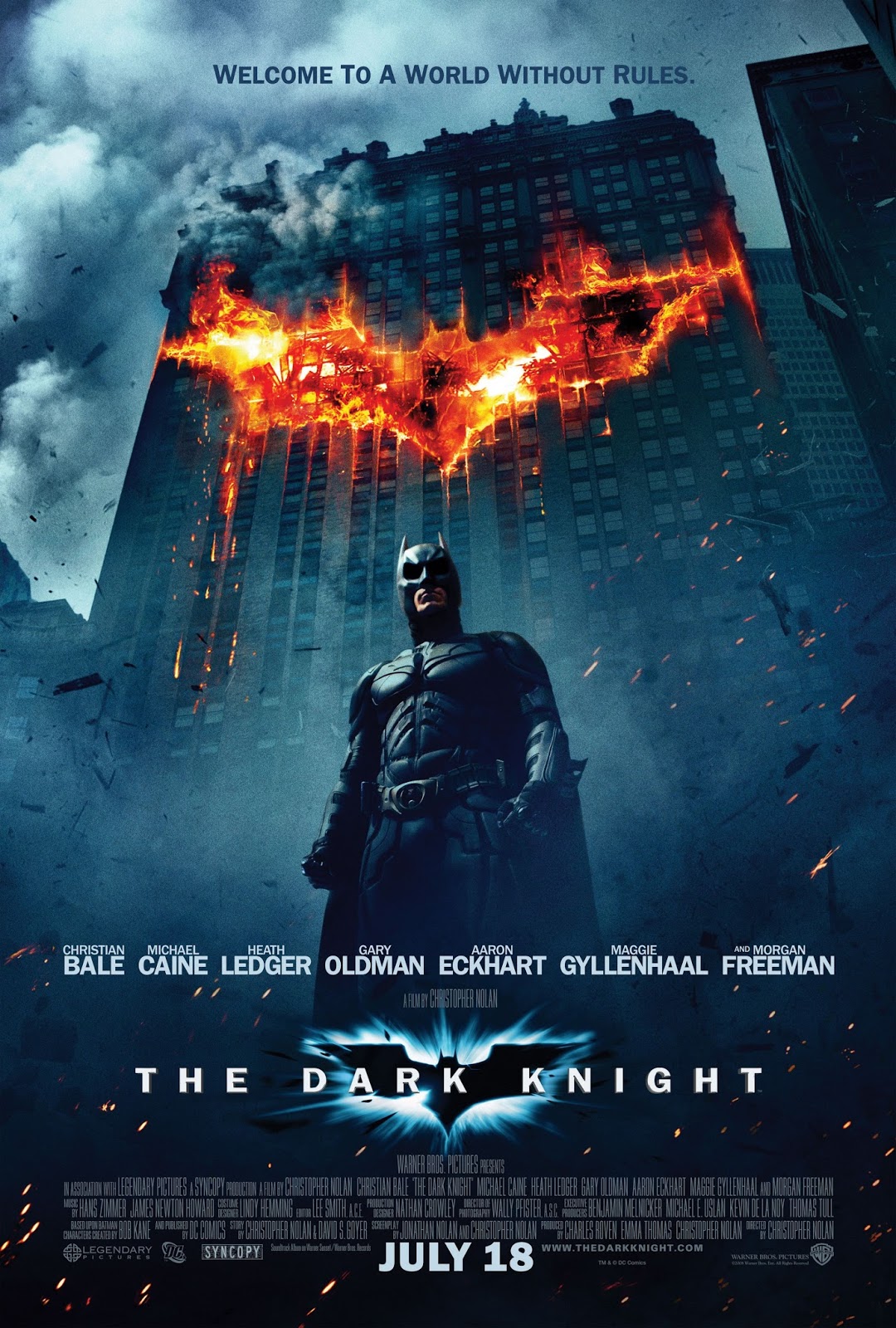
Throwback Thursday Review: 'The Dark Knight'

This week I'm reviewing The Dark Knight to tie in with the release of this weekend heavily anticipated Suicide Squad since both feature incarnations of the Joker and I wanted to review the Dark Knight Trilogy which I already began with my review of Batman Begins and I'll finish it out when I review The Dark Knight Rises in three weeks. In between then and now expect Throwback Thursday reviews on Disney's older Pete's Dragon with the release of the new live action version followed by the beginning of my series of Harry Potter reviews with Harry Potter and the Sorcerer's Stone where I will be rereading the books and reviewing each Harry Potter film every two weeks till the release of Fantastic Beasts and Where to Find Them. New reviews you can expect in the next two weeks include Suicide Squad, a review I've already writen that will be posted immediately after this review is uploaded, Pete's Dragon (2016)Sausage Party, and 
Florence Foster Jenkins.

'The Dark Knight' Review


Nominated For: Best Supporting Actor; Heath Ledger, Best Cinematography, Best Film Editing, Best Art Direction, Best Makeup, Best Sound Editing, Best Sound Mixing, and Best Visual Effects. 
Won: Best Supporting Actor; Heath Ledger and Best Sound Editing.

The Dark Knight picks up after Batman Begins. Batman's tidied up the streets of Gotham, but Joker has arrived to wreck havoc and unleash chaos. The Dark Knight is the summit of Christopher Nolan's exceptional Dark Knight Trilogy, and what a glorious peak it is! In the Dark Knight Trilogy, Nolan continues to transcend the superhero genre with a hyper-realized take on the Batman including complex messages and themes that explore the very meaning of Batman and Joker's ideologies. 
Nolan again takes up the responsibility of directing in addition to writing the screenplay alongside his brother Jonathan Nolan and working on the story with David Goyer. The trio craft a story that brings out an interesting message that darkness is hidden within all of us and that even the best of us can steep into darkness if molded correctly. Nolan, cinematographer Wally Pfizer,  and editor Lee Smith brilliantly fabricate suspense, raise tension prior to big twists and turns, and the gorgeous scenery is all cut together seamlessly. 
The practicality Nolan focused on in Batman Begins continues as he introduces the Bat-Pod, a new vehicle in Batman's arsenal, and plenty of new gadgets for his utility belt. The practicality help make the action sequences more exhilarating and believable as they are marvelous to watch. Other remarkable technical elements include the costuming, makeup, and visual effects that look phenomenal. The Dark Knight not only look great but sounds awesome as well thanks to a tremendous score composed by Hans Zimmer and James Newton Howard. 
Even better are the performances with Christian Bale once again delivering a solid dual-portrayal of billionaire Bruce Wayne and vigilante Batman. Michael Caine and Morgan Freeman are both great as Alfred Pennyworth and Lucius Fox respectively. Gary Oldman remains to be a terrific Jim Gordon and this time around gets to delve into some more emotional ground. 
Maggie Gyllenhaal's Rachel is an improvement over Katie Holmes' depiction, serving less as a damsel in distress, but an important character in this story relative to her relationship with Bruce Wayne. 
Aaron Eckhart's Harvey Dent is commonly overlooked, but his performance is truly something! Eckhart is a bright spot of the trilogy as we see him morph into Two-Face and watch his descent into darkness, proving the best of humanity can be corrupted.
Heath Ledger brings the best depiction of the Joker onscreen, as a brilliant strategist intent on unleashing hell and anarchy to prove his point. It's tragic that Ledger died shortly after, as the role took it's toll on him and caused him to eventually overdose, considering it's one of the best villainous performances in recent memory. The entire cast deliver in spades and beyond in some cases.
In summary, The Dark Knight is a cinematic masterpiece thanks to technical precision, talent in-front-of and behind-the-camera, a rousing score, and an intelligent story with sophisticated themes about the truth of humanity. The Dark Knight is easily one of the best comic book films-to-date. 


Film Assessment: A+

Friday, February 19, 2016

Throwback Thursday Review: 'Batman Begins'

Sorry for the delayed review but this week I'm beginning my series of Throwback Thursday Reviews of the Dark Knight Trilogy. I'm spreading these reviews throughout the year given the release of some new DC Comic Films of both Batman v Superman: Dawn of Justice and Suicide Squad. My main Throwback Thursday Review that will come the week Batman V. Superman: Dawn Of Justice is released will be Man Of Steel, since it's both a Superman origin and the only film in DC's current cinematic universe. However I wanted to do both a Batman origin film as well as review the Dark Knight Trilogy this year so I figured Batman Begins was a great compromise. The reason this review is coming this week as opposed to closer to Batman V. Superman: Dawn Of Justice's release is that from this week onward my schedule is booked for Throwback Thursday Reviews till August.

'Batman Begins' Review


Nominated For: Best Cinematography.

Batman Begins is the foundation for Christopher Nolan's brilliant Dark Knight Trilogy, and a rather solid foundation if ever there was one. Nolan broke ground for superhero films by being the first to take one completely seriously with a very realistic, grounded take on the Caped Crusader's origin story.
Christopher Nolan takes up the duties of director in addition to penning the script alongside  David Goyer, deciding to focus on character and story rather than spectacle going to the roots of the Batman and it's a wise decision. Nolan also makes the choice to utilize practical effects rather than CGI that leads to more authentic action sequences.
This practicality also oozes over in regards to Batman's arsenal gadgets and this version of the bat mobile, the Tumbler, that's more along the lines of a tank. I feel that the practical gadgets make perfect sense and love the explanation behind each trinket that Batman carries along with him. I also liked their use and purpose in various action sequences and felt that they certainly service the film.
One notable action sequence features the Tumbler abandoning the roads and resorting to jumping over rooftops as Batman is being frantically pursued by the authorities, and it was incredible.
Now, with that being said, this film does indeed have a few hiccups with a bit of lackluster action at times, but the film makes up for all with a phenomenal character-focused narrative. Another key piece to Nolan's larger puzzle are the performances being showcased.
Front and center we have Christian Bale as Bruce Wayne and I felt he is certainly serviceable in the duality of the role, bringing both a suave Wayne and an edgy Batman. Now, many critics are a little harsh on Bale's "Batman voice," which sounds like more of a growl, but it makes logical sense to me that Wayne would need to disguise his voice to avoid being recognize in his escapades.
Also, the film makes a point to establish that this version of Wayne uses the playboy persona as more of a mask rather than the cowl itself, and I liked that concept and how it's developed across the course of the Trilogy.
The film's supporting cast are where the performances are just exceptional. Michael Caine brings new depths to Alfred showing that Wayne's butler is not only concerned with Bruce's safety but protecting the Wayne legacy as well. Caine is exceptional in the role as a phenomenal casting choice.
Morgan Freeman portrays Lucius Fox and his character is given more prominence than ever before in any adaptation, where it's explained Fox supplies the gadgets to Wayne and Freeman is phenomenal as per usual.
Now, Gary Oldman was the perfect match for Jim Gordon as he not only shared a physical resemblance to the cop, but also the emotional core of the character.
Katie Holmes plays the main love interest for Wayne as Rachel Dawes, and sadly is of little use to the story, only to serve at the damsel of distress in some of the darkest moments. Holmes is decent in the role, but you'll see she's easily replaced for the sequel.
In regards to villains, the film holds an ace up it's sleeve with Liam Neeson by hiding his true importance for most of the film, but the reveal of who he's playing is quite satisfying. Neeson acts as a great mentor and opposition to Wayne that's integral to the film and later brings the narrative full circle in the closing act of the Dark Knight Trilogy.
Cillian Murphy brings the first live action version of the Scarecrow to the screen, and oh, boy is he terrifying. Murphy plays second fiddle to the main antagonist but is terrific when utilized.
Christopher Nolan's interpretation of the Caped Crusader is really one of the greatest superhero origin stories to be told, that serviced the source material while making it accessible to the mainstream public.

Film Assessment: A-