Showing posts with label Anne Hathaway. Show all posts

Tuesday, January 29, 2019

'Serenity' (2019) Review

Baker Dill is a fishing boat captain who leads tours off of the tranquil enclave of Plymouth Island. However, his peaceful life is shattered when his ex-wife tracks him down and begs him to save her and their young son from her abusive husband. Thrust back into a life he wanted to forget, Baker now finds himself struggling between right and wrong. 
Written and directed by Steven Knight, Serenity is sure to be the most bizarre thing shown at the multiplex all year. I was drawn into seeing it purely out of curiosity upon learning there was a ludicrous twist at the film's center (I'll eventually elaborate on this in a clearly marked spoiler section of the review) but walked in entirely unaware of what would soon occur. While I'll quickly detail why I believe you shouldn't waste your money seeing Serenity in cinemas, going in blind is the proper way to best experience this head-scratcher of a movie. Knowing absolutely nothing about it aside from the talent involved with the project honestly made the experience all the more interesting as I was perplexed to wonder why in the world this project wasn't scrapped at the scripting stage. At the outset, the story seemed to be a modern take on Ernest Hemingway's The Old Man and the Sea, but it then became a thriller of sorts before eventually evolving into something else entirely. I'd say Serenity has an identity crisis, but that's not quite the case. 
It knows what it is, but Knight doesn't reveal what Serenity's actually about until the end. I've heard it said plot-twists can make or break a movie but never seen a late revelation neuter its narrative quite like this. A bonkers twist turns the entire thing on its head and makes you re-evaluate everything you just watched, but not in a good way. Ultimately, this discovery calls the whole plot into question. So what is this game-changer of a twist you ask? I'm happy to tell you.

**Spoiler Warning for Serenity**

When Dill's ex-wife Karen finds Dill, she asks him to take her husband Frank out fishing and push Frank overboard to be eaten by sharks. She requests this of him because she and their son are abused by this man. Dill contemplates the deed over the course of the film but declines several times before eventually agreeing. Meanwhile, there's a character named Reid Miller who's been trying to speak with Dill but regularly misses him by mere minutes. It quickly becomes a recurring gag as the story progresses. Towards the end, Reid finally reaches Dill and shadily tries to give him free product (a fish finder and other materials to help him fish). Dill sees through the deception when Reid accidentally tells Dill that he knows of the murder plot, so Dill demands Reid tell him what's really going on. The audience then learns that everything in Serenity is happening inside of a video game created by Dill's son Patrick in real life.
We learn Dill actually died in the Iraq War and that Patrick coded the game as a way of connecting with his lost father. It's a form of escapism from his troubled life which enables him to "fish with his father again." However, as Patrick's focus shifts from fishing with his dad to murdering his step-father, the game follows suit, and a fantasy scenario ensues where his father can "save him" in the virtual world. It's quite literally wish fulfillment for the young boy, and the game is representative of Patrick's inner thought process. There are some subtle hints towards this, but the twist comes entirely out of left field and renders everything else to follow as inconsequential. Essentially, Dill becomes self-aware of the fabricated reality without realizing it, but Reid's revelation helps him see it the following day for himself.
The focus is then once again drawn to whether Dill will kill Frank or not, but the conflict immediately becomes superficial because the illusion of choice for this character is gone. He's not the one making the decision. He's a video game avatar. His sentience is left largely unclear, but since his dilemma is symbolic of Patrick's struggle, you'd assume Patrick's the one in control. Anyways, the non-playable characters (NPCs) populating the game try to convince Dill he shouldn't kill Frank, but nothing they say dissuades him. In fact, the game and the NPCs sabotage this plot somehow by sending gang members to break Frank's hand so he can't fish. This plot point is incredibly confusing because the audience is aware Patrick is in control of the game, so did Patrick willingly put this obstacle in his own path? That question's never really answered, but it's implied the game did this on its own? Very confusing, I know. Despite this obstacle and many others, Dill ends up embarking on the fishing voyage with Frank and Karen (who comes along to help Frank fish). Another character somehow sneaks onboard and shows up out-of-nowhere as an attempt to adding further weight to this choice. It's treated as though Dill will be punished for following through with the murder, but the audience already knows this is all taking place inside a video game, rendering the stakes meaningless. 
I mentioned earlier that The Old Man and the Sea came to mind while I watched this insane production, and here's why... In the very beginning, there's a specific fish called "Justice" that Dill is desperately trying to catch. Nevertheless, the fish eludes him time-and-time again. So to bring things full circle, they catch Justice on the fishing line and hand the rod to Frank. The fish is putting up a fight, so Frank ends up at the edge of the boat. Anne and Dill release Frank, he falls overboard and is dragged to the depths of the sea to drown. Then, we see Patrick from the computer monitor's perspective. He's holding a knife and contemplating something. He gets up and leaves the room to go LITERALLY kill his step-father. The film has lost ALL subtlety at this point. It's shown that Patrick went to some sort of facility or mental institution. However, we then see the ending from Dill's perspective inside the game. He speaks to Patrick in real life via a payphone somehow... Whatever... At this point, I'd already questioned so much... Patrick tells him they can be together again and the world dissolves before reforming, bringing Patrick into the game. This ending's fairly ambiguous with a wide range of possible implications, but it just seemed like a strange way to end such a sadistic story. 
It's a happy ending which effectively condones violence with virtually no consequences. The characters get what they want, but at no cost in spite of their heinous actions. Imagine if there was a happily ever after for all the characters in Breaking Bad, that's how out-of-sorts this seemed. Not to mention how confused I was by the pivotal twist...

**End of spoilers**

Regarding positives, I'd say the cinematography offers up idyllic imagery. I think I've gone on enough regarding the writing and direction, but elsewhere, the score rarely matched the tone of what was happening onscreen and the acting was less than stellar for this A-List line-up of Matthew McConaughey, Anne Hathaway, Jason Clarke, and Diane Lane. 
Aside from its bonkers twist, Serenity is a dull expedition which capsizes after encountering some troubled waters...

Film Assessment: D-

Sunday, June 10, 2018

'Ocean's Eight' Review

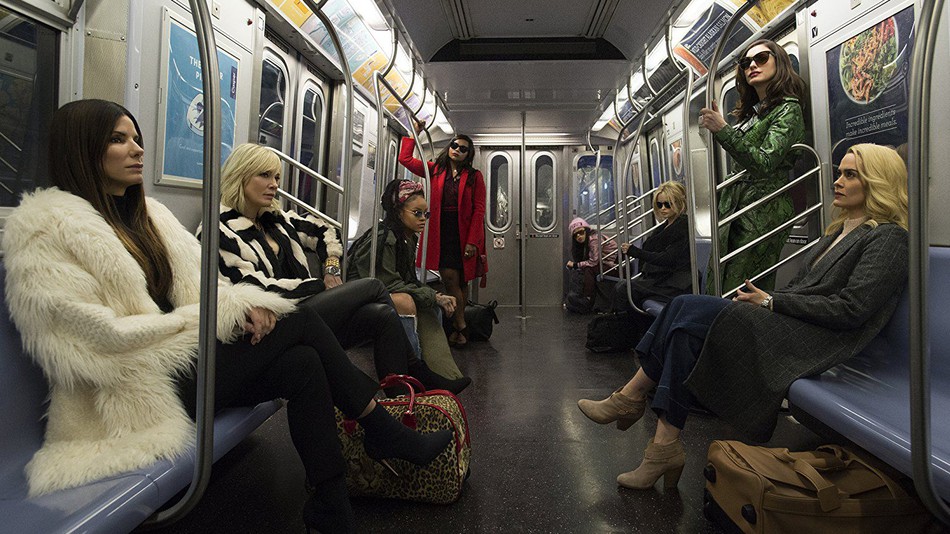
After being released from a five year prison sentence, Debbie Ocean sets out to recruit an all-female crew and pull off the heist of a lifetime by stealing a $150 million necklace during New York City's annual Met Gala.
Ocean's Eight functions as an extension of sorts to the pre-existing Ocean's Trilogy, and this is made abundantly clear in the film's opening where it's confirmed that Debbie is Danny Ocean's sister (this is in the trailers). Since I had absolutely no attachment to the Ocean's Trilogy on behalf of never having seen the films prior to a few days ago, I wasn't perturbed when this all-female reboot was announced. In fact, I was somewhat intrigued by the A-list talent assembled for the project and thought the reboot had huge potential. However, I was very surprised not to see a similar backlash which befell 2016's Ghostbusters, since that film was also a gender-swapped reboot. I suppose this is simply because the 1984 Ghostbusters is much more beloved than any Ocean's installment, plus the blowback was lessened by the fact Ocean's Eleven (2001) was already a remake and this spin-off happens in the same universe. 
The lady-led soft reboot was spearheaded by Gary Ross who took up directorial duties, wrote the story treatment solo, and penned the screenplay alongside Olivia Milch. Unfortunately, these are the areas in which I found Ocean's Eight to be the most lacking. While certainly a competently made film, Ocean's Eight lacks its own voice in the ever-growing heist genre and this is largely because Ross seems reluctant to put his own stamp on the film. Where Steven Soderbergh has made an effort to put his own spin on heist films with Logan Lucky and his Ocean's Trilogy, Ross simply retreads old ground with the same franchise blueprints. It's almost as though Warner Bros. saw the toxic fanboy reaction to Ghostbusters (2016) and decided it would be best to play things as safe as possible with a familiar story and nothing new aside from an almost entirely female ensemble. As a result, there's very little to differentiate Ocean's Eight from any of the other installments in the Ocean's franchise or any other heist film for that matter. 
It just felt as though Ocean's Eight was going through the motions of the conventional heist formula. One thing that was particularly bothersome was that **very minor spoiler warning, I guess?**  the heist went off without a hitch. All of the obstacles felt like they were easily overcome in a matter of seconds, so this heist which is supposed to be ridiculously difficult didn't feel like it was much of a challenge for these ladies. Therefore, the heist was devoid of tension and I was never concerned for the characters or their wellbeing (which is another issue altogether). In spite of this, the heist was actually my favorite portion of the film and the section I found to be the most entertaining. There are some decent twists at the end, even though a few were fairly predictable, but the remaining runtime was overinflated with standard setup and an additional twenty-thirty minutes after the heist. Not to mention the wasted time from two scenes that were practically advertisements for Subway and Tinder. They weren't as egregious as the product placement in Power Rangers (2017) or Transformers, but it was enough for me to roll my eyes in the theater. 
Otherwise, the script was lackluster and the characters were underdeveloped and fairly uninteresting. Much of the screen-time is dedicated towards recruiting a crew for the heist, explaining the heist, preparing for the heist, and then executing the heist. Ocean's Eight doesn't dedicate much time towards developing the characters or establishing much camaraderie between the crew so I ultimately didn't care about them. You could also tell that some of the lines that were supposed to be scene-ending zingers didn't really land, and it was really awkward whenever a joke fell flat.
Even though it may seem as if I'm simply ranting about mediocrity, there were elements I appreciated including a couple Ocean's Trilogy cameos, cool transitions effects, the elegant costumes, a funky, upbeat Ocean's-inspired score from Daniel Pemberton, and most importantly, the cast. The film largely works because of the talent it has at its disposal. These actresses elevate their thinly drawn characters and pepper in a little extra personality, but they were mostly typecast to play exaggerated versions of themselves or female versions of their male counterparts from the Ocean's Trilogy. The performances across the board were fine, but there was hardly a standout aside from Anne Hathaway playing a vain actress. When you hear the names Sandra Bullock, Cate Blanchett, Anne Hathaway, Helena Bonham Carter, Sarah Paulson, Mindy Kaling, Awkwafina, and Rihanna, there's a degree of star power associated with those names, and I was mostly disappointed to see so many of these actresses blend into the background.
While not nearly the worst of the Ocean’s franchise, I still felt Ocean's Eight conned me out of two hours. A sequel seems likely based on Ocean's Eight scoring the franchise's highest weekend debut, and I'm actually all in for that regardless of my issues. With a solid ensemble and the potential to easily top this entry, I just hope Warner Bros. lets Ross venture outside the box next time or at least hires someone willing to get their hands dirty and take some risks.

Film Assessment: C+

Sunday, December 3, 2017

Recollection Reflection Review: 'Interstellar'

This review was originally supposed to be published the week Dunkirk was released, but it just got delayed and delayed and delayed due to extenuating circumstances... However, we can just pretend I'm publishing it now to coincide with Dunkirk's home media release and the upcoming Ultra HD 4K editions of Nolan's films next week. In other news, I'm all caught up with my draft reviews of more current releases (which I'll soon finally be able to share with you) and I'm currently overcoming an illness, so it seemed like the optimal time to finally work on this review.

'Interstellar' Review


Nominated for: Best Visual Effects, Best Production Design, Best Sound Editing, Best Sound Mixing, and Best Original Score.
Won: Best Visual Effects.

Recollection- 'Interstellar' Review

Reflection- I can recall seeing Interstellar in IMAX three years back and being blown away by Nolan's mastery of storytelling, both visually and narratively. I'd consider my older review of the film more simple in detailing my thoughts when compared to my more recent reviews, but that's exactly why I started doing these Triple-R Reviews! Anyways, since that review I've discovered more and more to love about Interstellar every time I watch it, so I suspect this review will come across as much more enthusiastic!

Review- Interstellar launches audiences into a future where Earth is experiencing a global crop blight and a second Dust Bowl that are rendering the planet to be uninhabitable. When mysterious forces lead former NASA pilot Cooper to the secluded remnants of NASA, physicist Professor Brand informs Cooper there may be a way to save mankind. Ten years prior, NASA sent twelve landing pods to twelve potentially habitable worlds through a wormhole on a series of missions known as the Lazarus missions. Of the twelve sent, three promising worlds were discovered in one system. Cooper then joins the crew of the Endurance to travel through the wormhole to that system and identify which of those three planets would be optimal for human colonization.
Interstellar was directed by Christopher Nolan, who also cowrote the film's screenplay with his brother Jonathan Nolan. Interstellar was Nolan's ninth feature length film and his first project following the completion of the Dark Knight Trilogy, but Nolan's auteur fingerprints can still be found all over Interstellar. The film is just as emotionally and intellectually charged as the best of Nolan's work and even features one of his trademark ambiguous endings.
Interstellar's defining characteristic is its determination to tell a personal story on a universal scale. Nolan wisely waits to widen the scope of the character's circumstances till aptly investing audiences in the focal father/daughter relationship between Cooper and Murph. Only then, does Nolan up the ante. Cooper is presented with a monumental decision to choose between abandoning his kids in hopes of saving the human race and staying on Earth to raise his children at the risk of humanity's survival. Objectively, it'd be easy to pronounce a decision. However, in actuality, the alternatives bear fare more weight. By firmly establishing a steadfast bond between Cooper and Murph, the stakes have astronomically risen and audiences understand Cooper's trepidation as he journeys out into the great unknown. From that point onward, Interstellar's anecdotes revolve around perseverance in the face of the most improbable odds, proving that love is the only thing that truly capable of transcending time and space.
Technically, Interstellar is masterfully made in every way, shape, and form imaginable. The visual effects are not only awe-inspiring to look at, they also bestow an authenticity to the incredible and extensive fabric of space. In fact, I can't think of a single frame that looked as though it were captured inside a sound stage against a green screen background. In other departments, the film features stunning cinematography, intense editing, phenomenal production design, stirring sound editing and sound mixing, and another sensational score from Hans Zimmer. I'd daresay it's one of his best film scores to date because each composition not only suits the subsequent scenes, but also stands as an epic piece of music on its own merit. In fact, I often listen to themes from his Interstellar soundtrack because it can be soothing or simply provides a grandiose sound that's difficult to find elsewhere. 
Sure, the sequence inside the tesseract can be a bit of a head-scratcher on first viewing, but I've found it to make much more sense on subsequent rewatches. The sequence really serves as the lynch pin of the entire film, tying everything together remarkably well thematically and narratively. 
As for the cast, Matthew McConaughey turns in one of his most emotionally vulnerable performances yet as Cooper. McConaughey sells Cooper's warmth and trauma equally well with many of his scenes packing an emotional wallop. The sequence where he leaves his family is notably heart-wrenching, as well as one onboard the Endurance when he's watching video messages from his grown children. If neither of those bring you to tears, then you're simply not human. Mackenzie Foy and Timothée Chalamet also deserve some recognition for playing the younger versions of his two children, Murph and Tom. Foy, in particular, shows a lot of promise as an captivating child actor considering she's never overshadowed by McConaughey's larger-than-life screen presence in their scenes together. 
Jessica Chastain and Casey Affleck lend themselves to playing the adult versions of Murph and Tom, and both are quite good, but Chastain takes the cake. Chastain expertly builds upon everything established by Foy and McConaughey to ensure the mature Murph is resolute, intelligent, and headstrong, but believably so. 
As for the crew of the Endurance, Anne Hathaway convincingly captures Brand's intellect and empathy while David Gyasi discerns Romilly with more cerebral sense.
Rounding out the Nolan regulars, Michael Caine offers a solemn, serene performance as Professor Brand with one scene in particular that really shows his acting talent beyond playing a sophisticated British man.  
Last but certainly not least, I must credit Bill Irwin for voicing and operating the hydraulics for the snarky tactical robot, TARS. I think the design of the robot is unique and impressive on its own, but I've found myself gravitating towards the robot every time I watch Interstellar thanks to Irwin's precise line delivery.
Perhaps, three years ago I would have told you that I merely enjoyed Interstellar for Nolan's astonishing craftsmanship and superb storytelling, but it's only now that I realize Interstellar is an film that will endure the test of time for its impeccable example of the resilience of the human spirit. It's emotional. It's intelligent. It's insightful. It's exceptional.

Film Assessment: A+

Thursday, August 25, 2016

Throwback Thursday Review: 'The Dark Knight Rises'

This week I'll be concluding my series of Throwback Thursday Reviews of The Dark Knight Trilogy with my review of The Dark Knight Rises. Next week look forward to a continuation of my Harry Potter Throwback Thursday Reviews with my review of  Harry Potter and the Chamber of Secrets and the following week I will review Saving Private Ryan since Sully, a film starring Tom Hanks will be released. In the meantime, I'm currently unsure of Ben-Hur (2016) and this weekends releases so I may review a few of those films and I may not, it just depends on if I find time to see these releases. However, I did watch Sing Street recently and plan to post a review relatively soon in addition to a post detailing what I believe to be the 5 Hidden Gems & 5 Biggest Disasters of the summer movie season.

'The Dark Knight Rises' Review


The Dark Knight Rises is the epic conclusion to Christopher Nolan's exceptional Dark Knight Trilogy, finishing strong despite not living up to it's predecessors. The Dark Knight Rises takes place eight years after the events of The Dark Knight where the audience finds that the Batman hasn't been seen in some time, Bruce Wayne remains secluded in his estate, and the streets are cleared thanks to the prop-up of Harvey Dent as Gotham's hero but everything changes when a brute cunning terrorist Bane arrives on the scene to terrorize Gotham. 
Unfortunately, The Dark Knight Rises has gone down as the weak link in the Dark Knight Trilogy, when in fact it's a lot better than people give it credit for. Yes, the film has problems. There are quite a few plot-holes, and it's certainly not perfect, but it's entertaining and takes the journey Nolan began with Batman Begins full circle. Nolan once again directs the film and co-wrote the screenplay with brother Jonathan Nolan and shared story duties alongside David Goyer. The writers ensure the realized world they've created remains intact as they continue to inject both complex characters and intellectual themes.
Nolan and cinematographer Wally Pfizer brings some of their most striking visuals to date and the editing from Lee Smith helps to intersperse feelings of suspense throughout the film's runtime. Another element Nolan carries over is a reliance of practicality with believable action sequences and awesome gadgets for the Batman to utilize including the latest new vehicle, the Bat. As for the sound, Hans Zimmer brings about another exceptional score for the series that 's the epitome of the word epic. 
The performances from the capable cast are once again a highlight and some supporting characters get more time to shine. Christian Bale gets to do much more acting outside the suit as opposed to the preceding installments, and he brings a dynamic physical change in this film when he bulks up for his final confrontation with Bane. Bale's Bruce Wayne is made a more focal part of the story, a welcome change considering how character driven it made the story, while his Batman is terrific as well, showcasing Bale's ability to handle the duality of the role with relative ease. 
Michael Caine brings more sentiment to Alfred as his willingness to ensure Bruce carries on the Wayne legacy is brought to the forefront. Morgan Freeman is terrific in his role of Lucius Fox and Gary Oldman continued to be an excellent Gordon. 
Newcomers Anne Hathaway, Marion Cotillard, and Joseph Gordon-Levitt all have scene stealing moments as the enigmatic Selina Kyle, sophisticated Miranda Tate, and courageous John Blake. 
Admittedly, the biggest letdown in The Dark Knight Rises is without a doubt Bane. Tom Hardy's Bane is ruthless as he exhibits wit, brute strength, and a strategic mind in his fight to take Gotham, but a third act twist neuters the character of everything that made him so fascinating as he's ousted to merely be a love-sick henchman. Tom Hardy certainly exemplified physicality and intellect to make for an intellectual and physical threat when compared to the hulking abomination in Batman and Robin. However, the mask he wears makes some of his dialogue discernible. Hardy's Bane was never going to be able to live up to the complex anarchist nature of Heath Ledger's Joker, but he does quite well with what he had to work with. 
The Dark Knight Rises may be remembered as the worst film in the trilogy, but it's not inherently bad at all, and actually is a very competent piece of filmmaking due to the talent involved both in front of and behind the camera. If anything, the reality that The Dark Knight Rises doesn't measure up to the previous installments goes to show just how amazing those films are, considering how terrific the conclusion to the Dark Knight Trilogy proved to be. 

Film Assessment: B+

Thursday, June 2, 2016

'Alice Through the Looking Glass' Review

Alice in Wonderland was financially successful and even one of Disney's first films to cross the billion dollar mark at the worldwide box office, so from a business standpoint I'm sure it made perfect sense to make a sequel. However, the critical reception was decisively mixed from both audiences and critics and neither showed signs of interest in a sequel.
Regardless, Disney reasoned a sequel was warranted and here we are with the results. I'll admit that I dreaded going to watch this as it tanked at the box office last weekend, wasn't too well received by audiences or critics, and I'm not a fan of the animated version or the 2010 live action incarnation. I decided to watch it since I had already written a Throwback Thursday Review for it's predecessor and I wanted to check it out for myself and see if it was truly that bad.
Alice Through the Looking Glass picks up relatively soon after Alice in Wonderland (I don't think the time gap was ever specified, and it wasn't important enough for me to remember if it was), and the audience learns that the Mad Hatter is in peril, so Alice must travel through time to save him. That's the lead up of events in the first act in a nut shell.
Alice's actions have plenty of huge repercussions, and my biggest issue with the story is that at the end of the film it's almost as though she didn't need to travel through time to help the Hatter. It bothered me that this made Alice seem stubborn and ignorant, seeing as she selfishly unknowingly wreaked havoc on Underland and wasn't reprimanded for such actions. The time travel allowed for many interesting concepts, but unfortunately almost none were fleshed out.
James Bobin takes the helm from Tim Burton as director and the change up behind the scenes is especially evident as Wonderland or Underland is visually much brighter and colorful as opposed to Burton's darker oblique tones. This was a welcome change for the visual aesthetic, as I found its predecessor to be too dark and just downright strange.
The visual style is once again fantastic to look at, but still odd nonetheless. The visual effects are improved for the most parts but there are some bits that were poorly rendered. The costumes, production design, and hair and makeup are fairly decent, but not as impressive as the precursor.
The screenplay written by Linda Woolverton has many of the same issues I found in the first with absurd dialogue, a weak plot, and lackluster story, but this time around actually puts Alice front and center. The characters are again simpletons as many of the characters have virtually no knowledge of ongoing events till reminded by one single word.
For example, the characters act like they no absolutely nothing about time travel what so ever until the White Queen mentions that none of them can go along... to which the characters nod their head. The supporting characters were actually written to be of absolutely no importance to any of the ongoing events, they contribute virtually nothing to the story. These characters aren't given any humorous bit parts, memorable one-liners, or even any development whatsoever as they merely embrace all the one-note caricatures exhibited in the forerunner.
In regards to performances, all virtually do the same thing they did in the last film. Mia Wasikowska is better this time around in the role of Alice though, as we actually see her emote. Something that definitely didn't happen in the first. 
Johnny Depp lazily provides virtually the same performance as the bonkers Mad Hatter, but delivers dialogue as though he has some kind of speech impediment and once again can't maintain a consistent accent. Like I said in my review of Alice in Wonderland, I feel Depp isn't giving his all because he is a versatile talented actor and I've seen him perform much better, but I think in this case, he's merely working to work and get a nice paycheck. 
Anne Hathaway plays the White Queen, and once again daintly and obnoxiously wafts her hand in the air.
Helena Bonham Carter screams in practically every scene as the Red Queen, which is frankly very annoying. Sacha Baron Cohen is one of the few newcomers to the group as Time, who's essentially the antagonist of the piece and has the wonkiest inconsistent European accent I have ever heard. At times he sounded like Arnold Schwarzenegger and other times he dropped the accent altogether making for a rather uncommitted showcase.
Matt Lucas, Michael Sheen, Stephen Fry, Alan Rickman, Barbara Windsor, Paul Whitehouse, and Timothy Spall all return to once again lend their voices to memorable characters from the animated classic including Tweedle-Dee/Dum, the White Rabbit, Cheshire Cat, the Blue Butterfly, Dormouse, the March Hare, and Bayard respectively (Apparently this time they were given names aside from the classic names, but I'm going to refer to them all as they are more well known). This time around each of the actors I just listed had significantly less to say and as I said earlier virtually no significance to the story aside from actually being present. 
Another returning player was the composer Danny Elfman, who once again composes a fabulous score. Thankfully, his composition matches the quickened fantasy adventure tone this time around, so that's one significant improvement from his previous score for Alice in Wonderland
If you enjoyed the Tim Burton Alice in Wonderland or the animated version, you may like this. Otherwise, I'd advise skipping out on seeing it in the cinema, if you want to see it badly enough but are discouraged wait to rent it from Redox or something. Alice Through the Looking Glass does fix some issues I had with the first but ultimately brings a weaker less cohesive jumbled mess of a story, a plethora of pathetic performances, and has yet to invest me in any of the characters that supposedly warranted this sequel in the first place.

Film Assessment: F

Thursday, May 26, 2016

Throwback Thursday Review: 'Alice in Wonderland' (2010)

This week will be quite ambitious as I am going to be churning out at least three reviews today. A Throwback Thursday Review for the 2010 Tim Burton adaptation of Alice in Wonderland, a Throwback Thursday Review for X-Men: First Class and a special review that will be unveiled once it's posted. All three reviews will correlate to the dual release of X-Men: Apocalypse and Alice Through the Looking Glass this weekend. I expect to review both X-Men: Apocalypse and Alice Through The Looking Glass within the next few days or so (The X-Men: Apocalypse review will come first). Next week's Throwback Thursday Review will be over the latest 2014 Teenage Mutant Ninja Turtles to coincide with the sequel's release. 

'Alice in Wonderland' (2010) Review


Nominated For: Best Visual Effects, Best Costume Design, and Best Art Direction.
Won: Best Costume Design, and Best Art Direction.

There's a lot that can be said about Alice in Wonderland (all adaptations), but I think one word that sums it up best is "odd". Therefore, it's only apt that Tim Burton's take on Wonderland fits the bill. One key thing to note about the film is that it falls along the lines of a sequel rather than a straight adaptation of what's come before. 
Alice in Wonderland was the beginning of Disney's push to venture into the live action fairytale genre by adapting their classic animated films, which has since become an annual endeavor from the Mouse-House. Despite the financial success (It grossed over a billion dollars worldwide), the film wasn't too well regarded by audiences or critics. Sadly, I have to agree that I fall into the camp that didn't quite take a shine to the film and in all honesty, I was never a big fan of the animated version either. 
Tim Burton is known for his strange films, that's just his niche as a filmmaker, and this is certainly no exception. One of Burton's strengths is his unique visual style that is applied to the expansive worlds he explores and Alice in Wonderland's visuals are marvelous. The work that went into the extensive hair and makeup, involved costume design, intricate art direction and brilliant visual effects should be commended and it's no shock the film was nominated and won in a few categories at that year's Academy Awards (These can be seen above bolded in the subheading). 
I think it's clear Burton's vision was perfectly realized and is quite appropriate for the Wonderland mythos. Rather than read me gush over the fantastic technical elements, which I'm sure is to be found in any review of Alice in Wonderland, I'm going to decipher what went wrong. 
Alice in Wonderland proves to be another case of "style over substance." Meaning, the creative team clearly focused on the aesthetics rather than the story. The narrative becomes very unfocused when forced to incorporate larger roles for supporting characters and the film makes it's message clear and then immediately deviates from it. There's a scene in which Alice outright says that she will be her own person and choose her own destiny, then she immediately proceeds to do as instructed by those around her? The characters were all poorly written with a lack of consistency in their actions throughout the film like the example I just provided. 
Also, for some reason, almost every character is written as a complete imbecile. Almost none of the characters actually think for themselves. For example, the Red Queen is deceived to not recognizing Alice because she consumed a growth hormone cake-thing and is about a foot taller yet looks the same? She even has a line of dialogue earlier in the film when looking at a drawing of Alice and says that she'd recognize that mess of hair anywhere. Then a few scenes later, she's in the same room as Alice, yet has no idea. To put it bluntly, they made the Red Queen a moron. 
It's difficult to be engaged in the film when I didn't care about any of the characters, since they're pretty much one-note caricatures, or any of the proceedings for that matter as I became a bit bored by the lackluster plot. And it only gets worse as the screenplay written by Linda Woolverton shoves pure gibberish into the character's dialogue that makes literally no sense, even in the context of the film (This is coming from the writer of The Lion KingBeauty and the Beast (1991), and Mulan?!?). All the negative elements I just discussed derive from the flimsy poorly written script. 
The film actually managed to assemble quite the all-star cast amassing many prestigious British talents, and some fan favorite actors, yet the performances fell flat in my opinion. Mia Wasikowska plays a nineteen year old Alice and manages to do a great job capturing Alice's innocent confusion and feels like an authentic version of the animated character. Unfortunately, Wasikowska has one-note limited emotional range so she doesn't get to really show her true acting prowess, it's yet to be seen if she has any and if it's a result of poor direction or lack of opportunity. 
Johnny Depp dives into his most deranged role yet as the Mad Hatter. Depp embodies the luny wack-job persona and so I can say he did well in that department, but he also implemented an inconsistent Scottish accent that irked me. This was bothersome because in some moments he dropped it altogether. Watching the film aware of Depp's talent made the performance seem like he wasn't putting his best foot forward but rather an unhinged version of Jack Sparrow. 
Anne Hathaway plays the White Queen and has this strange mannerism with her hands that will drive you insane as she waves them about daintily. 
Helena Bonham Carter is supposed to be the piece's villain as the Red Queen, yet never felt menacing. This was probably due to the creative decision to give the Red Queen an enlarged bobblehead, it's very difficult to take her seriously as it looks like she will fall over if she becomes unbalanced. Carter screams her way through the performance, so I can say that it was true to the animation but not quite villainous in my eyes. 
Among the other antagonists, Crispin Glover makes for a typical henchman as the Knave while Christopher Lee lends his British Baritone as the malicious Jabberwocky, a brilliant casting decision. Lee's moments as the demented dragon illicit the only feelings of true suspense throughout the entire film to which I must say "Bravo!" 
Matt Lucas, Michael Sheen, Stephen Fry, Alan Rickman, Barbara Windsor, Paul Whitehouse, and Timothy Spall all lend their great talents to memorable characters from the animated classic including Tweedle-Dee/Dum, the White Rabbit, Cheshire Cat, the Blue Caterpillar, Dormouse, the March Hare, and Bayard respectively. The assortment of CGI characters were all fairly serviceable, although they were cast to the side in favor of focus on the human characters. Once I took a step back, I did come to the realization many of these actors were probably involved for a paycheck and not concerned with delivering a memorable performance. 
Another mixed element for me was Danny Elfman's score. Elfman's composition is quite epic, yet feels mismatched with the events unfolding in the film. The score on it's own is an grandiose and surely worth listening to, however it actually detracts from the events unfolding onscreen as the score vastly over exaggerates the sense of adventure, with a quick tempo juxtaposing the slow, drugged pace of events in the film. I suspect that had Elfman gone for a more fantastical score rather than adventurous, it would have gelled together quite nicely. And this is no knock on Danny Elfman, whom I believe to be a wonderful composer that composed one of my favorite superhero film scores (the Sam Raimi Spider-Man Trilogy), but rather an assertment that his skills would be better utilized elsewhere. 
Alice in Wonderland lacks consistency in all areas aside from visuals and world building and is probably not worth your time unless you're into Burton's previous work or happen to be an Alice in Wonderland fanatic. 

Film Assessment: F