Showing posts with label Gary Oldman. Show all posts

Sunday, December 6, 2020

'Mank' Review

It's been quite a few months since I've written and shared a review. In that time, I started a new job and now have a little less free time on my hands for writing. However, I'd like to get back on track soon and felt reviewing David Fincher's latest film from Netflix would be a fine place to start. In the coming weeks, I'll share Reel Recaps for everything I watched before Mank that I haven't already reviewed this year, as well as standalone reviews for other recent releases. I'd like to be caught up by New Year's Eve, so I can piece together a proper Top 10 list celebrating my favorite films of the year as usual. This year, the number of 2020 movies I've seen is noticeably lacking due to movie theaters' current state. However, there are plenty of films that debuted on streaming platforms I'd like to cram in. 

'Mank' Review


Nominated For: Best Picture, Best Director; David Fincher, Best Actor; Gary Oldman, Best Supporting Actress; Amanda Seyfried, Best Cinematography, Best Costume Design, Best Makeup and Hairstyling, Best Production Design, Best Sound, and Best Original Score.
Won: Best Cinematography and Best Production Design.

Synopsis: A scathing social critique of 1930s Hollywood through the eyes of alcoholic screenwriter Herman J. Mankiewicz as he races to finish the screenplay of Citizen Kane.

Runtime: 131 minutes

MPAA Rating: R (for some language)

Who should see it? Film fans enamored with early Hollywood and the real-life influences on Citizen Kane.
It has been nearly eighty years since the release of Citizen Kane, and the film is still held in high regard as one of the greatest motion pictures ever made for how it revolutionized cinema. With his eleventh feature, acclaimed filmmaker David Fincher realized his late father Jack Fincher's screenplay to shed new light on the mastermind behind said masterpiece. That said, it's important to note that Mank isn't strictly about the making of Citizen Kane, ala The Disaster Artist. Mank revolves around Herman J. Mankiewicz as he reflects on touchstone moments throughout his career, which now pervade his script. Before watching Mank, I suggest doing a little cursory research.
In preparation for Mank, I covered some glaring blindspots by finally watching the coveted Citizen Kane in addition to much of Fincher's filmography. While seeing Citizen Kane beforehand isn't essential to grasp Mank's story, it certainly enhanced my viewing experience. Plus, it never hurts to indulge in experiencing a classic for the first time! But one thing missing from my repertoire was a full understanding of 1930s Hollywood. Again, this isn't required by any means. But you'll get more out of Mank if you're more accustomed to the politics and key players of the period. Individuals worth googling include William Randolph Hearst, Marion Davies, Louis B. Mayer, Irving G. Thalberg, Upton Sinclair, and Orson Welles. Fincher offers enough subtext for viewers to piece things together and get the big picture, but I'm sure I'll takeaway more when I revisit Mank now that I possess more than a passing familiarity with these names.  
On a technical level, Mank is astounding. Considered to be an obsessive perfectionist by many, Fincher transports audiences to yesteryear by replicating the look and sound of early motion pictures, complete with all the era's trademark quirks. Mank is littered with cue marks and slow fades, filmed in black and white, and boasts the soundscape of an old talkie. A few visual effects involving animals don't hold up to the scrutiny of today's standards, but they're brief. Of course, I must give credit where it's due to the crew members who successfully recreated the rough-around-the-edges glamour of early Hollywood pictures. A job well done by Fincher's longtime sound designer and supervisor Ren Klyce, cinematographer Erik Messerschmidt, the costumers, production designers, and set decorators. And I couldn't dare forget the spellbinding score from the Oscar-winning composers Trent Reznor and Atticus Ross. 
While Mank is not solely about the making of Citizen Kane, the two films will forever be intertwined. It's befitting that a movie about the screenwriter of Citizen Kane would employ a similar story structure to examine its protagonist. As reporter Jerry Thompson relentlessly sought to unravel the significance of Kane's final words, Jack Fincher is equally fascinated in determining how a life of alcoholism and rocky Hollywood career lead a washed-up screenwriter to pen his magnum opus. Where Citizen Kane's flashbacks were told from the supporting cast's point-of-view to offer a comprehensive look at Kane's life, flashbacks in Mank do the opposite. Mankiewicz's point-of-view fills in the dimension and context of those same supporting characters' real-life inspiration.  It's worth remembering that Mankiewicz is meant to be an unreliable narrator since he's an alcoholic, so the depictions of these key figures are heavily skewed.
In the titular role, Gary Oldman is incredible as Herman Mankiewicz. Oldman's proven himself time-and-time again to be a chameleon onscreen, and this outing is no exception. Acting intoxicated is a slippery slope, but Oldman managed to do so in a way that didn't come off as cartoonish. Oldman's depiction of a drunk is imbued with enough nuances for viewers to sense the broken soul and crisis of conscience bubbling beneath the surface. Opposite Oldman, Amanda Seyfried and Lily Collins are delightful as the spirited actress Marion Davies and Mank's kind secretary Rita Alexander. The two share an endearing friendship with Mank, which livened the proceedings and lent the film its heart. 
 
Chief among the supporting cast, Charles Dance is as impeccable as ever. Dance portrays William Randolph-Hurst as snide, gaudy, and pretentious. There's no mincing of words, as Game of Thrones fans are well aware of Dance's formidable screen presence. Other noteworthy performances include Tom Burke as Orson Welles and Tom Pelphrey as Herman's brother, Joseph Mankiewicz. The remainder of the cast is uniformly good. But I must say I was taken aback to discover the actor cast as Upton Sinclair as I watched the film (I think it's best left a surprise, so I'll leave it at that).
In the wake of COVID-19, time's are a-changing, and so is film distribution. It's almost ironic that a film so indebted to traditional filmmaking techniques is debuting on a streamer. Nevertheless, Netflix offers a degree of creative freedom almost unheard of nowadays, so it's understandable Fincher would be enticed to partner with the studio (especially after successful collaborations such as Mindhunter and House of Cards). So no, Mank is not jank, rank, and it certainly doesn't stank. Fincher's latest feature harkens back to the culture of Hollywood's Golden Age not with dreamy eyes but disdainful scrutiny. Mank can best be described as an old fashioned motion picture that's actually kind of dank (cool).

Film Assessment: A-

Friday, December 29, 2017

'Darkest Hour' Review

Nominated For: Best Picture, Best Actor; Gary Oldman, Best Cinematography, Best Costume Design, Best Makeup and Hairstyling, and Best Production Design.
Won: Best Actor; Gary Oldman and Best Makeup and Hairstyling.

Darkest Hour informs audiences of the appointment of Winston Churchill to the office of British Prime Minister in the early days of World War II. The film then details the struggles he faced in his early days of office as Churchill must decide to negotiate a peace treaty with Nazi Germany or rally the British to fight for their freedom and liberty.
Some of you may or not remember that there was another World War II film released this year that depicted the mass evacuation of 338,000 troops from the beaches of Dunkirk, that being Christopher Nolan's Dunkirk of course. Well, Darkest Hour essentially is the administrative account behind those events. If you're looking to catch up on the year's awards contenders, I'd highly recommend watching the two together as a Dunkirk Double Feature in the order of Darkest Hour to first get the administrative context and then Dunkirk to see the events unfold, because I'm sure both films will bring in a substantial number of significant nominations based on the pedigree and craftsmanship. 
Joe Wright oversees the biographical picture with Anthony McCarten penning the screenplay, and each does a fine job in their respective roles of director and writer. The film is also stimulated by Bruno Delbonnel's captivating cinematography and a spellbinding score from Dario Marianelli that help Darkest Hour to stand out from the crowd of historical dramas. Unlike most bio-pics, Wright and McCarten don't simply define Churchill by his life story though. Instead, they let Churchill's character shine through Oldman's exceptional performance and the decision-making behind the evacuation of Dunkirk. One scene aboard a subway really speaks volume to the kind of man Churchill was, and you'll know exactly what I'm talking about once you see it... Although not entirely accurate, Wright's gone on record to say there's no evidence to suggest something like that didn't happen considering Churchill would often disappear and was known to speak with the common people to hear their opinion on matters. However, the film never overtly glorifies Churchill. Wright and McCarten always show him for who he really is, even if that means starting the film with Churchill absent from Parliament and instead lounging about at home eating breakfast in his bathrobe...
Darkest Hour depicts Churchill in the most humane light possible, as it's shown that a great deal of pressure surrounded him on a daily basis due to being in such a high position of authority. You never get the sense Wright is toying with the audience to trick them into thinking he's one of Great Britain's most courageous Prime Ministers purely on account of his success. Wright ensures audiences feel the massive weight on his shoulders. There's a scene of him having to administrate from the loo for goodness sake! Wright makes it known that Churchill wasn't dubbed the "British Bulldog" for his ferocity alone. Wright reveals that Churchill is a revered historical figure because of his courageous strength and resolve in leading a nation amidst unsurpassable adversity. 
To me, some of the best acting performances are those where an actor completely disappears into the role, and Gary Oldman does just that with his take on Winston Churchill. Oldman's almost entirely unrecognizable due to the superb seamless hair and makeup work, and on top of that, he captures the quirks and mannerisms of Churchill so well that you genuinely feel like you're watching Winston Churchill onscreen. Oldman's had a distinguished career, so I wouldn't go as far to saying this is his best performance per say, but it definitely ranks high among his best work. At this point in time, Oldman seems to be the frontrunner for that coveted Best Actor Oscar, and it would certainly be a well deserved win if he winds up with one more opportunity to hold up the trademark "V" for victory come March.
Oldman's also backed by some solid supporting actors including Lily James, Kristin Scott Thomas, Ben Mendelsohn, Ronald Pickup, and Stephen Dillane in the respective roles of the steadfast secretary Elizabeth Layton, loving wife Clemmie, the regal King George VI, nervous Neville Chamberlain, and intense adversary Lord Viscount Halifax.
Whether you're a history buff or cinephile wondering if The Darkest Hour represents Churchill's finest hours, there's no need to fret, because The Darkest Hour is victorious in its efforts to pay respects to Winston Churchill while telling an inspirational and exciting account of what transpired behind the scenes of the massive evacuation at Dunkirk.

Film Assessment: B+

Monday, July 17, 2017

Recollection Reflection Review: 'Dawn of the Planet of the Apes'

I've reviewed Rise of the Planet of the Apes and am now revisiting Dawn of the Planet of the Apes to coincide with this weekend's release of War for the Planet of the Apes. I'm aware this review's a little late but I've had a busy weekend and only just got around to writing this review. I hope to have my review of War for the Planet of the Apes online ASAP.

'Dawn of the Planet of the Apes' Review


Nominated For: Best Visual Effects.

Recollection- 'Dawn of the Planet of the Apes' Review

Reflection- This section of my review is probably going to be a little boring considering my opinion of Dawn of the Planet of the Apes hasn't changed much in the last three years. I remember thoroughly enjoying Dawn of the Planet of the Apes the first time around and that hasn't really shifted at all.

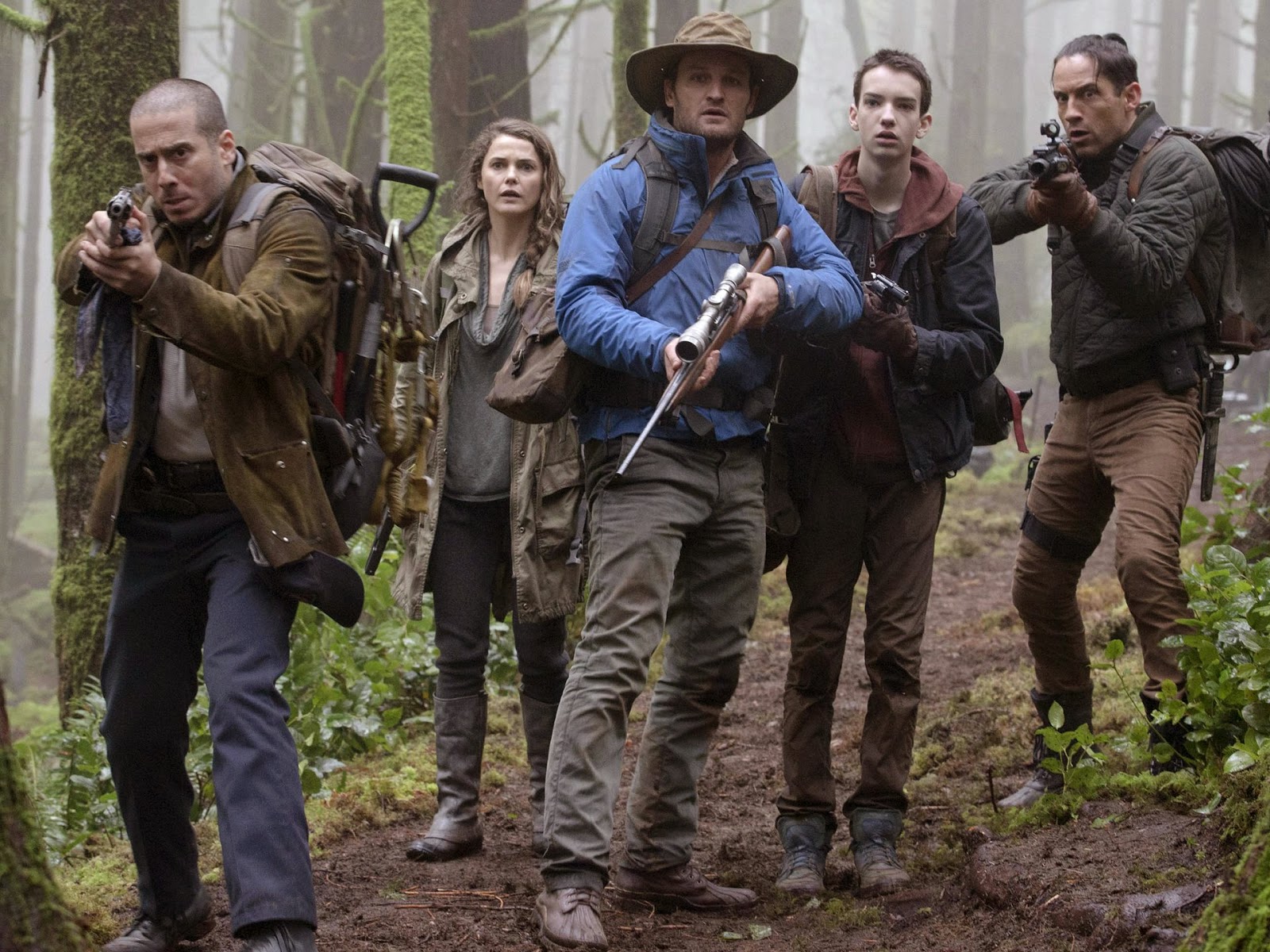
Review- In Dawn of the Planet of the Apes, it's been ten years since the Simian flu outbreak. Mankind has seemingly been wiped out by the disease while Caesar's established a thriving ape colony in the Muir Woods just outside San Fransisco. When a band of human survivors emerge desperate to gain access to hydroelectric dam that can provide power to their encampment, Caesar must grapple with the decision to remain isolated from humanity in order protect his people or work alongside the humans in hopes of co-existing peacefully.
Dawn of the Planet of the Apes saw a change in direction as Rupert Wyatt handed off the blockbuster baton to Matt Reeves. Reeves along with screenwriters Mark Bomba, Rick Jaffa, and Amanda Silver are then afforded the opportunity to thrust the viewer into a post-apocalyptic world that constantly swings the pendulum of being hopeful and hopeless. There are optimistic occasions where it seems ape and man can live alongside one another that are only contrasted by the horrors of warfare between two species.
Reeves and cinematographer Michael Seresin extenuate this disparity by capturing the natural beauty of California's prolific locales in the film's quieter, peaceful moments and shooting intense action sequences primarily in a dingy, disparaged urban environment. It really speaks wonders that Reeves and his technical crew were able to stage something as outrageous as primates wielding machine guns while riding horses and make it seem plausible. 
The Weta vfx artists also significantly stepped up their game as I still am unable to distinguish the motion-capture apes as being digital developments. The visual effects are undoubtedly an incredible achievement for the company that continually pushes the boundaries of technology in film. And I've got to give Michael Giacchino props for another sensational score full of captivating compositions.
In the acting department, Andy Serkis once again delivers a commanding performance via motion capture. Serkis is afforded an opportunity to intrinsically explore Caesar's responsibilities as a leader and father so Serkis imbues Caesar with the confidence, wisdom, and dedication that naturally accompanies said roles. Serkis is even backed by an exceptional primate posse including the likes of  Nick Thurston, Terry Notary, Karin Konoval, Judy Greer, and Larramie Doc Shaw as Blue Eyes, Rocket, Maurice, Cornelia, and Ash respectively. 
However Toby Kebbell challenges Serkis for the position of ruling motion-capture acting as his rampant, rage-induced primate Koba unleashes hell upon the humans and fellow apes. Kebbell gathers enough menace and intellect to portray Koba as a fearsome, undermining antagonist with understandable intentions, however radical those ideologies may be. It's precisely the quarrel between Caesar and Koba that evokes so many feuding philosophies found in history and cinema such as Malcolm X and Martin Luther King Jr. or Mufasa and Scar. 
On the human side of things, Jason Clarke takes up a trusting demeanor as Malcolm and the progression from unease to upmost confidence in Caesar is a fascinating journey. Meanwhile, Gary Oldman's one of the most reliable supporting actors around these days and he makes the most of his time onscreen with grit and gusto. Elsewhere, Keri Russell and Kodi Smitt-McPhee each offer some sufficient impressions for their allotted screen time as Ellie and Alexander.
In conclusion, Dawn of the Planet of the Apes succeeds at something only a scarce number of sequels ever accomplish. It significantly surpasses a fantastic first film and improves upon absolutely every aspect of the predeceasing chapter with an exhibition of technical mastery rarely seen in today's blockbuster franchises.

Film Assessment: A+

Thursday, August 25, 2016

Throwback Thursday Review: 'The Dark Knight Rises'

This week I'll be concluding my series of Throwback Thursday Reviews of The Dark Knight Trilogy with my review of The Dark Knight Rises. Next week look forward to a continuation of my Harry Potter Throwback Thursday Reviews with my review of  Harry Potter and the Chamber of Secrets and the following week I will review Saving Private Ryan since Sully, a film starring Tom Hanks will be released. In the meantime, I'm currently unsure of Ben-Hur (2016) and this weekends releases so I may review a few of those films and I may not, it just depends on if I find time to see these releases. However, I did watch Sing Street recently and plan to post a review relatively soon in addition to a post detailing what I believe to be the 5 Hidden Gems & 5 Biggest Disasters of the summer movie season.

'The Dark Knight Rises' Review


The Dark Knight Rises is the epic conclusion to Christopher Nolan's exceptional Dark Knight Trilogy, finishing strong despite not living up to it's predecessors. The Dark Knight Rises takes place eight years after the events of The Dark Knight where the audience finds that the Batman hasn't been seen in some time, Bruce Wayne remains secluded in his estate, and the streets are cleared thanks to the prop-up of Harvey Dent as Gotham's hero but everything changes when a brute cunning terrorist Bane arrives on the scene to terrorize Gotham. 
Unfortunately, The Dark Knight Rises has gone down as the weak link in the Dark Knight Trilogy, when in fact it's a lot better than people give it credit for. Yes, the film has problems. There are quite a few plot-holes, and it's certainly not perfect, but it's entertaining and takes the journey Nolan began with Batman Begins full circle. Nolan once again directs the film and co-wrote the screenplay with brother Jonathan Nolan and shared story duties alongside David Goyer. The writers ensure the realized world they've created remains intact as they continue to inject both complex characters and intellectual themes.
Nolan and cinematographer Wally Pfizer brings some of their most striking visuals to date and the editing from Lee Smith helps to intersperse feelings of suspense throughout the film's runtime. Another element Nolan carries over is a reliance of practicality with believable action sequences and awesome gadgets for the Batman to utilize including the latest new vehicle, the Bat. As for the sound, Hans Zimmer brings about another exceptional score for the series that 's the epitome of the word epic. 
The performances from the capable cast are once again a highlight and some supporting characters get more time to shine. Christian Bale gets to do much more acting outside the suit as opposed to the preceding installments, and he brings a dynamic physical change in this film when he bulks up for his final confrontation with Bane. Bale's Bruce Wayne is made a more focal part of the story, a welcome change considering how character driven it made the story, while his Batman is terrific as well, showcasing Bale's ability to handle the duality of the role with relative ease. 
Michael Caine brings more sentiment to Alfred as his willingness to ensure Bruce carries on the Wayne legacy is brought to the forefront. Morgan Freeman is terrific in his role of Lucius Fox and Gary Oldman continued to be an excellent Gordon. 
Newcomers Anne Hathaway, Marion Cotillard, and Joseph Gordon-Levitt all have scene stealing moments as the enigmatic Selina Kyle, sophisticated Miranda Tate, and courageous John Blake. 
Admittedly, the biggest letdown in The Dark Knight Rises is without a doubt Bane. Tom Hardy's Bane is ruthless as he exhibits wit, brute strength, and a strategic mind in his fight to take Gotham, but a third act twist neuters the character of everything that made him so fascinating as he's ousted to merely be a love-sick henchman. Tom Hardy certainly exemplified physicality and intellect to make for an intellectual and physical threat when compared to the hulking abomination in Batman and Robin. However, the mask he wears makes some of his dialogue discernible. Hardy's Bane was never going to be able to live up to the complex anarchist nature of Heath Ledger's Joker, but he does quite well with what he had to work with. 
The Dark Knight Rises may be remembered as the worst film in the trilogy, but it's not inherently bad at all, and actually is a very competent piece of filmmaking due to the talent involved both in front of and behind the camera. If anything, the reality that The Dark Knight Rises doesn't measure up to the previous installments goes to show just how amazing those films are, considering how terrific the conclusion to the Dark Knight Trilogy proved to be. 

Film Assessment: B+

Thursday, August 4, 2016

Throwback Thursday Review: 'The Dark Knight'

This week I'm reviewing The Dark Knight to tie in with the release of this weekend heavily anticipated Suicide Squad since both feature incarnations of the Joker and I wanted to review the Dark Knight Trilogy which I already began with my review of Batman Begins and I'll finish it out when I review The Dark Knight Rises in three weeks. In between then and now expect Throwback Thursday reviews on Disney's older Pete's Dragon with the release of the new live action version followed by the beginning of my series of Harry Potter reviews with Harry Potter and the Sorcerer's Stone where I will be rereading the books and reviewing each Harry Potter film every two weeks till the release of Fantastic Beasts and Where to Find Them. New reviews you can expect in the next two weeks include Suicide Squad, a review I've already writen that will be posted immediately after this review is uploaded, Pete's Dragon (2016), Sausage Party, and 
Florence Foster Jenkins.

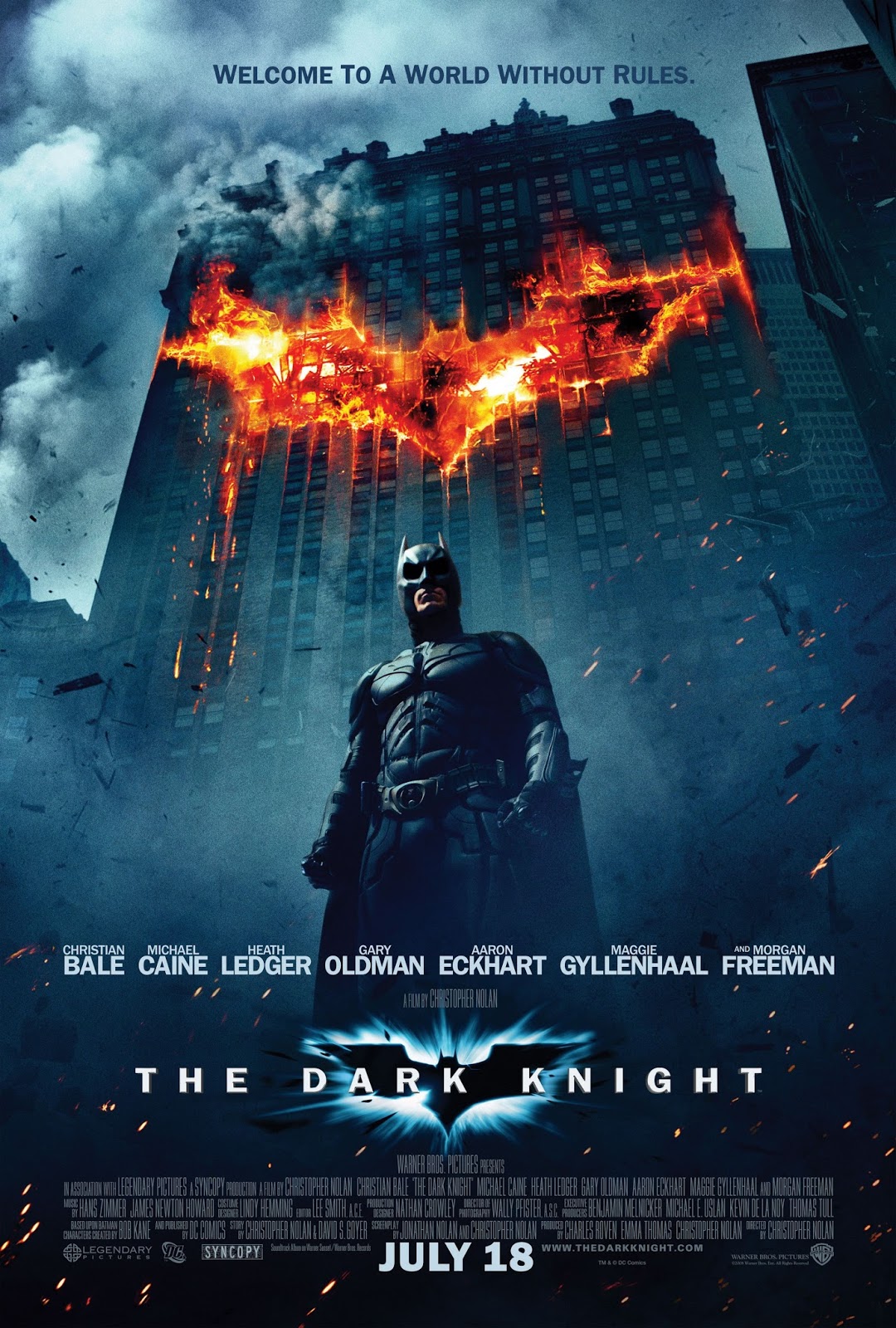
'The Dark Knight' Review


Nominated For: Best Supporting Actor; Heath Ledger, Best Cinematography, Best Film Editing, Best Art Direction, Best Makeup, Best Sound Editing, Best Sound Mixing, and Best Visual Effects. 
Won: Best Supporting Actor; Heath Ledger and Best Sound Editing.

The Dark Knight picks up after Batman Begins. Batman's tidied up the streets of Gotham, but Joker has arrived to wreck havoc and unleash chaos. The Dark Knight is the summit of Christopher Nolan's exceptional Dark Knight Trilogy, and what a glorious peak it is! In the Dark Knight Trilogy, Nolan continues to transcend the superhero genre with a hyper-realized take on the Batman including complex messages and themes that explore the very meaning of Batman and Joker's ideologies. 
Nolan again takes up the responsibility of directing in addition to writing the screenplay alongside his brother Jonathan Nolan and working on the story with David Goyer. The trio craft a story that brings out an interesting message that darkness is hidden within all of us and that even the best of us can steep into darkness if molded correctly. Nolan, cinematographer Wally Pfizer,  and editor Lee Smith brilliantly fabricate suspense, raise tension prior to big twists and turns, and the gorgeous scenery is all cut together seamlessly. 
The practicality Nolan focused on in Batman Begins continues as he introduces the Bat-Pod, a new vehicle in Batman's arsenal, and plenty of new gadgets for his utility belt. The practicality help make the action sequences more exhilarating and believable as they are marvelous to watch. Other remarkable technical elements include the costuming, makeup, and visual effects that look phenomenal. The Dark Knight not only look great but sounds awesome as well thanks to a tremendous score composed by Hans Zimmer and James Newton Howard. 
Even better are the performances with Christian Bale once again delivering a solid dual-portrayal of billionaire Bruce Wayne and vigilante Batman. Michael Caine and Morgan Freeman are both great as Alfred Pennyworth and Lucius Fox respectively. Gary Oldman remains to be a terrific Jim Gordon and this time around gets to delve into some more emotional ground. 
Maggie Gyllenhaal's Rachel is an improvement over Katie Holmes' depiction, serving less as a damsel in distress, but an important character in this story relative to her relationship with Bruce Wayne. 
Aaron Eckhart's Harvey Dent is commonly overlooked, but his performance is truly something! Eckhart is a bright spot of the trilogy as we see him morph into Two-Face and watch his descent into darkness, proving the best of humanity can be corrupted.
Heath Ledger brings the best depiction of the Joker onscreen, as a brilliant strategist intent on unleashing hell and anarchy to prove his point. It's tragic that Ledger died shortly after, as the role took it's toll on him and caused him to eventually overdose, considering it's one of the best villainous performances in recent memory. The entire cast deliver in spades and beyond in some cases.
In summary, The Dark Knight is a cinematic masterpiece thanks to technical precision, talent in-front-of and behind-the-camera, a rousing score, and an intelligent story with sophisticated themes about the truth of humanity. The Dark Knight is easily one of the best comic book films-to-date. 


Film Assessment: A+

Friday, February 19, 2016

Throwback Thursday Review: 'Batman Begins'

Sorry for the delayed review but this week I'm beginning my series of Throwback Thursday Reviews of the Dark Knight Trilogy. I'm spreading these reviews throughout the year given the release of some new DC Comic Films of both Batman v Superman: Dawn of Justice and Suicide Squad. My main Throwback Thursday Review that will come the week Batman V. Superman: Dawn Of Justice is released will be Man Of Steel, since it's both a Superman origin and the only film in DC's current cinematic universe. However I wanted to do both a Batman origin film as well as review the Dark Knight Trilogy this year so I figured Batman Begins was a great compromise. The reason this review is coming this week as opposed to closer to Batman V. Superman: Dawn Of Justice's release is that from this week onward my schedule is booked for Throwback Thursday Reviews till August.

'Batman Begins' Review


Nominated For: Best Cinematography.

Batman Begins is the foundation for Christopher Nolan's brilliant Dark Knight Trilogy, and a rather solid foundation if ever there was one. Nolan broke ground for superhero films by being the first to take one completely seriously with a very realistic, grounded take on the Caped Crusader's origin story.
Christopher Nolan takes up the duties of director in addition to penning the script alongside  David Goyer, deciding to focus on character and story rather than spectacle going to the roots of the Batman and it's a wise decision. Nolan also makes the choice to utilize practical effects rather than CGI that leads to more authentic action sequences.
This practicality also oozes over in regards to Batman's arsenal gadgets and this version of the bat mobile, the Tumbler, that's more along the lines of a tank. I feel that the practical gadgets make perfect sense and love the explanation behind each trinket that Batman carries along with him. I also liked their use and purpose in various action sequences and felt that they certainly service the film.
One notable action sequence features the Tumbler abandoning the roads and resorting to jumping over rooftops as Batman is being frantically pursued by the authorities, and it was incredible.
Now, with that being said, this film does indeed have a few hiccups with a bit of lackluster action at times, but the film makes up for all with a phenomenal character-focused narrative. Another key piece to Nolan's larger puzzle are the performances being showcased.
Front and center we have Christian Bale as Bruce Wayne and I felt he is certainly serviceable in the duality of the role, bringing both a suave Wayne and an edgy Batman. Now, many critics are a little harsh on Bale's "Batman voice," which sounds like more of a growl, but it makes logical sense to me that Wayne would need to disguise his voice to avoid being recognize in his escapades.
Also, the film makes a point to establish that this version of Wayne uses the playboy persona as more of a mask rather than the cowl itself, and I liked that concept and how it's developed across the course of the Trilogy.
The film's supporting cast are where the performances are just exceptional. Michael Caine brings new depths to Alfred showing that Wayne's butler is not only concerned with Bruce's safety but protecting the Wayne legacy as well. Caine is exceptional in the role as a phenomenal casting choice.
Morgan Freeman portrays Lucius Fox and his character is given more prominence than ever before in any adaptation, where it's explained Fox supplies the gadgets to Wayne and Freeman is phenomenal as per usual.
Now, Gary Oldman was the perfect match for Jim Gordon as he not only shared a physical resemblance to the cop, but also the emotional core of the character.
Katie Holmes plays the main love interest for Wayne as Rachel Dawes, and sadly is of little use to the story, only to serve at the damsel of distress in some of the darkest moments. Holmes is decent in the role, but you'll see she's easily replaced for the sequel.
In regards to villains, the film holds an ace up it's sleeve with Liam Neeson by hiding his true importance for most of the film, but the reveal of who he's playing is quite satisfying. Neeson acts as a great mentor and opposition to Wayne that's integral to the film and later brings the narrative full circle in the closing act of the Dark Knight Trilogy.
Cillian Murphy brings the first live action version of the Scarecrow to the screen, and oh, boy is he terrifying. Murphy plays second fiddle to the main antagonist but is terrific when utilized.
Christopher Nolan's interpretation of the Caped Crusader is really one of the greatest superhero origin stories to be told, that serviced the source material while making it accessible to the mainstream public.

Film Assessment: A-