Showing posts with label Amanda Seyfried. Show all posts

Sunday, December 6, 2020

'Mank' Review

It's been quite a few months since I've written and shared a review. In that time, I started a new job and now have a little less free time on my hands for writing. However, I'd like to get back on track soon and felt reviewing David Fincher's latest film from Netflix would be a fine place to start. In the coming weeks, I'll share Reel Recaps for everything I watched before Mank that I haven't already reviewed this year, as well as standalone reviews for other recent releases. I'd like to be caught up by New Year's Eve, so I can piece together a proper Top 10 list celebrating my favorite films of the year as usual. This year, the number of 2020 movies I've seen is noticeably lacking due to movie theaters' current state. However, there are plenty of films that debuted on streaming platforms I'd like to cram in. 

'Mank' Review


Nominated For: Best Picture, Best Director; David Fincher, Best Actor; Gary Oldman, Best Supporting Actress; Amanda Seyfried, Best Cinematography, Best Costume Design, Best Makeup and Hairstyling, Best Production Design, Best Sound, and Best Original Score.
Won: Best Cinematography and Best Production Design.

Synopsis: A scathing social critique of 1930s Hollywood through the eyes of alcoholic screenwriter Herman J. Mankiewicz as he races to finish the screenplay of Citizen Kane.

Runtime: 131 minutes

MPAA Rating: R (for some language)

Who should see it? Film fans enamored with early Hollywood and the real-life influences on Citizen Kane.
It has been nearly eighty years since the release of Citizen Kane, and the film is still held in high regard as one of the greatest motion pictures ever made for how it revolutionized cinema. With his eleventh feature, acclaimed filmmaker David Fincher realized his late father Jack Fincher's screenplay to shed new light on the mastermind behind said masterpiece. That said, it's important to note that Mank isn't strictly about the making of Citizen Kane, ala The Disaster Artist. Mank revolves around Herman J. Mankiewicz as he reflects on touchstone moments throughout his career, which now pervade his script. Before watching Mank, I suggest doing a little cursory research.
In preparation for Mank, I covered some glaring blindspots by finally watching the coveted Citizen Kane in addition to much of Fincher's filmography. While seeing Citizen Kane beforehand isn't essential to grasp Mank's story, it certainly enhanced my viewing experience. Plus, it never hurts to indulge in experiencing a classic for the first time! But one thing missing from my repertoire was a full understanding of 1930s Hollywood. Again, this isn't required by any means. But you'll get more out of Mank if you're more accustomed to the politics and key players of the period. Individuals worth googling include William Randolph Hearst, Marion Davies, Louis B. Mayer, Irving G. Thalberg, Upton Sinclair, and Orson Welles. Fincher offers enough subtext for viewers to piece things together and get the big picture, but I'm sure I'll takeaway more when I revisit Mank now that I possess more than a passing familiarity with these names.  
On a technical level, Mank is astounding. Considered to be an obsessive perfectionist by many, Fincher transports audiences to yesteryear by replicating the look and sound of early motion pictures, complete with all the era's trademark quirks. Mank is littered with cue marks and slow fades, filmed in black and white, and boasts the soundscape of an old talkie. A few visual effects involving animals don't hold up to the scrutiny of today's standards, but they're brief. Of course, I must give credit where it's due to the crew members who successfully recreated the rough-around-the-edges glamour of early Hollywood pictures. A job well done by Fincher's longtime sound designer and supervisor Ren Klyce, cinematographer Erik Messerschmidt, the costumers, production designers, and set decorators. And I couldn't dare forget the spellbinding score from the Oscar-winning composers Trent Reznor and Atticus Ross. 
While Mank is not solely about the making of Citizen Kane, the two films will forever be intertwined. It's befitting that a movie about the screenwriter of Citizen Kane would employ a similar story structure to examine its protagonist. As reporter Jerry Thompson relentlessly sought to unravel the significance of Kane's final words, Jack Fincher is equally fascinated in determining how a life of alcoholism and rocky Hollywood career lead a washed-up screenwriter to pen his magnum opus. Where Citizen Kane's flashbacks were told from the supporting cast's point-of-view to offer a comprehensive look at Kane's life, flashbacks in Mank do the opposite. Mankiewicz's point-of-view fills in the dimension and context of those same supporting characters' real-life inspiration.  It's worth remembering that Mankiewicz is meant to be an unreliable narrator since he's an alcoholic, so the depictions of these key figures are heavily skewed.
In the titular role, Gary Oldman is incredible as Herman Mankiewicz. Oldman's proven himself time-and-time again to be a chameleon onscreen, and this outing is no exception. Acting intoxicated is a slippery slope, but Oldman managed to do so in a way that didn't come off as cartoonish. Oldman's depiction of a drunk is imbued with enough nuances for viewers to sense the broken soul and crisis of conscience bubbling beneath the surface. Opposite Oldman, Amanda Seyfried and Lily Collins are delightful as the spirited actress Marion Davies and Mank's kind secretary Rita Alexander. The two share an endearing friendship with Mank, which livened the proceedings and lent the film its heart. 
 
Chief among the supporting cast, Charles Dance is as impeccable as ever. Dance portrays William Randolph-Hurst as snide, gaudy, and pretentious. There's no mincing of words, as Game of Thrones fans are well aware of Dance's formidable screen presence. Other noteworthy performances include Tom Burke as Orson Welles and Tom Pelphrey as Herman's brother, Joseph Mankiewicz. The remainder of the cast is uniformly good. But I must say I was taken aback to discover the actor cast as Upton Sinclair as I watched the film (I think it's best left a surprise, so I'll leave it at that).
In the wake of COVID-19, time's are a-changing, and so is film distribution. It's almost ironic that a film so indebted to traditional filmmaking techniques is debuting on a streamer. Nevertheless, Netflix offers a degree of creative freedom almost unheard of nowadays, so it's understandable Fincher would be enticed to partner with the studio (especially after successful collaborations such as Mindhunter and House of Cards). So no, Mank is not jank, rank, and it certainly doesn't stank. Fincher's latest feature harkens back to the culture of Hollywood's Golden Age not with dreamy eyes but disdainful scrutiny. Mank can best be described as an old fashioned motion picture that's actually kind of dank (cool).

Film Assessment: A-

Saturday, July 21, 2018

'Mamma Mia! Here We Go Again' Review

Mamma Mia! Here We Go Again fluctuates between the lives of Donna circa 1979 and her daughter Sophie in the present day to intertwine two tales and show how relationships formed in the past resonate in the present. Determined to live out her mother's dream, Sophie prepares for the grand re-opening of her hotel the Bella Donna with the guidance of her mother's friends. As she becomes overwhelmed by the daunting tasks, Sophie learns more about Donna's past as she discovers how she ran the hotel, met each of Sophie's dads, and raised a baby all on her own.
Written and directed by Ol Parker, Mamma Mia! Here We Go Again is a prequel/sequel to the decade-old jukebox musical motion-picture, Mamma Mia!. Story writing credits go to Parker, Richard Curtis, and Catherine Johnson (a writer/producer on the first film), but I noticed Here We Go Again's storytelling structure seems to have been inspired by The Godfather Part II. The film cuts between timelines on a dime which occasionally allows for some creative transitions, but there were also several switches that were just jarring, unnecessary, and awkward in execution. This decision to split the screentime between these two storylines is an interesting one, but ultimately the fractured focus holds each narrative from reaching its full potential. The audience is then left with a half-baked musical memoir. 
I'm sure some of you are already upset that I'd dare critique the plot of a musical because "that's not the point," but I can rattle off plenty of marvelous movie musicals with both a quality story and incredible music. La La Land, Sing Street, Into The Woods, Les Misérables, Enchanted, West Side Story, Phantom of the Opera, Oliver!, Singing' in the Rain, The Sound of Music, The Wizard of Oz, and most Disney productions. I could go on, but I won't for the sake of length. I'm actually getting war flashbacks to December when I was unimpressed with The Greatest Showman and am already aware this will likely be a contested review as well, but I don't really care because I feel like I need to share my genuine opinion on things rather than conform to what others deem to be appropriate. There's not really a way around it... Mamma Mia! Here We Go Again is a lackluster sequel and mediocre musical in nearly every way imaginable.
As I've already addressed, the story's stretched thin by the decision to tell a story on two fronts. There's somehow even less of a plot holding this thing together than the first film, no regard for continuity, and some baffling choices were made as to how to best progress the series (I presume there will be an unnecessary third installment as well). While I certainly enjoyed the first two-thirds for the most part due to some energetic, entertaining musical numbers, the third act lost all momentum and dragged so much. It was only an hour and fifty four minutes, but towards the end I kept thinking to myself "when is this going to end?..." It seriously felt like I was watching a three hour film because the energy and sense of pacing completely disappeared. At that point, it was torturous to say the least... but I'll get to that momentarily... Just be patient and remember that this is coming from someone who LIKES musicals... 
One story element that was handled quite distastefully was Donna's trio of romantic entanglements. Here We Go Again was already put in a tough spot when it decided to depict this because the first film dictated that these encounters happened within quick succession of one another. Otherwise, Donna would have immediately known who Sophie's father was. However, Donna basically slept with each guy after a quick musical number and you didn't really buy the chemistry between the actors because everything happened so fast... Next thing you know, she's moved on. There didn't seem to be much effort being made to flesh out the relationships whatsoever. To me, it really painted Donna in a bad light and I wish I could have bought into the bonds being formed between Donna and the three men. 
If Here We Go Again got one thing right though, it was casting Lily James as a young Donna. Between this, Cinderella (2015), and Baby Driver, James has proven herself to be a captivating, charismatic screen presence and I'd love to see her as a female lead in more musicals. She has the looks, an exceptional singing voice, and a genuinely uplifting aura. She wound up being a great stand-in for Meryl Streep in a weird way as well, but more on that in a moment...
Alongside Lily as younger versions of characters from the first film are Jessica Keenan Wynn, Alexa Davies, Jeremy Irvine, Josh Dylan, and Hugh Skinner. They play young Tanya, Rosie, Sam, Bill, and Harry respectively, but each actor did an excellent job channeling the persona and mannerisms of the older actor while making the role their own.
Meanwhile, returning cast members Amanda Seyfried, Christine Baranski, Julie Walters, Pierce Brosnan, Stellan Skarsgård, Colin Firth, and Dominic Cooper do a swell job reprising their respective roles. None of them are really given any substantial material outside of Seyfried, but their presence definitely won't go unnoticed either.
You can't really write a review of a film which stars Meryl Streep without addressing her whatsoever, and I've gotta say she was is in like two scenes at most. There really wasn't much of a legitimate reason for her conspicuous absence either... The actress is still alive, so you think a film banking on her name would want to make the most of her, but they really wasted her to be completely honest. I'm guessing it was to keep the budget down because I presume she commands a big paycheck and they didn't want to pay her an unreasonable amount. 
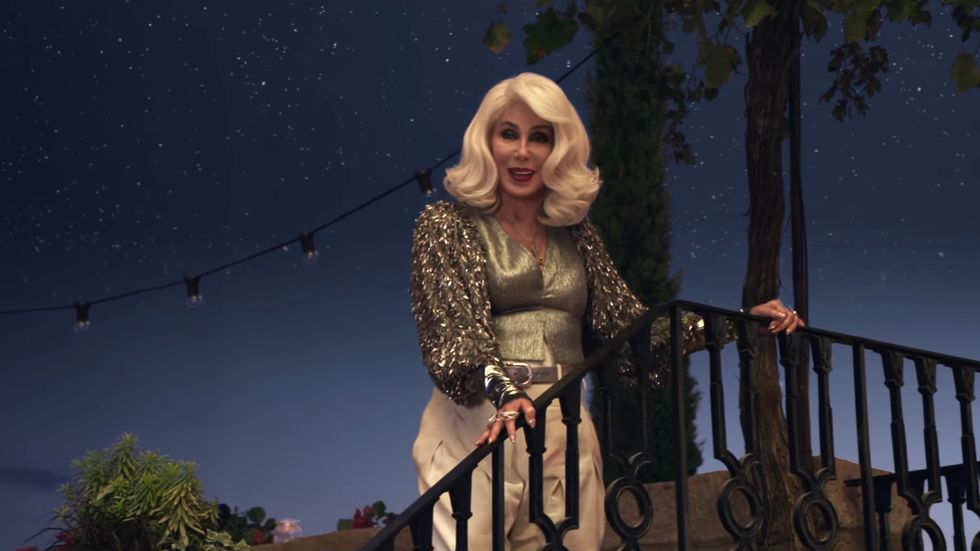
I try not to be overly negative, but there's no polite way to get around the fact that Cher sounded god-awful in this. Like I'm pretty positive my ears got some form of cancer after listening to her... I was baffled at how such a beloved pop singer could sound so terrible. I guess it makes sense that she's basically a has-been now... To make matters worse, her role had absolutely no bearing on the plot and was clearly written with the intention of shoe-horning a cameo appearance for Cher. My entire family agreed that she sounded terrible, so it wasn't just me either. 
To put it simply, Here We Go Again is a disappointing follow-up to a feel-good musical. There are some bright spots, but not even more ABBA could save this thing from its sealed fate as an inferior sequel. I realize it's called Mamma Mia! Here We Go Again, but Mamma Mia! Let's Please Never Do This Again would have been a more fitting title. 

Film Assessment: C+

Throwback Thursday Review: 'Mamma Mia!'

Sorry for the slight delay, but I decided to share two Throwback Thursday Reviews this week since there are two major sequels being released this weekend. I've also decided to go ahead and share the post recapping my best and worst films of the year so far on Sunday regardless of whether I finish watching the films I missed out on or not. Later this weekend, you can expect my Throwback Thursday Review of The Equalizer as well as my reviews of Mamma Mia! Here We Go Again, The Equalizer 2, and You Were Never Really Here. Next week, I aim to review Teen Titans Go! To The Movies and complete my Mission: Impossible series of reviews with reviews for Mission: Impossible - Ghost Protocol, Mission: Impossible - Rogue Nation, and the upcoming Mission: Impossible - Fallout.

'Mamma Mia!' Review


Mamma Mia! follows an independent, single hotel owner in the Greek islands as she prepares for her daughter's wedding with the help of her two old friends. Meanwhile, the spirited bride-to-be secretly invites three men from her mother's past in hopes of finding her real father and having him escort her down the aisle on her big day.
Based on a 1999 stage musical, Mamma Mia! is a jukebox movie musical directed by Phyllinda Lloyd and written by Catherine Johnson which revolves almost entirely around songs from the renowned pop group ABBA. I'd previously seen bits and pieces of Mamma Mia! in passing (largely because my youngest sister is OBSESSED with it), but this was my first time to watch it from start-to-finish. As a fan of musicals, I went in hoping to at least be charmed by the renditions of ABBA's delightfully catchy show tunes, but that of course proved to be an inevitable outcome.
Given the irresistibly upbeat nature of their music, it's difficult not to be won over by this whimsical musical in a matter of minutes. It's silly for sure, but in an endearing way. There's a peppiness that permeates from the ensemble and their insatiable delight at the opportunity to groove to ABBA. On that note, it's remarkable how coherent the plot turned out when you consider that it essentially just stitched several ABBA songs together to tell a story.
With that being said, it's an interesting premise that runs out of steam from a narrative perspective. The mystery of which man is Sophie's father is quite compelling, but that gets thrown out the window towards the end and my interest began to wane as a result. At that point, the music is no longer driven by the story and all the song-and-dance numbers turn into surface level celebration. It may be pure, harmless fun, but it suddenly becomes devoid of any substance.  
Otherwise, the lighting was wildly inconsistent between shots and it drove me absolutely insane... I wish Lloyd and her cinematographer Haris Zambarloukos had simply settled on a constant aesthetic. I will however concede that the choreography was flashy and well-done, the island made for an effective luscious backdrop, and the ADR and sound mix were fairly decent. The singing from the cast also wasn't half-bad either, ranging from mediocre-to-pretty good. 
The all-star ensemble amassed are really the film's saving grace though. Meryl Streep and Amanda Seyfried sell their mother-daughter dynamic and are able to service the script as best they can. Christine Baranski and Julie Walters are scene stealers as Donna's homegirls while Dominic Cooper is stuck on the sidelines as Sophie's choice fiancé.
Lastly, Pierce Brosnan, Colin Firth, and Stellan Skarsgård lend their respective personalities to Sophie's prospective fathers and are a hoot to watch. Brosnan was panned by critics for his singing abilities, but I actually don't think he was THAT bad... He at least matched pitch, so he was nowhere near being one of the worst singers I've ever heard or anything... His singing voice was just alright. Firth and Skarsgård both sung pretty well though. 
As far as feel-good musicals go, Mamma Mia! hits that sweet spot between being totally ridiculous and obnoxiously overbearing. Certainly not one of my favorite movie musicals, but a worthwhile watch nevertheless!

Film Assessment: B