Showing posts with label Mark Rylance. Show all posts

Friday, March 30, 2018

'Ready Player One' Review

Nominated For: Best Visual Effects. 

Set in the dystopian future of 2045, people escape the harsh realities of life by spending a majority of their time in the OASIS, a vast virtual reality invented by the brilliant and eccentric entrepreneur James Halliday. Inside the OASIS, anything is possible. Users are able to endlessly customize their avatars and unlock unique items to help them in their quests. The only limit is your imagination. However, once Halliday dies, it's revealed to the world that he's hidden an Easter egg inside the OASIS that will grant the finder full ownership of the game in addition to Halliday's massive fortune. Ready Player One accompanies the unlikely young hero Wade Watts as he races against time and other users of the OASIS to locate all three keys left behind by Halliday so he can unlock the highly sought-after Easter egg. 
Functioning as Steven Spielberg's triumphant return to the big budget blockbuster, Ready Player One is helmed by the beloved director and features a screenplay co-penned by Zak Penn and Ernest Cline which adapts Cline's best selling novel. It's hard not to be ecstatic for a new Spielberg movie so, of course, I was overly enthusiastic going into Ready Player One. We don't get too many flicks from Spielberg these days, and I know there will inevitably be a tragic time where we never see another, so I relish in whatever he has to offer, whether it be The Post or The BFG. Where Steven Spielberg's career of-late has mostly pertained to dramas, Ready Player One presented itself as an opportunity for the genius filmmaker to get in touch with his blockbuster roots, and that idea alone excited me very much. 
I haven't read Cline's novel, but I was well aware there would be a heavy emphasis on '80s pop-culture due to the film's marketing material. On the surface, Ready Player One may look like a candy-coated nostalgia fest, but I can assure you the references are incorporated tastefully and there's an in-universe reason for it all. It's actually quite fitting that a film about a hidden Easter egg would be crammed full of them and also be released on Easter weekend. I can assure you that's no coincidence. Geeks are sure to be giddy whenever they spot references to a character, weapon, location, or vehicle they recognize from their favorite video games or movies, but that's not the sole source of the film's whimsy. While many homages had me smiling ear-to-ear, I was ultimately engaged by the characters, the focal mystery, the breathtaking, fully-realized OASIS, an exceptional score from Alan Silvestri, and the sheer spectacle of it all. 
It's no secret that Spielberg knows how to handle an action sequence, so it then comes at no surprise that Ready Player One would be littered with instances invigorating activity. As a child of the late '90s, I missed out on seeing Spielberg's more noteworthy motion pictures in theaters. Therefore, I saw them at home plopped in front of the television screen and missed out on the complete cinematic experience one desires from a Spielberg production. For the last decade or so, Spielberg has made many well-crafted films that I've had the pleasure of seeing in the theater, but none of them really carried that trademark "Spielberg magic." Wednesday night, I watched Ready Player One in IMAX and felt the Spielbergian sense of awe and wonder for the first time in awhile. It was glorious, and well worth the price of admission. So much that I intend to see Ready Player One at least once more this weekend.
However, my enthusiasm going into Ready Player One was paired with a couple caveats. The first of which being that it would be an indulgent nostalgia parade. I've already touched on that, but another one of my concerns was that the overall design of the OASIS and the avatars looked very video game-ish and the shift from the OASIS-to-reality might be jarring. Fortunately, this proved not to be the case. While the aesthetic of the OASIS does certainly resemble the graphics found in a modern high-end video game, that's kind of the point. It's a virtual reality after all. With that being said, the visual effects are absolutely outstanding. The environment and avatars of the OASIS are richly rendered and exhibit a wide array of vibrant colors that are truly a treat for the eyes. Editors Sarah Broshar and Michael Kahn also ensured the transitions between worlds were smooth and managed to keep the flow of the movie at a lively pace. 
Where the film doesn't fully deliver is fleshing out the nuts and bolts of the real world. By design, the OASIS is infinitely more interesting than reality, so it's not a stretch to say humanity would become obsessed with this form of escapism. Just look around you for goodness sakes. Everyone's already addicted to the internet. The commentary on that addiction is Ready Player One's poignant truth and part of the reason Ready Player One should be seen aside from the aforementioned attributes. Anyways, it's easy to imagine something like the OASIS taking off in our own world so the futuristic dystopian society depicted doesn't require significant suspension of disbelief.
What becomes questionable under further scrutiny is how the evil IOI even operates. You vaguely understand the inner workings, but the legality remained fuzzy. This becomes most problematic at the end when the audience is shown something that suggests their activities weren't legal. This probably won't bother you if you can set logic aside, but it may drive others insane. I simply viewed it as an unclear area of this universe. Otherwise, strap in for an exciting ride!
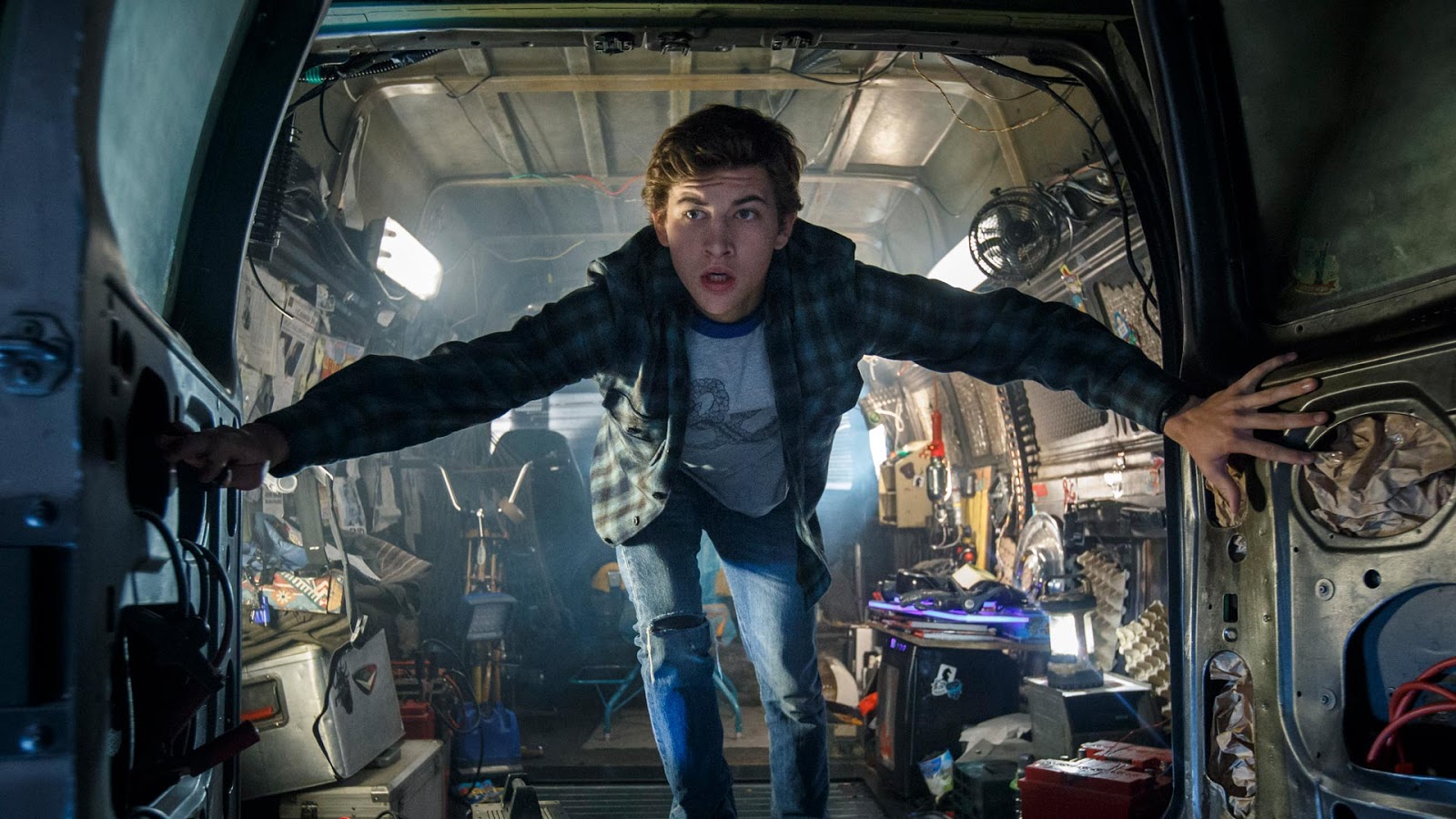
Leading said ride is Tye Sheridan as Wade Watts/Parzival (the second name being his OASIS username). Sheridan imbues Watts with traits one would expect from an unsure hero who's also a huge nerd, and he hit the sweet spot as an ideally awkward audience entry point. He's a likable lead, but never charming enough to upend his geek cred.
Opposite Sheridan, Olivia Cooke is the sure standout in the role of Samantha (also known as Art3mis in the OASIS). Cooke plays Art3mis as a stoic badass with some underlying insecurities, and seeing her eventually come to embrace those will undoubtedly inspire others as well. Sheridan and Cooke carry a captivating chemistry between them so their on-screen pairing was undoubtedly one of the film's highlights. Rounding out their friend group are Lena Waithe, Phillip Zhao, and Win Morisaki who were all equally endearing characters as Aech, Sho, and Daito respectively. 
Surrounding the young cast, veteran actors Mark Rylance, Simon Pegg, and Ben Mendelsohn leave substantial impressions in their varying roles of Halliday, Ogden Morrow, and Sorrento. Mark Rylance's good natured temperament and subdued personality lent itself well to Halliday and it's always a delight to see Simon Pegg in something! I'd rather not spoil his role for anyone, so I've decided to just skim right over it... Meanwhile, Mendelsohn made for an excellent antagonist and elevated what could have been a cliché corporate baddie to an intimidating force of evil.
Now let's be honest folks... Some of you are considering seeing Black Panther again this weekend, aren't you? Haven't you seen that enough by now? All jokes aside, Ready Player One currently isn't tracking very well for its opening weekend considering it's a Spielberg film (currently in the range of $52-55 M for the four day Easter weekend) and that saddens me. While that number's fairly high in comparison to everything Spielberg's made since Indiana Jones and The Kingdom of the Crystal SkullReady Player One honestly deserves better. If for nothing else, you should really be see Ready Player One on the biggest screen possible for the cinematic Spielberg experience. It's a celebration of pop-culture like no other and will be the most exhilarating Easter egg hunt you'll witness all weekend. 

Film Assessment: A-

Monday, July 24, 2017

'Dunkirk' Review

Nominated For: Best Picture, Best Director; Christopher Nolan, Best Film Editing, Best Cinematography, Best Production Design, Best Sound Editing, Best Sound Mixing, and Best Original Score.
Won: Best Film Editing, Best Sound Editing, and Best Sound Mixing.

The year is 1940 and Allied forces fighting in World War II have been driven back to the beaches of Dunkirk. The Germans have the British and French soldiers surrounded and the only hope of survival is an impossible escape. That's the dire circumstances our heroes find themselves in at the start of DunkirkDunkirk then depicts the attempted evacuation of over 300,000 men by land, sea, and air.
Dunkirk is written and directed by auteur filmmaker Christopher Nolan, a man whose work's powerful enough to speak for itself. You're probably familiar with Nolan's other highly regarded films such as InceptionInterstellar, and The Dark Knight Trilogy, but you may not know that Nolan has yet to be nominated in the category of "Best Director" at the annual Academy Awards, or even win an Oscar for that matter (although he's received nominations for Best Picture and Best Original Screenplay and his films have faired well in the technical categories with a number of wins). 
Well, that's all about to change because there's absolutely no way the Academy would dare snub his work displayed in Dunkirk. While we still have a ways to go in regards to awards season, and it's a little early to speculate, I have yet to see any formidable competition arise. Dunkirk marks Nolan's first foray into the war genre and his experience with a big budget and practical effects carried over quite nicely. Nolan is accustomed putting his own spin on all his productions, and Dunkirk is no exception because Dunkirk is unlike any war film I've ever seen.
In Dunkirk, emphasis is placed on the event rather than the characters. You don't get the opportunity to know these heroes because Nolan thrusts the audience straight into the ensuing chaos. Dunkirk represents a glimpse of the events "in-the-moment" and I must say, I was enraptured from the get-go. There's no time to sit around the fire and talk about what's waiting back home because this is a struggle-for-survival. Time is of the essence for these soldiers and nothing communicates that better than a ticking timepiece, which Hans Zimmer impressively embedded into his swirling, epic score. Nolan then ensures that everything ranging from shot composition-to-an actor's expression conveys a sense of urgency to match Zimmer's harmonic pulses and it all culminates in a heart-pounding pressure cooker.
Dunkirk is probably the most expensive and authentic recreation of said-evacuation that divides its focus among three interwoven chapters, despite the fact each takes place at a different point in time;

1. The Mole, One Week.
2. The Sea, One Day.    
3. The Air, One Hour.    

Eventually, all of these ongoing events overlap and there are certainly some interesting intersections which your eyes will be more attuned to after an initial viewing. You'll find yourself thinking "Haven't I seen that already?" upon realizing the chapter title cards signified the location and duration of each chapter. On that note, it's worth mention that the dictionary defines a mole as a large solid structure on a shore serving as a pier, breakwater, or causeway (but there's also an underlying double-meaning that you should be able to wrap your mind around if you pay enough attention).
Occasionally the same events are shown a second or third time from one of the other primary perspectives and in an ordinary war-film that might wear the viewer down. However, this is Nolan we're talking about, and only a director with Nolan's skill and attention to detail is capable of captivating audiences with an intense inter-weaving of three different accounts. Even though Nolan is depicting the same event three times from a different perspective, he manages to integrate an overwhelming intensity that carries over nicely when he transitions among the tri-arched chronology. 
The performances across the board are certainly good, but are admittedly handicapped by Nolan's narrative. Nolan extrapolates some exceptional acting from his cast but I'll be honest in saying I had a hard time pinpointing particular stand-outs. The acting is largely reactionary and while the actors' work is commendable, no single performer blew me away. Fionn Whitehead, Aneurin Barnard, and Harry Styles showcased a surprising amount of range as the soldiers headlining the mole chapter, but none of them aren't offered enough character exploration for you to be entirely invested in the men-at-arms. Nolan has gone on the record comparing the casting of Styles to his decision to have Heath Ledger portray the Joker, but I'll go ahead and set the record straight that his performance is good, but nowhere near the leagues of Ledger's legendary turn. Familiar faces consisting of Mark Rylance, Cillian Murphy, Kenneth Branagh, and James D'Arcy are also to be found among the ensemble and each actor carried their weight well.
Elsewhere, Tom Hardy once again finds his face obstructed by some sort of mask in Dunkirk and I did find it difficult to interpret exactly what he was saying on occasion. However, Hardy did a tremendous job expressing himself with essentially only his eyes. If you thought some frequent Nolan collaborators were missing from my breakdown of the performances, then listen carefully for Michael Caine's voice as it turns up once in the film's first act. 
Dunkirk is one of the year's most meticulously made movies that's undoubtedly elevated by the IMAX format. Nolan makes good use of the enormous screen's full aspect ratio and the spectacular sound design really explodes in IMAX's thunderous sound system. The heftier ticket price of an IMAX screening is certainly worth it and if you only plan on seeing Dunkirk only once, I'd go with the IMAX experience. However, the 70 MM print is also not to be missed for cinema enthusiasts as it was quite cool to see something projected on actual film opposed to the standard digital projection found in most theaters today. If you're curious, I saw Dunkirk in 70MM for my first go-around and my second viewing was in IMAX. I'd personally advise you to do the same because there's a lot you'll pick up on that you may not have noticed the first time around. But if you have to choose, pick IMAX.
In conclusion, Dunkirk is an exceptional example of why I found filmmaking so fascinating in the first place. In the hands of a less-capable artist, the events at Dunkirk would have probably come across as boring or generic, but Nolan's insistence to tell this story through unconventional means enables an intense, immersive experience you'd be hard-pressed to emulate or liken to anything else.

Film Assessment: A

Wednesday, July 6, 2016

'The BFG' Review

The BFG is an adaptation of the classic children's book The BFG written by Roald Dahl about a Big Friendly Giant (what BFG stands for) who frolics about at night collecting dreams from a magical tree and distributing them to the people of the world. One night, he accidentally catches the attention of a young orphan girl Sophie and kidnaps her to prevent her from blabbering on about a giant in the streets of London, fortunately she was taken by BFG as he's a kindred spirit and all of the other giants are brutish man-eating cannibals. The two quickly become friends and must devise a way to get rid of the villainous giants so that the BFG may carry out his life in serenity. 
That's the plot of The BFG in a nutshell, seems simple right? Well it is quite simple and I summarized it here because I don't feel the marketing material has done the best job of representing what the film is about, something reflected in The BFG's tragic abysmal box office performance last weekend. 
The one of a kind director Steven Spielberg directs the flick and teams with some of his favorite collaborators over the years including the brilliant composer John Williams who has scored a number of Spielberg's films, screenwriter Melissa Mathison who wrote the Spielberg classic E.T. The Extra-Terrestrial, and actor Mark Rylance who won an Oscar this year as a result of his work with Spielberg on last year's Bridge Of Spies and those names alone were enough to convince me to see The BFG given I had never heard of the story or read the book before. Spielberg elevates the source material of The BFG to heights I don't believe it could reach on the story's own merit creating an immersive world for families to explore that's both straightforward and goodnatured. 
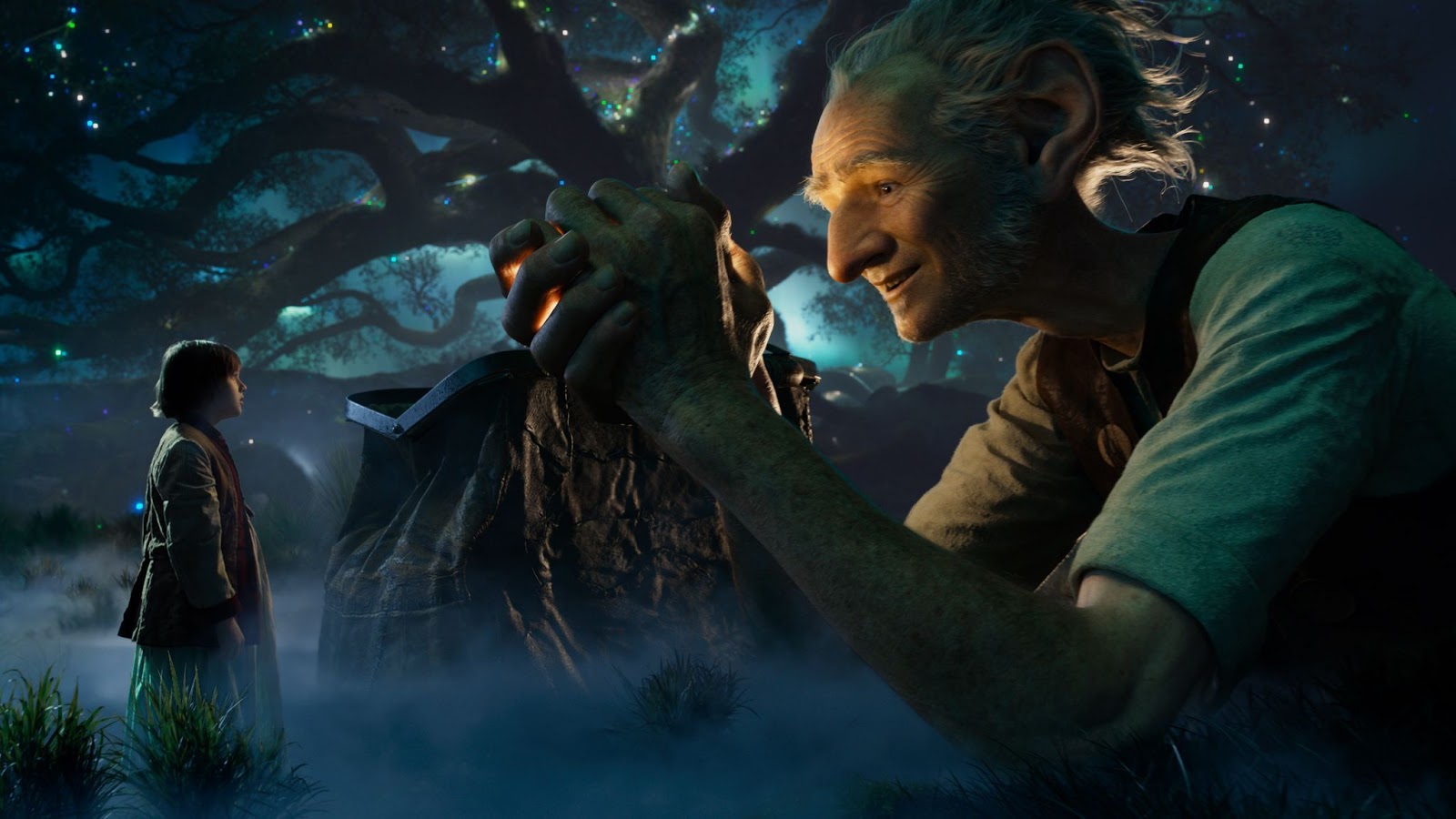
Spielberg and cinematographer Januz Kaminski have plenty of fun depicting the giants as they takes ordinary objects and makes them miniature decor for the BFG and the Spielberg fills the gaps of logic as to why the BFG has never been discovered with simple visual imagery, lingering on subtle moments such as the water washing away the BFG's footprint in the sand or the BFG disguising himself to blend in with the darkness as he embarks at night. Spielberg's vision is greatly assisted by the masterful visual effects work as Spielberg once again brings feelings of wonderment and awe with the look of the "dreams" and Giant Country. 
There were moments when I couldn't decipher which set pieces were rendered by visual effects artists or tangibly there. For example, the streets of London were either animated to look like London or constructed to appear as a slight caricature of London. To describe the visual effects, I would have to say that the character design is a happy medium to the marvelous realism of this year's The Jungle Book and the somewhat cartoonish yet real video game aesthetic seen to portray the orcs in this year's Warcraft
That may sound a bit strange, but it works as the the BFG actually looks like the splitting image of Mark Rylance with some exaggerated features, the cartoonish demeanor I was referring to. The other mean spirited giants also get the same treatment and certainly look menacing but are all flat one dimensional "bad guys", they all have generic malevolent names but beyond that just bully the BFG so don't be surprised if I don't bring them up again as they weren't particularly memorable antagonists but a nice fit for a simple children's story. And on that note, the film's greatest weakness is it's story. 
The screenplay penned by Melissa Mathison probably wasn't altered after she unfortunately lost her battle with cancer last year and I don't think Spielberg was in the wrong for choosing to not make alterations to the script and let her last work ring on, but on that same note I'm unsure that this was her finished product as there's a few unnecessary sequences that make the film drag on and seem a tad boring. 
The film also has the shortest anti-climactic ending where everything is conveniently resolved in a matter of ten minutes. While there are moments in Mathison's script that evoke warm feelings, I don't believe it measures up to her previous work on E.T. I'm unsure if the lackluster story is a result of the source material itself, given I've never read it, or lies in Spielberg's compulsion to honor both Roald Dahl and Mathison's work. Elsewhere, the film features a new score from composer John Williams, a rare treat these days, and I can say it does a great job instilling feelings of awe and wonderment as Sophie and the audience are introduced to Giant Country. 
The sense of awe is only intensified by the film's cast lead by child actor Ruby Barnhill as the spunky orphan Sophie and Mark Rylance as The Big Friendly Giant. Barnhill delivers a wonderful child performance she had to act opposite plenty of green screens to bring the giants to life and she makes the world and magic that much more convincing. 
Rylance brings a lovable demeanor and gravitas to the BFG through voice work and motion capture that's quite different from his award winning role in Bridge of Spies and breaks out of what I was expecting to be derivative characteristics he would carry forth to all his roles. Rylance nails the "Giant Speak" and mannerisms you would expect from an excessively large humanoid and thanks to motion capture ensures his subtle facial expressions are carried forth to inject heart into the large creature. At it's core the film succeeds thanks to the unbelievably charming kindred friendship between Rylance and Barnhill. I was amazed at how well the young actress acted opposite an Academy Award winner and can't wait to see what projects she will take part in next! 
There's not too much of a cast in the film though with supporting players introduced in the final act including Penelope Wilton as the Queen, Rebecca Hall and Rafe Spall as Mary and Mr. Tibbs, respective servants to her Majesty. As I said earlier, the other giants aren't particularly worth mentioning as they're purely one-dimensional bullies, but Jermaine Clement's Fleshlumpeater is the best of the bunch. 
When it comes down to it though, The BFG is technically astounding, but fails to captivate interest in its lackadaisical storyThe BFG may not be Spielberg's greatest work, but it's charming worthwhile family friendly entertainment that's hard to come by these days that I think children will love and adults will be pleasantly surprised by thanks to gorgeous visual imagery, fantastic direction, a magical score, and some truly wonderful performances. 


Film Assessment: B-