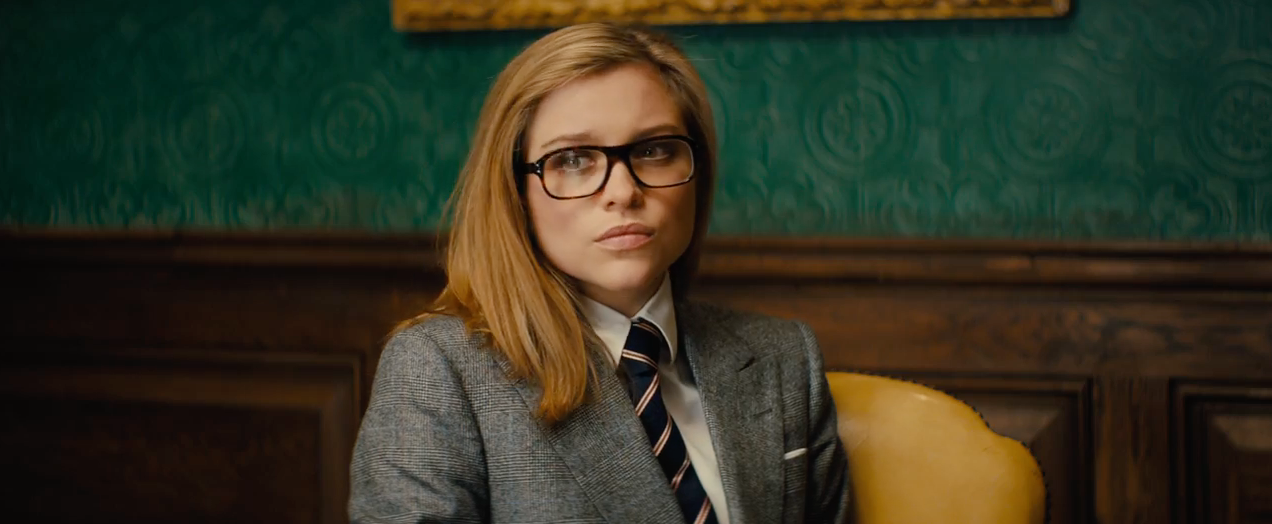
Tuesday, November 28, 2017

'Kingsman: The Golden Circle' Review

I was surprised to see how divisive this movie wound up being (currently standing with a 51% Rotten Tomatoes score), so I'm going to have spoiler areas to discuss some specifics in more detail. There will be clear spoiler warnings to mark these as a means of forewarning those who've yet to watch Kingsman: The Golden Circle.

[This review was originally written in September 2017 and is now being published to coincide with the digital home media release. For an explanation of this, visit my Fall 2017 Important Update post.] 

Kingsman: The Golden Circle revolves around Eggsy approximately a year after the events of The Secret Service. When disaster strikes Kingsman headquarters in the form of an egomaniacal drug lord named Poppy, Eggsy and the remnants of Kingsman must align themselves with their American cousins in order to save the world once more. 
Matthew Vaughn circled back to write and direct the spy sequel, once again receiving some assistance in the screenplay department from Jane Goldman. Since The Golden Circle managed to wrangle together much of the same behind-the-camera talent from The Secret Service, I was hoping the sequel might be able to stand toe-to-toe with the fantastic first film. Unfortunately, that wasn't necessarily the case. Instead, I was quite shocked to see The Golden Circle face such a mostly-mixed critical reception. While I don't agree with the general consensus, I can certainly concede that The Golden Circle wasn't quite as great as The Secret Service.
However, I don't think a sequel succeeds simply by surpassing the original. While that is the ideal scenario, it's an uncommon occurrence. When I see an action-packed blockbuster sequel, I hope to to be entertained and I felt Kingsman: The Golden Circle flourished in that regard. I first saw the film in an early screening, as a part of my fall internship, and enjoyed it enough to then pay and see it a second time in IMAX opening weekend. Trust me when I say it doesn't happen too terribly often that I watch something more than once the same week of release. 
Any-who, on a technical level The Golden Circle is superbly shot, exceptionally edited, and the film moves at a fun, brisk pace. The one downfall is that the visual effects work in the CG-reliant action sequences aren't always up to snuff; but even at their worst, the effects are still sufficient and not too distracting. Meanwhile, Vaughn doubles down on his stylized sensibilities this time around, injecting a frenetic vitality into every second of action fueled by an upbeat soundtrack. Even though The Golden Circle's action sequences never quite measure up to the church massacre sequence from the first, the film has an exuberant opening car chase and the insanity goes full throttle from that point on with a bonkers buckaroo bar brawl, a spellbinding shootout, and an insane all-out assault to cap things off. 
One of the common complaints regarding The Golden Circle was that the sequel was too far-fetched. To those griping, I ask this "Did you not watch The Secret Service?" For me, absurdity has seemed to be the whole point of this franchise. The Secret Service kept itself in a relatively restricted reality that progressively loosened the confines of this fictional world till there no longer were any confines. At the start of The Golden Circle, the can of worms has already been opened as we'd seen the glorious church massacre and the hosts of exploding heads. It's difficult for me to imagine The Golden Circle would then regress backwards to sensible surroundings, especially when you take into account that this franchise is inspired by classic Bond, with this installment tipping its cap to Roger Moore in particular.
So yes, this film gets absurd at times and I think that's perfectly okay. I'm not expecting a movie about international spies to remain grounded from start-to-finish, especially since the franchise is based off a comic book. In the case of Kingsman, I excuse the ridiculousness because I'm invested in the characters and the action commanded my attention. In regards to the story itself, Vaughn and Goldman do a swell job tying up loose threads from the first, advancing the plot, and simultaneously laying the groundwork for promising possibilities later on down the road. Vaughn and Goldman make an interesting addition to the world of Kingsman in the form of the Statesman. The American spin on the Kingsman agency allow for plenty of laughs and are an interesting expansion on the global intelligence community, but the plot does sometimes suffer from their inclusion.
While I think Vaughn and Goldman succeeded in progressing with a fun, outlandish spy venture, The Golden Circle does sometimes suffer from feeling too formulaic at times. This is largely because the villain is another eccentric antagonist with a henchman who has a weaponized appendage and a plan involving the sale/distribution of some product that will spell doom for many. The parallels are then made abundantly clear by countless call-backs to the original. However, these references found a nice, natural niche in the narrative rather than coming across as forced. 

**Spoiler Warning**

In particular, I actually liked how Eggsy wound up in a committed relationship with Tilde, the Swedish princess from the first film. The relationship took me aback, because I didn't realize they'd be carrying forward with that plot point, but I like how it distances Eggsy from Bond. Where Bond typically moves on from his woman without a second thought, Eggsy's actually interested in forming and maintaining a romantic relationship. I found that to be a nice twist on the traditional gentleman spy archetype and was glad they incorporated it into the plot.
As for my problems, I wasn't a fan of the way Roxy quickly got one-offed and how it was just brushed over. I'm guessing this was done because Vaughn wanted to loop in the Statesman and bring back Harry, but I think they could have still made it work. It's not like many of the Statesman had much to do either, considering Channing Tatum, Jeff Bridges, and Halle Berry had relatively reduced roles in comparison to how the Statesman were being thrown around in the marketing for The Golden Circle. Who knows though? Roxy could turn out to have somehow miraculously survived in the next one! For the time being, I'm a bit bothered by it though...
When it comes to the return of Harry Hart, I found the explanation for his survival to be quite convenient. The Statesman just so happened to arrive right after he was shot in the face and have an "alpha gel" that was able to repair any damage. I suppose it works for the purposes of quickly explaining how he's alive, but I'm still not sure it was entirely necessary for his character to come back to begin with. I wasn't opposed to seeing him reappear per say, but I felt they could have dedicated his screen time towards some of the underutilized characters I just mentioned or at least come up with a better explanation for his return. Otherwise, I was happy enough to see him back in the mix.
I thought it was intriguing they took one of the top agents of Kingsman and subverted audience expectations by making him clumsy and unrefined after recovering from amnesia. On the subject of amnesia, I liked how it took time for Harry to recall everything as opposed to healing immediately. I think many people are wondering where the heck the whole butterfly thing came from, but the idea Harry's interested by butterflies is planted in the original. When Eggsy's visiting Harry's home, there are MANY butterflies decorating the wall so it's not like the lepidopterist subplot came out of nowhere. My one issue with his character though, was that he seemed to become a proficient agent again just before the third act without much explanation. If they hadn't devoted so much screen time to explaining his return and recovery, I probably wouldn't have been as bothered, but it just came across as sloppy, storytelling to me.
Another thing that bothered me was a subplot shoehorned into the story seemingly for the sake of ridiculing Donald Trump. It's not that I'm bothered by mockery of Trump, considering I see it on a daily basis all over social media, but I didn't feel the political agenda warranted its place in this movie. I'd understand if the entire plot had political undertones and it serviced the storyline, but that's not really the case and it just stood to bloat the film's running time. Although, I suppose Vaughn felt he had to make it up to Democratic audiences for blowing up Obama's head in the last one. 
Then there's one scene that I'm sure will be controversial where Eggsy has to seduce a girl in order for them to locate Poppy and find a cure to the Blue Rash. It's rather risqué to say the least, but stands in accordance with one of the predecessors' contentious scenes, so I wasn't really bothered by it. One thing that's probably being overlooked in favor of viewing the moment as misogynistic is how it brought about a crisis of conscience for Eggsy. He wants to remain faithful to Tilde, but at the same time he knows he needs to plant this tracker to help save the world. Sure, it was unnecessary, but it did show some maturity on Eggsy's behalf and I liked that touch. 

**End of spoilers**
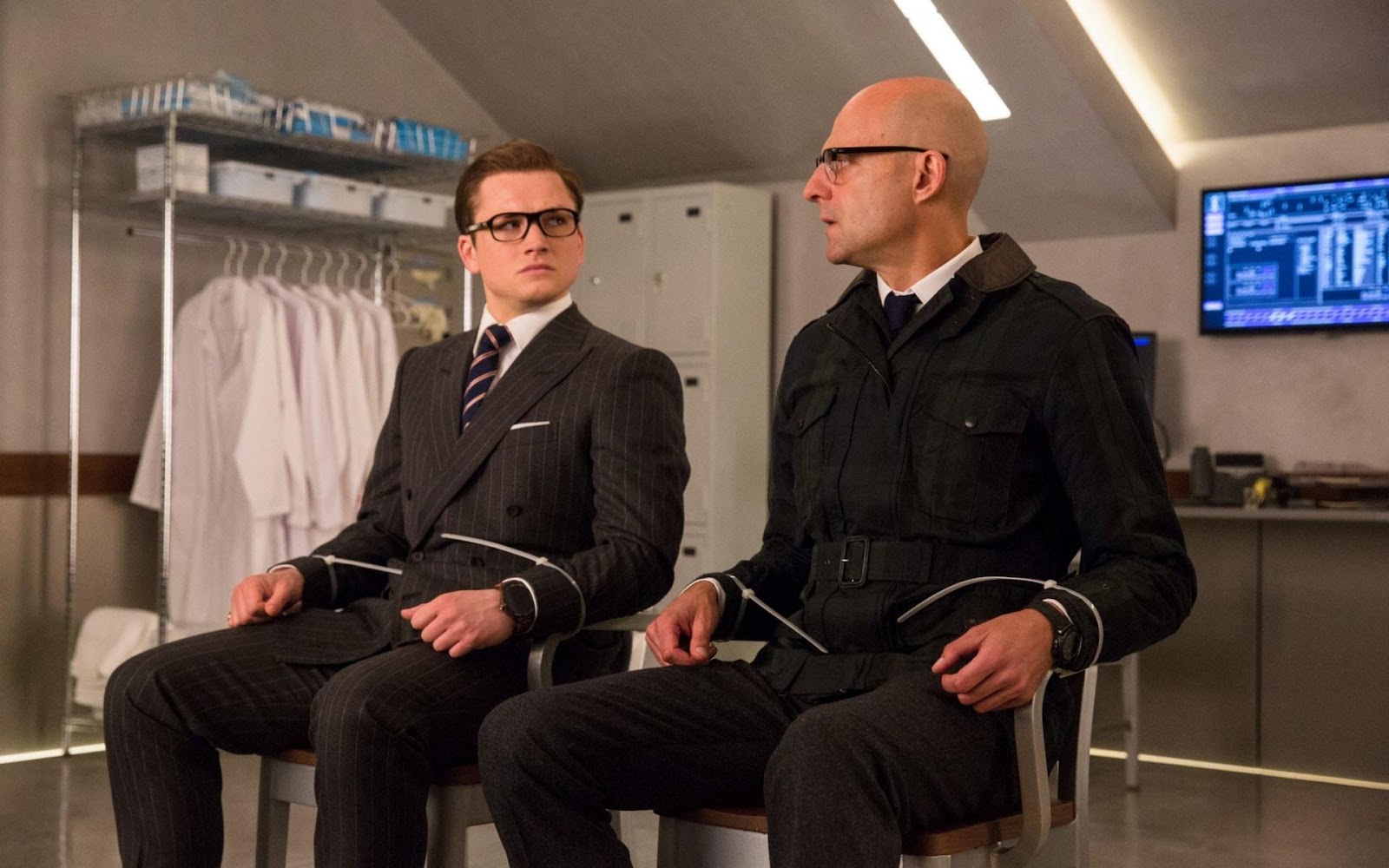
Among the ensemble, Taron Egerton once again channels a suave, charming sensibility into Eggsy that enables him to stand his ground opposite established talent. Egerton imbues Eggsy with such confidence and charisma that you can't help but be drawn towards the character. Alongside Egerton, Mark Strong turns in a prime performance as Merlin. Strong manages to elicit lots of laughs thanks to commendable comedic timing and even strings out some heartfelt emotional beats I didn't see coming. Meanwhile, Colin Firth puts his all into resurrecting Harry Hart by breathing new life into the character with a surprisingly layered performance. There's not much I can say without spoiling the film, so if you're wondering what all I thought of his return; watch the film and come back to check out the spoiler section above! 
Now for the woefully underutilized Statesman... Halle Berry, Channing Tatum, and Jeff Bridges are all billed as being a big part of The Golden Circle. They're on ALL the posters and trailers relating to The Golden Circle, but sadly none of these actors are afforded much to do. They make a strong impression when onscreen, but simply don't factor into the story as much as I would have liked. Basically, don't expect to see these three actors onscreen for more than ten minutes total or you'll be woefully disappointed.
Thankfully, Pedro Pascal stands out apart from the crowd as Agent Whiskey. The Game of Thrones star does it again, putting forth a gruff, chiseled Southern charm that's simply satisfying to see. Pascal gets plenty of time in the limelight with a couple key action sequences that will knock your socks off, and his character is by-far the most developed of the Statesman agents, so it's only fitting that he lassoes his way towards standing being one of the top performers.
In the antagonistic department, neither Julianne Moore or Edward Holcroft were able to fill the void Samuel L. Jackson and Sofia Boutella left behind. Moore seems to have thoroughly enjoyed herself playing Poppy as an bozo baddie, but I don't think the script did her character any favors. Poppy's motivation aren't really relatable and she's not positioned to be particularly menacing in her own right whatsoever. Her right hand-henchman, the rejected Kingsman applicant Charlie, is portrayed by Holcroft once more, and while he makes for a serviceable servant of evil, he's rarely anything more than that. On the bright side, viewers may or may not be surprised to see Elton John pop up in The Golden Circle for an extended cameo appearance. Elton John's scenes had me dying of laughter and independently are more than worth the price of admission (or Blu-Ray in this case?).
Kingsman: The Golden Circle isn't perfect by any stretch of the imagination, but there was enough fun to outweigh its problems in my opinion. Kingsman: The Golden Circle may not be a golden follow-up, but it shouldn't be discounted as fool's gold, because The Golden Circle still shines as a delightful globe-trotting spy adventure in spite of its flaws! 

Film Assessment: B

Sunday, November 26, 2017

Star Wars Speculation: The Poetry of the Star Wars Saga

Welcome readers to another installment of Star Wars Speculation!! I took a break to bring you my first "In Defense Of" entry, In Defense Of: 'Batman v. Superman: Dawn of Justice' (The "Martha Scene), but today I'm back to dive deep into Star Wars again in the mere weeks leading up to the release of Star Wars: The Last Jedi. This week's topic I'll be tackling is "The Poetry of the Star Wars Saga" and I'll be using that as the basis of my argument that The Force Awakens isn't a rehash of A New Hope. Also, keep in mind that I'm writing this with the base assumption that you'll have at least seen A New Hope and The Force Awakens so there could be somethings you may consider spoilers if you haven't seen either for whatever reason... Although, I suspect you would not be here if that were the case. 

The Poetry of the Star Wars Saga


So I'm sure many of you are wondering what the heck poetry has to do with Star Wars, and the answer to that comes from the Saga's creator himself, George Lucas.

Back in 2002, Lucas told Entertainment Weekly "I create themes, and I repeat those themes, in different chords and different arrangements" regarding how the Prequel Trilogy mirrors the Original Trilogy. Within the Skywalker Saga, there are many moments that reverberate and are echoed across the Saga. Lucas explained it like this, "It's like poetry. Every stanza kind of rhymes with the last one." There are quite a few story beats that carry thematic significance within the Saga, and these are absolutely integral to the DNA of Star Wars. Naturally, these aforementioned segments resurface as a means of strengthening the overall narrative.

Evidence of Lucas' comments can be found all throughout the Star Wars saga, but I've embedded a link to a brief Vimeo video from Pablo Fernández Eyre that keys in on some of the prominent examples below:


Now that you've hopefully watched the video and have some idea of what I'm talking about, let's dig in.

Lucas' approach refers back to the ancient style of poetry commonly found in The Old Testament of the Bible that is often called parallelism.

Now you may have noticed in the video that the Prequel Trilogy and Original Trilogy relate to each other in this way with The Phantom Menace correlating with A New Hope, Attack Of The Clones with The Empire Strikes Back, and Revenge Of The Sith with Return Of The Jedi.

How does this apply to Star Wars now?


I suspect the ongoing sequel trilogy will fit into this pattern as well. The Force Awakens has already broken into the cycle by mirroring A New Hope, and subsequently The Phantom Menace, but it remains to be seen how much The Last Jedi will evoke The Empire Strikes Back or Attack of the Clones. Based on the trailers though, it seems that there will at least be a few similarities so I suspect it's very possible it will jump in while also differentiating itself.

The brilliance of this technique though is how it permits wiggle-room for the storytellers to deviate the pre-established path and simultaneously incorporate the integral elements of the franchise. I think people get hung up on the idea that just because a film homages something, it automatically means that it ripped the other one off. However, Star Wars is a franchise that has always stayed true to itself in the face of exploring such an expansive galaxy.

Why 'Star Wars: The Force Awakens' isn't a remake of 'A New Hope'


I remember when The Force Awakens first came out, just about everyone loved it. It wasn't until a few weeks afterwards that someone on the Internet pointed out some similarities harkening back to A New Hope.
Of course, this spread like wildfire and people turned on the film saying things like "OMG, J.J. AbRaM5 rU1N3d St4R W4r5!" or "tH3 f0Rc3 4W4k3n5 5ux 4ND T0R3 Ap4Rt MY CH1LdH00D!!" Yes, the fandom whined. Like they always do. Now, I'm not here to refute that there are some similar story beats to A New Hope. That much is crystal clear, and I can see the reasons why the parallelism was implemented.
First of all, people need to take into account the state of the franchise at this point. Star Wars was not as commercially viable as it once was. The Prequels had soured the general moviegoer's appetite for anymore Star Wars. Sure, there were The Clone Wars and Rebels animated series, comics, novels, and video games, but there hadn't been a live action Star Wars film since Revenge of the Sith... There was a lot riding on the success of The Force Awakens, and fortunately it decimated the box office, but Disney was taking a gamble buying Lucasfilm. What if they were unable to create something that would appeal to both old and new fans? That's where the parallelism comes in.
J.J. Abrams was brought on to direct and also had a huge hand in the script alongside Star Wars scribe Lawrence Kasdan and Pixar writer Michael Arndt. The thing is... Abrams is a fan of Star Wars himself, in addition to being a fantastic filmmaker. As a part of the Star Wars fandom, he knew what they would respond well to and so naturally he knew what would click with audiences and what wouldn't. He shot on film, used practical effects/locations, the cast of the Original Trilogy was brought back, and incorporated as many references as possible.
Abrams and Lucasfilm understood that the structure of this new Star Wars had to resemble something audiences were already familiar with if it were to be accepted and jettison a new era of Star Wars, so naturally they pulled from Lucas' pattern itself and echoed some beats from the Original Trilogy. This mirroring technique has already been implemented in Star Wars, yet fans feel the need to complain for whatever reason. They act as though most other film franchises don't do this in order to keep the franchise DNA intact.
Just look at Jurassic World and Creed. The plot of both films are essentially the same base premise of the original film in the subsequent franchise (Jurassic Park and Rocky). Both films also feature pivotal moments homaging back to the original with the same sense of nostalgia utilized by The Force Awakens.
Both films were released in 2015, the same year as The Force Awakens, yet I hardly have ever seen anyone call out either for "copying the original." I've never seen anyone complain about the Prequel's use of parallelism and mirroring either... Although, that could be due to the multitude of problems present in the Prequels...
If someone still wants to complain that The Force Awakens is a remake of A New Hope after reading all of my informed arguments, I ask them to please elaborate on how The Force Awakens blatantly rips off A New Hope. 
Sure, you can tell me that something pivotal to the plot is put inside a droid, there's a desert planet, on that planet is our protagonist who longs for more, there's a super space weapon capable of destroying planets, the antagonist is masked and wears dark clothing, there's a cantina, and the heroes' mentor is killed by the antagonist on the Death Star/Starkiller Base, BUT those are the familiar elements of The Force Awakens I mentioned earlier. I've constantly found that in the internet's insistence to force these two films to fit the same framework, they have to describe the plots with incredibly vague terminology. The further you narrow in on the films, the more different they become. The Force Awakens tells the same story in broad strokes, but the specificity is drastically different.
Also, the whole complaint about The First Order building another Death Star seems sorta stupid to me. Realistically, if you were an evil organization and knew there was a weapon that had previously been built with the capability to destroy entire planets, wouldn't you have a desire to reconstruct it with major modifications to cause even more destruction? Just a thought... Sure, the last two were taken out, but that just shows there's room for improvement. With that being said, I'd still rather not see a fourth iteration of a planet-sized weapon in either The Last Jedi or Episode IX.
So yes, I can agree with the sentiment that Lucasfilm played it safe, but Lucasfilm needed something that could be conceived as commercially safe in order to take some secluded risks. Just take a look at the film's cast... The sequel trilogy's leads are diverse both ethnically and in terms of gender. Rey was the saga's first female protagonist who turned out to be the TRUE protagonist as the force user many had already dismissed the possibility of thanks to marketing showing Finn holding the saber. Finn was the first African American protagonist in Star Wars (sure you could make a case for Lando I guess... but he's more of a side supporting character in my eyes), who was positioned as a turncoat stormtrooper. Lastly, Poe Dameron was the first Latin protagonist.

**Spoiler Warning for Star Wars: The Force Awakens**

Kylo Ren's STILL rather controversial (but I'll dig more into that in my next post), and I don't think the fact he killed Han Solo did him any favors in that regard... Much less, make him a safe choice as an antagonist.

**End of Spoilers for Star Wars: The Force Awakens**

In conclusion, The Force Awakens had a difficult task ahead of it in introducing new characters, bringing back revered, classic characters, continuing the story left off in Return of the Jedi, and making Star Wars commercially viable again, but I think it did all of that beautifully and I still appreciate the film as one of my favorites in the franchise! I'd still even consider the first time I saw The Force Awakens to be one of the greatest experiences I've ever had in a movie theater because it's simply something I longed for most of my life and it delivered everything I possibly could have imagined. For all of those reasons and even more that I won't get into for the sake of length, I absolutely adore Star Wars The Force Awakens and it's use of parallelism to accomplish the daunting task of revitalizing Star Wars.

-As always, may the force be with you!!

Saturday, November 25, 2017

Throwback Thursday Review: 'Ratatouille'

Sorry for the delay on this review, as it was supposed to be published on Thanksgiving. I watched the film on Thanksgiving, but only recently had a chance to sit down and write about it. Anyways, I'm reviewing Ratatouille to coincide with the most recent Pixar release, Coco. I felt Ratatouille was the perfect choice because it's a Pixar film about a foreign culture (France), and since it's all about cooking, it ties into the food motif of Thanksgiving! The Throwback Thursday Reviews I have scheduled through the end of the year include Pitch Perfect, The Room, Looper, and Jumanji (1995) to go along with Pitch Perfect 3, The Disaster Artist, Star Wars: The Last Jedi, and Jumanji: Welcome to the Jungle. I'm also well aware that I've yet to publish the last two Throwback Thursday Reviews in addition to all the other significantly delayed ones. I haven't had a chance to sit down and watch any of them yet, but I will get them out there!

'Ratatouille' Review


Nominated For: Best Animated Feature, Best Original Screenplay, Best Sound Editing, Best Sound Mixing, and Best Original Score.
Won: Best Animated Feature.

Ratatouille scampers alongside the remarkable rat Remy, whose heightened sense of smell and passion for cooking cultivate a foolish fantasy that he may one day become a world class chef. As fate would have it, Remy unexpectedly winds up underneath one of France's most exclusive restaurants, which happens to also be the restaurant popularized by Remy's culinary idol, Auguste Gusteau. When the garbage boy, Linguini, discovers the rodent and bears witness to Remy's unique expertise, the two strike a peculiar partnership in hopes of rising through the restaurant's ranks.
Ratatouille was cooked up concurrently by Brad Bird and Jan Pinkava, who co-directed the feature and developed the story with Jim Capobianco while Bird was the sole screenwriter. Like the vast majority of Pixar's work, the film is still stirring thanks to exceptional animation, worthwhile themes, and a reluctance to adhere to any formula. However, despite its shared characteristics, Ratatouille always seems to be one of the forgotten films among Pixar's nineteen animated features. I'd daresay it's one of their more underrated entries in the grand scheme of things.
Ratatouille's unique flavor is derived from the ingenuity of its masterful storytelling. The emphasis remains on character and servicing the story in spite of all the entrées presented to the viewer. There's never a wasted moment, and a deft balance of humor and seriousness is successfully achieved in Bird's script. 
Ratatouille even offers ample meta commentary on criticism through the Anton Ego character by pointing out the humble origins of a critic's subjective perspective. Bird walks the tightrope between satirizing critics and glorifying them quite well in presenting an honest outlook of the profession.
And of course the animators ensure kitchen utensils, food ingredients, rat fur, and human hair are all as intricately detailed as any of the incredible animation to be found in Pixar's other offerings! Elsewhere, Michael Giacchino's swell score encompasses an extraordinary assortment of compositions ranging from pleasant and deliberate to swift and lively, but each one stands out as an inviting accompaniment underneath the ongoing events. 
Tossed to the forefront, Patton Oswalt's pleasant personality strictly suits Remy's delightful disposition and Lou Romano grants Linguini an apprehensive aptitude fitting of the character's aloof clumsiness.
Ian Holm chews the scenery as Gusteau's fiendish head chef Skinner, Brad Garrett brings a light-heartedness and compassionate nature to Gusteau, but Peter O'Toole's seemingly cynical food critic Ego is perhaps one of the standout supporting characters. Sprinkled throughout the animated ensemble, Brian Dennehy, Peter Sohn, Janeane Garofalo, Will Arnett, and John Ratzenberger can all be found voicing Remy's doubting dad Django, Remy's amiable brother Emile, cunning female chef Colette, mysterious German sous-chef Horst, and worried waiter Mustafa.
Ratatouille remains a bold, original recipe thanks to its inspired mixture of seasoned storytelling, charming characters, outstanding animation, and pinch of heart. When it's all over, you won't be able to resist the urge for a second helping. 

Film Assessment: A-


Monday, November 20, 2017

'American Assassin' Review

[This review was originally written in October 2017 and is now being published to coincide with the digital home media release. For an explanation of this, visit my Fall 2017 Important Update post.] 

American Assassin follows the response of Mitch Rapp after his fiancé dies in a terrorist attack. Rapp then takes it upon himself to become a highly skilled combatant so that he may seek justice. In the midst of his revenge plot, Rapp catches the attention of the CIA so he's recruited to train underneath the grizzled Cold War veteran Stan Hurley and help prevent the outbreak of a widespread global catastrophe. 
Now if you thought that plot synopsis sounded like the plot of almost every action movie out there, you'd be forgiven because you're certainly correct, because American Assassin is as average an action movie can come these days. Michael Cuesta, who previously dabbled in the realm of television, directs the film and his lack of experience comes across quite quickly in his attempt to adapt Vince Flynn's novel as it feels like an extended episode of a mediocre television series. I haven't read the novel, so I'm unsure if the problem lies there or in the screenplay penned by Stephen Schiff, Michael Finch, Edward Wick, and Marshall Herskovitz, but American Assassin repetitively succumbs to tired tropes of the action genre. Whether it be nuclear warheads being launched or the typical training montage, American Assassin leaves no stone unturned. 
However, on occasion American Assassin definitely defied convention and was at its best when carving out a unique identity for itself. Unfortunately, the script is still spotty with undistinguished dialogue and predictable twists and turns. The action itself is actually well-shot and choreographed though, which somewhat makes up for the standard story.
Thankfully, the film's lead by Dylan O'Brien so not all is so-so. O'Brien seems as committed as any other action star is these days, and really shines in making Rapp a likable lead. Alongside him, Shiva Negar made a fairly adequate action debut as fellow agent Annika, and I can see her possibly getting more work based on this performance.
However, it's Michael Keaton who walks away MVP. An actor of his caliber simply never turns in a passable performance, and Keaton really shines in one engrossing torture sequence that really evoked the expressive attitude of his iconic "Now you wanna get nuts? Come on! Let's get nuts." line from Batman (1989).
Sanaaa Lathan on the other hand feels especially bland as CIA director Irene Kennedy. There's just not much of substance to her character worth noting, and Lathan doesn't add any particularly interesting layers to her performance. She's the straight-faced government agency head you've seen a thousand times before.
Lastly, Taylor Kitsch does his best to invoke menace out of the villainous Ghost, but the character's murky motivations and limited backstory only cripple his every effort.
There's no avoiding it, no matter how potent it is, American Assassin just couldn't hit its target.

Film Assessment: C+

Saturday, November 18, 2017

In Defense Of: 'Batman v. Superman: Dawn of Justice' (The "Martha Scene)

Welcome readers! Today I'm introducing a new series I'll be periodically publishing from time to time called "In Defense Of" where I do as the title implies, defend something that's commonly criticized. Today I'm tackling the "Martha" scene from Batman v Superman: Dawn of Justice to tie into Justice League's release this weekend, and I'm sure many of you are already appalled that someone could think this moment has any merit whatsoever, but hear me out. I'm not going to be telling you this film is some misunderstood masterpiece, it has many flaws that I'm well aware of. However, I don't think the "Martha" scene has more substance than people give it credit for.  

In Defense Of: 'Batman v. Superman: Dawn of Justice' (The "Martha Scene)


So for starters, let's dismiss this notion that Batman simply stopped because their moms have the same name. I think there's a lot more to it than that, but people refuse to look past the surface level so alas this meme was born.
Also, Superman doesn't seem to be saying his mother's name as an effort to stop Batman from killing him. I view the scene much differently than most. So over the course of the entire film, Batman is hellbent on killing Superman because he believes that Superman powers are too dangerous based on what he witnessed firsthand in the Battle of Metropolis. This Batman is darker than most and completely unlike the one we're used to seeing in the pages of comics or even onscreen because he straight up murders people with no remorse. 
However, I think that's one of the film's central themes... Alfred acknowledges the shift himself when he says "Everything's changed. Men fall from the sky, the gods hurl thunderbolts, innocents die. That's how it starts, sir. The fever, the race, the feeling of powerlessness that turns good men... cruel." 
Essentially in Batman's pent-up aggression, he's fallen so far into darkness and despair that he can't even accurately judge Superman's true character. In his rage, Batman only sees Superman as a monster who's going to eradicate humanity and Batman is becoming the very thing he feared as he was being manipulated by Lex Luthor to kill a good man. I'll tie this back in a moment...
On the flip-side, Superman is in a moment of vulnerability. The strongest, most powerful man in the universe is essentially on the ground unable to do anything to prevent his death, and what does he do? He doesn't plead for mercy, instead he simply requests that Batman save the life of another. 
This completely throws Batman off-guard. In that very moment, Batman realizes he's been tricked and sees Superman's character shine through. He sees Superman's inner humanity as opposed to the alien he's so afraid of. He realizes that he's become so obsessed with stopping Superman that he never stopped to think if he even should be doing that. This all powerful being is in a moment of weakness and instead of begging for his own life, he asks Batman to save another. Batman's now in a moment of self-reflection and confusion where he realizes what he's become while generally just confounded how he, the world's greatest detective, could have been so wrong. 
When Lois steps in and informs him that Martha is his mother, Bruce then reflects to a time when he was powerless to prevent his own mother's death. Lois then lays down atop Superman and Batman must process why someone would possibly give their life for Superman, only to come to the conclusion that Superman is truly a man of good character.  
Batman then realizes that the right thing to do is to save Martha. He promises Superman he will do this because he knows what it's like to have his mother taken away from him when he could do nothing. The fact both their "mothers" have the same name is pure coincidence that people have kind of turned into a joke. I don't really think Batman stops because their mom's have the same name. It's because he saw Superman's virtues when he least expected them.
Now I realize many of you may still disagree with me, and that's perfectly fine. Film is subjective to every viewer, and the purpose of this post is to communicate my own perspective upon watching this scene. I'm simply making a case for why the moment works for me as well as explaining what I get out of the scene every time I watch it.