Showing posts with label Toby Kebbell. Show all posts

Monday, July 17, 2017

Recollection Reflection Review: 'Dawn of the Planet of the Apes'

I've reviewed Rise of the Planet of the Apes and am now revisiting Dawn of the Planet of the Apes to coincide with this weekend's release of War for the Planet of the Apes. I'm aware this review's a little late but I've had a busy weekend and only just got around to writing this review. I hope to have my review of War for the Planet of the Apes online ASAP.

'Dawn of the Planet of the Apes' Review


Nominated For: Best Visual Effects.

Recollection- 'Dawn of the Planet of the Apes' Review

Reflection- This section of my review is probably going to be a little boring considering my opinion of Dawn of the Planet of the Apes hasn't changed much in the last three years. I remember thoroughly enjoying Dawn of the Planet of the Apes the first time around and that hasn't really shifted at all.

Review- In Dawn of the Planet of the Apes, it's been ten years since the Simian flu outbreak. Mankind has seemingly been wiped out by the disease while Caesar's established a thriving ape colony in the Muir Woods just outside San Fransisco. When a band of human survivors emerge desperate to gain access to hydroelectric dam that can provide power to their encampment, Caesar must grapple with the decision to remain isolated from humanity in order protect his people or work alongside the humans in hopes of co-existing peacefully.
Dawn of the Planet of the Apes saw a change in direction as Rupert Wyatt handed off the blockbuster baton to Matt Reeves. Reeves along with screenwriters Mark Bomba, Rick Jaffa, and Amanda Silver are then afforded the opportunity to thrust the viewer into a post-apocalyptic world that constantly swings the pendulum of being hopeful and hopeless. There are optimistic occasions where it seems ape and man can live alongside one another that are only contrasted by the horrors of warfare between two species.
Reeves and cinematographer Michael Seresin extenuate this disparity by capturing the natural beauty of California's prolific locales in the film's quieter, peaceful moments and shooting intense action sequences primarily in a dingy, disparaged urban environment. It really speaks wonders that Reeves and his technical crew were able to stage something as outrageous as primates wielding machine guns while riding horses and make it seem plausible. 
The Weta vfx artists also significantly stepped up their game as I still am unable to distinguish the motion-capture apes as being digital developments. The visual effects are undoubtedly an incredible achievement for the company that continually pushes the boundaries of technology in film. And I've got to give Michael Giacchino props for another sensational score full of captivating compositions.
In the acting department, Andy Serkis once again delivers a commanding performance via motion capture. Serkis is afforded an opportunity to intrinsically explore Caesar's responsibilities as a leader and father so Serkis imbues Caesar with the confidence, wisdom, and dedication that naturally accompanies said roles. Serkis is even backed by an exceptional primate posse including the likes of  Nick Thurston, Terry Notary, Karin Konoval, Judy Greer, and Larramie Doc Shaw as Blue Eyes, Rocket, Maurice, Cornelia, and Ash respectively. 
However Toby Kebbell challenges Serkis for the position of ruling motion-capture acting as his rampant, rage-induced primate Koba unleashes hell upon the humans and fellow apes. Kebbell gathers enough menace and intellect to portray Koba as a fearsome, undermining antagonist with understandable intentions, however radical those ideologies may be. It's precisely the quarrel between Caesar and Koba that evokes so many feuding philosophies found in history and cinema such as Malcolm X and Martin Luther King Jr. or Mufasa and Scar. 
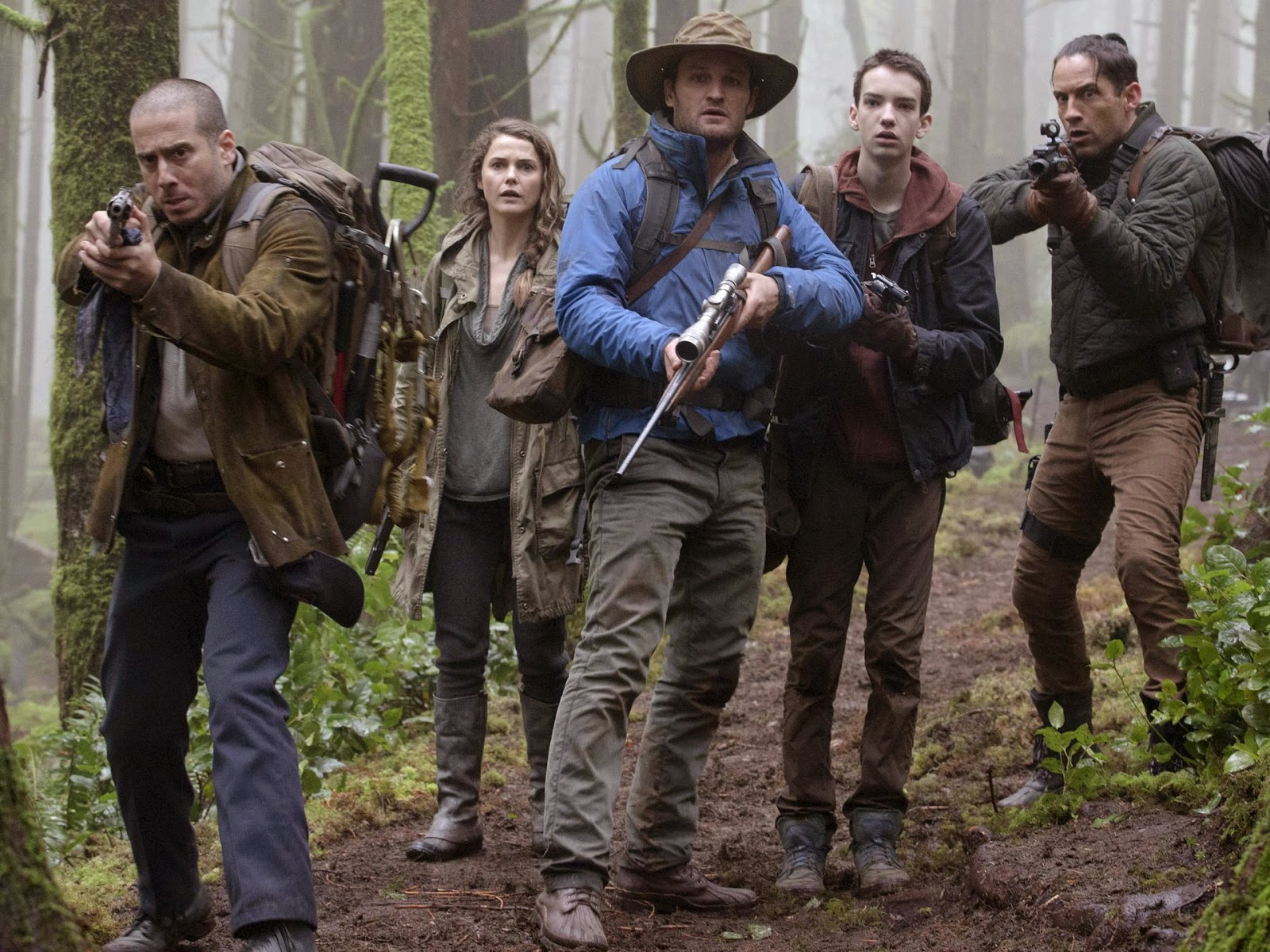
On the human side of things, Jason Clarke takes up a trusting demeanor as Malcolm and the progression from unease to upmost confidence in Caesar is a fascinating journey. Meanwhile, Gary Oldman's one of the most reliable supporting actors around these days and he makes the most of his time onscreen with grit and gusto. Elsewhere, Keri Russell and Kodi Smitt-McPhee each offer some sufficient impressions for their allotted screen time as Ellie and Alexander.
In conclusion, Dawn of the Planet of the Apes succeeds at something only a scarce number of sequels ever accomplish. It significantly surpasses a fantastic first film and improves upon absolutely every aspect of the predeceasing chapter with an exhibition of technical mastery rarely seen in today's blockbuster franchises.

Film Assessment: A+

Tuesday, March 7, 2017

'Kong: Skull Island' Review

Nominated For: Best Visual Effects.

In Kong: Skull Island secretive government organization Monarch sets off to explore the uncharted Skull Island, dropping bombs to map the island's terrain, only to have their expedition brought to a screeching halt when a 100 foot ape trashes their helicopter convoy. That ape is Kong of course, who happens to be the largest incarnation of the raging gorilla yet.
Kong: Skull Island is the second entry in Warner Bros. and Legendary's MonsterVerse which kicked off with 2014's Godzilla and is headed towards a monster showdown between these two versions of Kong and Godzilla (the reasoning behind Kong's size-up), and there are plenty of breadcrumbs sprinkled throughout the film hinting towards that confrontation including a post credits scene I highly advise you wait for afterwards. Kong: Skull Island is unique when contrasted to the other Kong flicks, its set in 1973 and takes place almost entirely on Skull Island once the crew arrives (Don't be hopeful for an Empire State Building standoff because you'll be severely disappointed).
Director Jordan Vogt-Roberts and cinematographer Larry Fong soak Kong's cinematic resurgence in 'Nam napalm to evoke Apocalypse Now's vibrant color palette, leaving Kong: Skull Island's stylistic aesthetic to be one of the film's highlights. On that note, Kong: Skull Island's quite impressive from a technical standpoint. It's got superb sound design and a rousing rock soundtrack but I found the score to be lacking. None of the arrangements from Henry Jackman were particularly memorable, something I found disappointing since I hold Jackman in high regard for his scoring of X-Men: First Class, Big Hero 6, Captain America: The Winter Soldier, and Captain America: Civil War.
The various creatures brought to life by the team of visual effects artists assembled for the feature are absolutely incredible though, with the great ape standing chief among them all as the film's crowning achievement. Kong manages to simultaneously exhibit inspiration from cutting edge motion capture animation work showcased in recent Planet of the Apes films while paying homage to the look of the model utilized in the 1933 King Kong production composed of rabbit fur, rubber/foam for muscle structure, and a metal mesh skeleton. It obviously looks much better than that original model but I noticed a few similarities when looking at Kong from a distance that I'm sure were intentional. One thing that annoyed me to no end about 2014's Godzilla was how long it took for director Garth Edwards to show the King of Monsters in his full reptilian glory, I understand the visual effects required to render the beast are expensive but consistently playing with your audiences expectations by teasing the beast's emergence only to cut away was downright cruel.
Thankfully, Kong: Skull Island doesn't suffer from this issue as it doesn't take long for Kong to trample onto the scene and Vogt-Roberts lets you back in his glory once he shows up. Kong's fight sequences against the other monsters are magnificent to say the least. My screening was in IMAX 3D and I can say in these moments the experience payed off, largely due to the larger screen and fuller sound, but overall I'm not quite sure it would be worth the uncharge. However, Kong: Skull Island does have story and character vulnerabilities that somewhat drag it down. Admittedly, that's not exactly what one would come to a monster movie like Kong: Skull Island to see but it doesn't hurt to have characters the audience will actually care about. I legitimately can't remember a single character's name and couldn't tell you any character traits beyond their corresponding skill set, appearance, and occupation for a vast majority of the characters.
This largely derives from the screenplay penned by Dan Gilroy, Max Borenstein, and Derek Connolly featuring a story from John Gatins. The script just has too many characters to juggle so the result is that virtually all the characters are underserved. On the flip-side, I was pleasantly surprised how the screenwriters toyed with genre conventions and cliché moments leading to some fantastic situational humor (I'm not even sure I was supposed to laugh at these moments but I relished in the irony). Otherwise, the plot of Kong: Skull Island is fairly paint-by-numbers so don't expect anything too abrupt.
Kong: Skull Island's cast is stacked with plenty of prestigious talent as well as names you may recognize from a genre film or two. Tom Hiddleston, Brie Larson, John Goodman, Corey Hawkins, Jason Mitchell, and Shea Whigham all do the most with what's provided to them but but it's Samuel L. Jackson and John C. Reilly who were able to flip things around and make the most of meager caricatures. Oh and Tian Jing shows up out of nowhere and literally adds nothing of significance to the story just so Warner Bros. and Legendary could shoehorn in an Asian actress and cover all demographics I guess?
Really just about every cast member but Jackson and Reilly are wasted space, something I'm disappointed to say considering their show of talent elsewhere. Something interesting to note though is that Tobey Kebbell has a small live action role and provided the motion capture performance for Kong, along with Terry Notary, similarly to how previous Dawn of the Planet of the Apes costar Andy Serkis was utilized in King Kong (2005). It's funny how the two were rival characters in the Dawn of the Planet of the Apes and have become the pillars of motion capture acting today. I rarely see motion capture performance driven films today that don't take advantage of all Serkis and Kebbell have to offer.
If you're looking to take a trip to the theater this weekend, I'd prioritize seeing Logan over Kong: Skull Island. However, if you're looking for a dumb popcorn blockbuster then Kong: Skull Island should suit your mindless monster movie needs. Sadly, the vague strokes of characterization hold Kong: Skull Island back from its true potential but the impressive effects work, adrenaline-fueled action sequences, and stylish visuals help position it to be an entertaining monster flick.

Film Assessment: C B-

Friday, January 6, 2017

'A Monster Calls' Review

In A Monster Calls single mother Lizzie O'Malley is diagnosed with a terminal illness and her son Conor must deal with this amidst being bullied at school, tolerating his indifferent mournful grandmother, and trying to forge a stronger connection with his absentee father. One evening Conor is approached by an unexpected ally, The Monster, who will guide him on learning the importance of courage, belief, and truth through the telling of three terrific tales.
A Monster Calls adapts the novel of the same name written by Patrick Ness, who also penned the screenplay, based on an original idea by Siobhan Dowd and while I haven't read the source material, I found the story to be incredibly heartfelt. J.A. Bayona directs the fantastical tearjerker and in collaboration with writer Patrick Ness maintains a nice balance of maturity and creativity communicating the narrative through a child's eyes.
By framing everything from Conor's perspective, Bayona is simultaneously able to explore the imaginative and keep things emotionally grounded by showing what's meaningful to Conor, making the film's final moments all the more impactful. A Monster Calls features a wide range of inventive imagery from the visual effects department with resplendent water color vignettes imagining the Monster's stories similar to the Deathly Hallows sequence in Harry Potter and the Deathly Hallows: Part 1 and a remarkably realistic looking CGI Monster that will undoubtedly be compared to Groot from Guardians of the Galaxy, while the real world visuals are exceptionally well-shot by cinematographer Oscar Faura.
One of the script's greatest strengths however is that Patrick Ness has a devout understanding of Conor as a character, providing a transparent window into his profound connection with his mother. Ness' wise choice to engage the viewer from Conor's eyes keep things focused on what's important to Conor and the story, never compromising the character arc by leaving the answers to some story threads up to the viewers' interpretation such as the origin of The Monster.
These unanswered questions may vex some viewers but I think it's a bold choice that doubles down and proves Conor to be a crucial centerpiece of the narrative. While the film's ending is in sight for a majority of the running time, I promise that you won't be prepared for the film's heartbreaking conclusion (bring tissues) and that's just another testament to Ness' strength as a writer and the outstanding performances showcased. It's incredible how fleshed out the world and characters are despite being presented from the viewpoint of a child, a rare occurrence in Hollywood.
I've attested to the sincere performances delivered by the gifted ensemble but perhaps the brightest standout is Lewis MacDougall's Conor. MacDougall puts forth one of the most sentimental and tender child-performances I've seen in recent memory and deservingly joins the ever-growing list of rising stars. MacDougall imbues Conor with a vast emotional range that's exceedingly authentic for how a child of that age would react to personal trauma and continues to amaze by making a 30 foot Monster seem real through everything from simple facial reactions to casual conversationalist dialogue. The Monster itself is something to be applauded as Liam Neeson's gravelly vocals and the stunning animation work hand-in-hand to bring yet another talking tree to cinemas. And one can't forget the talented supporting ensemble of Felicity Jones, Sigourney Weaver, and Toby Kebbell as Conor's Mum, Dad, and Grandma respectively, each making the most of every moment onscreen.
A Monster Calls doesn't just pluck the heart strings, it stretches them out over the course of the first two acts before unmercifully ripping them apart in the film's concluding thirty minutes. That's not to say that A Monster Calls is emotionally manipulative but rather speaks for the passionate and poignant strength of the writing, direction, and performances on display.

Film Assessment: A-

Friday, August 26, 2016

'Ben-Hur' (2016) Review

Ben-Hur (2016) tells the classic faith based story of Judah Ben-Hur, his descent and betrayal at the hands of his adopted brother and Judah's quest for revenge only to find forgiveness instead. The 2016 adaptation of Ben-Hur is the fifth adaptation of Lew Wallace's novel Ben-Hur: A Tale of Christ, the most famous adaptation being the Best Picture winning Ben-Hur (1959). My primary thought when I watch a remake or reboot or new adaptation of something is "What purpose does this new version serve the original material?" However, this time around I will have to admit to have not ever seeing the 1959 Ben-Hur or any adaptation for that matter, but I am curious despite it's 3 hour 44 minute runtime.
With that being said, it seemed clear that Ben-Hur (2016) was made purely for financial reasons. Ben-Hur fluctuates in quality since the first half of the film is a doldrum but around the midway point the film receives an injection that energizes the material by leaps and bounds leading to an entertaining finale. Director Timur Bekmambetov and cinematographer Oliver Wood frame incomprehensible hand-held shaky close-ups amidst the action and even scenes of straightforward dialogue.
When the film's budget is $100 M, they should be able to afford a camera rig or tripod at the very least but for some reason the minds behind the camera thought handheld would be a better choice. The thing that makes it all the more frustrating is that the chariot racing sequence is exhilarating, well shot and probably the best scene of the entire film. The lead-up to the race slowly raises the quality of story and filmmaking as the film finally finds itself.
The production design and costuming are terrific, exemplifying the essence of what I believe ancient Jerusalem would look like, with one exception, Morgan Freeman's absurd wig. Seeing Freeman walk around with dreadlocks is one of the most ridiculous things I've seen recently but as the film's runtime wore on it didn't stick out as much as it did at the start.
A weak point of the film is without a doubt it's screenplay from writers Keith R. Clarke and John Ridley, because the dialogue is sub-par and frankly the narrative uninteresting for the first half. The reason I found the film boring is not only that it lacked energy. but that the characters are thinly written and I didn't really care about the characters so when tragedy falls I wasn't impacted whatsoever. The duo do however succeed in regards to their overarching messages about forgiveness and that's greatly helped by the inclusion of Jesus. Thanks to the lackluster script though, the actors don't come off as strongly as they could have otherwise.
Jack Huston's Judah Ben-Hur lacks charm making it difficult to sympathize with his character as he endures trials and tribulations but I was impressed with his turn for the second half of the movie. Toby Kebbell comes off a little one-note as Messala, the benevolent brother turned fiendish foe, but he does brandish the persona well thanks to his dynamic opposite Huston's Ben-Hur. Morgan Freeman didn't seem to be putting forth much effort in his portrayal of Ilderim but he's fine in the role, regardless of whether he's in it for the paycheck or not. Rodrigo Santoro paints a compassionate portrayal of Jesus but he has brief screen time, interspersed where he services the story.
For those interested in the film I can promise that the chariot race is entertaining and the message about forgiveness is valuable but there's little else to relish in since it has a sluggish first act, the cinematography is a mess, and the performances do little to elevate the sloppy script. In conclusion, Ben-Hur isn't really worth watching.

Film Assessment: D

Saturday, June 11, 2016

'Warcraft' Review

Warcraft is a fantasy film based on the longstanding Warcraft franchise, which includes most notably the popular MMORP games, novels, and other media. I have never played a Warcraft game and I'm unfamiliar with it's expansive world so keep that in mind throughout this review. 
Warcraft tells the story of two worlds converging as the orcs must flee their dying world of Draenor and find a new home while humans must take up arms to defend their home world of Azeroth from said orcs. From the lengthy plot description alone, it's evident that this film had an agenda to simultaneously establish this fantasy world cinematically while attempting to set the stage for sequels, an evident issue with many recent comic book movies including The Amazing Spider-Man 2, Iron Man 2, Avengers: Age Of Ultron, Batman v Superman: Dawn of Justice, and X-Men: Apocalypse.
I can say Warcraft succeeds in fulfilling this endeavor, but at the expense of this film's quality, utilizing a "shot-gun approach." Meaning, Warcraft has a narrow scope in terms of restricting the audience's immersion into the world with a wide spread of characters, breaking basic plot structure by eliminating the lead character and following at least six major characters through their various points of view. 
In comparison to another fantasy film based on a property beloved by many, The Lord of the Rings, Warcraft never focuses on one key character or central protagonist like The Lord of the Rings: The Fellowship of the Ring centers on Frodo Baggins, which is obviously an issue. On the bright side, this allows viewers to become familiar with multiple characters and their philosophies but leaving the viewer confused as to who is good and bad in this fantasy, thankfully this feeling of confusion settles towards the end of the film. 
As I said earlier, Warcraft restricts the expansive world to a few key locations and actions set pieces and as an audience member I felt the borders of the sandbox since there were some areas of the world that I want to see further explored but I guess that will come in a sequel if a Warcraft sequel is indeed green lit, although the likelihood of a sequel is strong given Warcraft's international box office performance and strong numbers from China. 
Duncan Jones directs with Warcraft being his first enormous budget endeavor after his smaller films Moon and Source Code, and while I haven't seen either film, I've heard nothing but praise for them. One nitpick of mine derives from the film's editing that would jump elsewhere as soon as I settled into a scene. Literally right when I would become invested in ongoing events, the film would cut and pick up another character's story and while I understand some of the logic behind it, it did hinder my experience. 
Aesthetically, Jones and his team of visual effects artists, motion capture actors, and production designers create an incredible gorgeous world effectively balancing the tricky stability between practical sets and CGI that seemed true to the world while appropriately bringing the sense of massive scale to the epic confrontations between humans and orcs. 
The action sequences are without a doubt entertaining, but none are quite as memorable as those to be found in The Lord of the Rings. I'll do my best to avoid any more comparisons between the two from this point on. 
On the subject of visuals, I really took to Jones' depiction of magic as the effects for them looked awesome and felt unique and fresh as opposed to Harry Potter's sleek fast wand bolts and The Lord of the Rings' paranormal approach, Whoops did it again, but at least this time it was a more positively skewed comparison. Here's to hoping Marvel's upcoming Doctor Strange can deliver on that as well! The sound design and underlying wondrous epic score composed by Ramin Djawawadi service the visuals superbly and fits the world like a glove, not game changing but I felt they were worth mentioning. 
Jones and Charles Leavitt devise a screenplay that's surprisingly not exposition heavy, ignores tropes of the fantasy genre, and invokes some bold creative choices that payed off in the end. However, when forced to expunge a film from the script, Jones failed in making the first act of the film accessible to casual moviegoers. I was lost for a good thirty minutes of the movie and was confused as to what characters were doing, where they were going, and why they were doing such and such. 
And this is coming from a fan of fantasy films, so I'm sure someone who has never heard of Warcraft would be even more bewildered. The confusion derives from a very complex story with lots of moving parts and characters that I'm sure WoW (World of Warcraft) players are already familiar with but are never fully explored for those new to the franchise. While I did criticize the intricate convoluted plot, I will say the filmmakers were bold in regards to creative decisions even going as far to kill off some seemingly crucial characters, a decision that certainly implies the stakes are sky high in this fantastical world. On the flip side, it was difficult to care about these deaths as I wasn't emotionally invested in many of these characters. In large part to the awful acting to be found in the film. 
Don't fret though as there are a few bright spots to be found in the film's cast that I will get to, but across the board there were some dreadful casting decisions made. This casting director should probably be fired in all honesty. I'm going to start positively by praising Toby Kebbell who delivers without a doubt the standout performance as the orc Durotan, and one of his best motion capture performances yet, a great followup to his turn as Koba in Dawn of the Planet of the Apes. Andy Serkis better watch out, because Kebbell may be up for stealing his spot as the motion capture king. Kebbell manages to humanize Durotan and even make him a relatable character that I was emotionally invested in thanks to the character's path in Warcraft. 
Beyond Kebbell, the other motion capture orc performances were fine and serviced their respective characters well but didn't match the gravitas Kebbell brought by extrapolating human qualities from the least humane character. Anna Galvin comes close as Draka, Durotan's wife, by actually helping to bring out Durotan's humanity in their personal moments due to the great chemistry from the mo-cap performances. Robert Kazinsky and Clancy Brown both make for efficient orcs serviceable in the capacity used as Durotan's right hand orc Orgim Doomhammer and the fearsome war chief Blackhand respectively. 
Last but not least for the orcs is Daniel Wu as the orc warlock Gul'dan who seeks to claim Azeroth with his dark magic. Wu makes Gul'dan come off like Emperor Palpatine but with some surprising physical force to back him up as both a physical and magical threat and in that capacity did just fine. It's only fitting as I transition out of the orcs I next discuss the middle ground as Paula Patton portrays a half orc slave Garona. 
Patton is just fine as Garona, and her dialogue's a bit hard to comprehend thanks to her tusks (I believe that's what they are) but I did find Garona's arc to be intriguing and would love to see it continued onward as her character is left in a complicated situation that points to potential peace between humans and orcs down the line. Patton is okay in the role but from this point onward it's clear that better actors could have been found. 
On the human front, the line delivery is stale amounting to a lot of monotonous line delivery devoid of emotion, it's as if the actors were literally forced to recite their dialogue in robotic fashion. I have no idea if this was due to some communication barrier between the actors and Jones, poor direction on his part, or just poorly cast actors trying their best but regardless of where the problem stems from, it's something that can't be ignored. Travis Fimmel plays Stormwind Knight Anduin Lothar and I can say he fills the action capacity nicely, but lacks in regards to his emotional reactions to a few significant events. I can't quite discuss that point as much as I'd like without spoiling the film but I'll say he didn't react to a certain death the way any other emotional human being would by screaming in anger or frustration or even appearing to be saddened by the occurrence. 
Ben Schnetzer portrays the mage Khadgar, and looked cool while casting spells, but seemed out of his element in regards to acting. He had many awkward moments that were unintentionally humorous so I guess if you really want to defend his acting say he'd be a great comedian. 
Ben Foster brings another mage to the big screen as the Guardian, Medivh, and seemed too young to be believed as a wise magic mentor so I think the casting department skewed too young here but Foster is serviceable in the role. 
Dominic Cooper is an actor that I enjoy, as I like his portrayal of a younger Howard Stark in Captain America: The First Avenger and Agent Carter, but he is tragically miscast as the king of Stormwind, Llane Wrynn. He too seemed a bit young for the role as I think of kings to typically be aged and rugged, although a case can be made that they had to start ruling at some point and I guess this was the beginning of his rule? Cooper isn't bad.. actually making for a serviceable young king, but rather comes across as miscast more than anything. 
Yes, the acting is bad as a result of uninspired casting choices and there are story flaws, but the film makes up for it with technical elements. The world of Warcraft is one brimming with visual splendor that unfortunately suffers from choppy editing, a convoluted plot, and some truly atrocious acting to make for a bloated fantasy epic. 
Despite my mixed reaction to Warcraft, I can say I think a sequel is at least warranted based on the groundwork laid and hopefully can improve in the areas which Warcraft falters. Hardcore WoW fans will love Warcraft and those with a soft spot for the fantasy genre will be able to walk away admitting they had a good time, but if you don't fall into either of those categories, this isn't the summer blockbuster for you. When it comes down to it, Warcraft certainly isn't as bad as the 27% Rotten Tomatoes score makes it out to be, but it's not great either.

Film Assessment: C+