Showing posts with label Jason Clarke. Show all posts

Tuesday, January 29, 2019

'Serenity' (2019) Review

Baker Dill is a fishing boat captain who leads tours off of the tranquil enclave of Plymouth Island. However, his peaceful life is shattered when his ex-wife tracks him down and begs him to save her and their young son from her abusive husband. Thrust back into a life he wanted to forget, Baker now finds himself struggling between right and wrong. 
Written and directed by Steven Knight, Serenity is sure to be the most bizarre thing shown at the multiplex all year. I was drawn into seeing it purely out of curiosity upon learning there was a ludicrous twist at the film's center (I'll eventually elaborate on this in a clearly marked spoiler section of the review) but walked in entirely unaware of what would soon occur. While I'll quickly detail why I believe you shouldn't waste your money seeing Serenity in cinemas, going in blind is the proper way to best experience this head-scratcher of a movie. Knowing absolutely nothing about it aside from the talent involved with the project honestly made the experience all the more interesting as I was perplexed to wonder why in the world this project wasn't scrapped at the scripting stage. At the outset, the story seemed to be a modern take on Ernest Hemingway's The Old Man and the Sea, but it then became a thriller of sorts before eventually evolving into something else entirely. I'd say Serenity has an identity crisis, but that's not quite the case. 
It knows what it is, but Knight doesn't reveal what Serenity's actually about until the end. I've heard it said plot-twists can make or break a movie but never seen a late revelation neuter its narrative quite like this. A bonkers twist turns the entire thing on its head and makes you re-evaluate everything you just watched, but not in a good way. Ultimately, this discovery calls the whole plot into question. So what is this game-changer of a twist you ask? I'm happy to tell you.

**Spoiler Warning for Serenity**

When Dill's ex-wife Karen finds Dill, she asks him to take her husband Frank out fishing and push Frank overboard to be eaten by sharks. She requests this of him because she and their son are abused by this man. Dill contemplates the deed over the course of the film but declines several times before eventually agreeing. Meanwhile, there's a character named Reid Miller who's been trying to speak with Dill but regularly misses him by mere minutes. It quickly becomes a recurring gag as the story progresses. Towards the end, Reid finally reaches Dill and shadily tries to give him free product (a fish finder and other materials to help him fish). Dill sees through the deception when Reid accidentally tells Dill that he knows of the murder plot, so Dill demands Reid tell him what's really going on. The audience then learns that everything in Serenity is happening inside of a video game created by Dill's son Patrick in real life.
We learn Dill actually died in the Iraq War and that Patrick coded the game as a way of connecting with his lost father. It's a form of escapism from his troubled life which enables him to "fish with his father again." However, as Patrick's focus shifts from fishing with his dad to murdering his step-father, the game follows suit, and a fantasy scenario ensues where his father can "save him" in the virtual world. It's quite literally wish fulfillment for the young boy, and the game is representative of Patrick's inner thought process. There are some subtle hints towards this, but the twist comes entirely out of left field and renders everything else to follow as inconsequential. Essentially, Dill becomes self-aware of the fabricated reality without realizing it, but Reid's revelation helps him see it the following day for himself.
The focus is then once again drawn to whether Dill will kill Frank or not, but the conflict immediately becomes superficial because the illusion of choice for this character is gone. He's not the one making the decision. He's a video game avatar. His sentience is left largely unclear, but since his dilemma is symbolic of Patrick's struggle, you'd assume Patrick's the one in control. Anyways, the non-playable characters (NPCs) populating the game try to convince Dill he shouldn't kill Frank, but nothing they say dissuades him. In fact, the game and the NPCs sabotage this plot somehow by sending gang members to break Frank's hand so he can't fish. This plot point is incredibly confusing because the audience is aware Patrick is in control of the game, so did Patrick willingly put this obstacle in his own path? That question's never really answered, but it's implied the game did this on its own? Very confusing, I know. Despite this obstacle and many others, Dill ends up embarking on the fishing voyage with Frank and Karen (who comes along to help Frank fish). Another character somehow sneaks onboard and shows up out-of-nowhere as an attempt to adding further weight to this choice. It's treated as though Dill will be punished for following through with the murder, but the audience already knows this is all taking place inside a video game, rendering the stakes meaningless. 
I mentioned earlier that The Old Man and the Sea came to mind while I watched this insane production, and here's why... In the very beginning, there's a specific fish called "Justice" that Dill is desperately trying to catch. Nevertheless, the fish eludes him time-and-time again. So to bring things full circle, they catch Justice on the fishing line and hand the rod to Frank. The fish is putting up a fight, so Frank ends up at the edge of the boat. Anne and Dill release Frank, he falls overboard and is dragged to the depths of the sea to drown. Then, we see Patrick from the computer monitor's perspective. He's holding a knife and contemplating something. He gets up and leaves the room to go LITERALLY kill his step-father. The film has lost ALL subtlety at this point. It's shown that Patrick went to some sort of facility or mental institution. However, we then see the ending from Dill's perspective inside the game. He speaks to Patrick in real life via a payphone somehow... Whatever... At this point, I'd already questioned so much... Patrick tells him they can be together again and the world dissolves before reforming, bringing Patrick into the game. This ending's fairly ambiguous with a wide range of possible implications, but it just seemed like a strange way to end such a sadistic story. 
It's a happy ending which effectively condones violence with virtually no consequences. The characters get what they want, but at no cost in spite of their heinous actions. Imagine if there was a happily ever after for all the characters in Breaking Bad, that's how out-of-sorts this seemed. Not to mention how confused I was by the pivotal twist...

**End of spoilers**

Regarding positives, I'd say the cinematography offers up idyllic imagery. I think I've gone on enough regarding the writing and direction, but elsewhere, the score rarely matched the tone of what was happening onscreen and the acting was less than stellar for this A-List line-up of Matthew McConaughey, Anne Hathaway, Jason Clarke, and Diane Lane. 
Aside from its bonkers twist, Serenity is a dull expedition which capsizes after encountering some troubled waters...

Film Assessment: D-

Monday, October 15, 2018

'First Man' Review

Nominated For: Best Production Design, Best Visual Effects, Best Sound Editing, and Best Sound Mixing. 
Won: Best Visual Effects.

First Man examines the life of astronaut Neil Armstrong in addition to exploring the costs and sacrifices required by the legendary space mission that led him to become the first man to walk on the moon on July 20, 1969.
Blasting off as the follow-up to Damien Chazelle's Academy Award-winning work on La La Land, First Man is the fourth feature from the acclaimed writer-director with a screenplay penned by Josh Singer (writer of Spotlight and The Post). In recent years, Chazelle's emerged out of nowhere and taken Hollywood by storm to become one of my favorite working directors. Sufficed to say, Whiplash is brilliant and La La Land is one of my favorite films of all time, so I've eagerly anticipated this weekend's launch of First Man, and it didn't disappoint in the slightest. Here, Chazelle reveals himself to be an incredibly versatile filmmaker, and that bodes well for differentiating First Man from other Space Race cinema. Despite being the first film that he didn't have a hand in writing, Chazelle feels completely in control over the array of exceptional artists at his disposal, and everything coalesces into an extraordinary technical tapestry.
Perhaps what is most brilliant about Chazelle's direction though is how he balances the intimate and grandiose nature of space. Rocket launches are claustrophobic and chaotic as the camera remains inside the spacecraft rather than showing the audience cinematic shots of the rocket exterior. This technique not only immerses viewers by limiting their perspective to the confines of the craft but also underscoring the imminent feeling of danger astronauts experienced. Chazelle compounds the unease felt by the crew by following them as they board and focusing on the spacecraft instruments and rickety vibrations of the vessel. It's belabored that these early spaceships were little more than a bucket of bolts. Knowledge of failed missions resulting in the deaths of other astronauts only adds to the intensity. 
Meanwhile, First Man is well-crafted from the bottom-up thanks to Chazelle's crew of frequent collaborators! The space sequences were absolutely breathtaking thanks to Justin Hurwitz's outstanding orchestrations, Linus Sandgren's stunning cinematography, and an indistinguishable blend of practical effects and CGI. Of course, I'd be remiss to ignore the fine artistry from editor Tom Cross, production designer Nathan Crowley, and the team of sound designers. 
Despite the overarching objective of landing on the moon, First Man remains firmly grounded in fleshing out Neil Armstrong's family life as well, and these personal details prove to be just as imperative to the story as any of the space expeditions Armstrong partook in. While these scenes could have easily become irrelevant or cliché in lesser hands, Singer and Chazelle ensure each moment spent in the Armstrong homestead is heartfelt, touching, or otherwise genuinely tragic in addition to contributing to Armstrong's journey towards becoming an American hero.
Elsewhere, I found it fascinating how Chazelle and Singer acknowledged that Armstrong and NASA were under intense scrutiny by the press, general public, and Congress for their space ventures prior to the moon landing. I'd previously never heard of this or thought much about it for that matter. It seemed like it was a given the average citizen would be rooting for NASA to beat the Soviets in the Space Race, but I suppose that wasn't the case.
Leading the expedition, Ryan Gosling reteams with Chazelle to portray Neil Armstrong as an introspective protagonist. He's stoic, and his emotions are internalized, but Gosling expresses so much with so little. It's a subdued performance, but the best performance by a lead actor I've seen all year. Opposite Gosling, Claire Foy is phenomenal as Janet Armstrong, and the two have such raw, realistic chemistry. Rather than be relegated to the simple archetype of a doting wife, Singer ensures Janet has agency in the story in an authentic, meaningful way. Foy then takes that material and runs with it to deliver a show-stopping turn. Filling the ranks of the supporting cast, Jason Clarke, Kyle Chandler, Corey Stoll, and Lukas Haas each fulfill the duties requested of them, though none of their roles are too substantial. 
Lastly, it's impossible to avoid mentioning the flag dilemma. Of all the cinematic controversies I've seen, the one surrounding First Man may be the most ridiculous one yet. For those who don't know, when First Man debuted on the festival circuit two months ago, word got out that there wouldn't be a scene dedicated explicitly to Neil Armstrong planting the American flag on the moon. This fact was then wildly misinterpreted and twisted by the media to imply the flag was absent from the film altogether, suggesting that Chazell sought to "rewrite history."
However, that couldn't be further from the truth. First Man is a film which bleeds red, white, and blue. There's an entire scene dedicated to a boy raising the American flag. The flag's shown prominently on equipment, spacesuits, and even appears on the moon no less. You don't see Armstrong physically plant the flag on the moon, but the flag is there. Instead, Chazelle and Singer devote that screentime to something much more relevant to the narrative and more personal to Armstrong. The alternate scene is a touching moment I'd rather not spoil, and the historical accuracy of it may be up-for-debate, but tears welled up in my eyes as I watched because it was so beautiful. The difficulty of this achievement is not understated, and neither is the fact Americans accomplished it, so quit complaining and go out to see this film because it's one of the year's very best as well as one of the most patriotic!
It's still early in awards season, but for now, I am over-the-moon with Chazelle's latest masterpiece and intend on flying my flag for First Man in just about every category. First Man takes one small step for cinematic space-exploration, and one giant leap for cementing Chazelle's position as one of the most exciting filmmakers working today!

Film Assessment: A+

Wednesday, February 7, 2018

'Mudbound' Review

Nominated For: Best Supporting Actress; Mary J. Blige, Best Adapted Screenplay, Best Cinematography, and Best Original Song "Mighty River" (written by Raphael Saadiq, Taura Stinson, and Mary J. Blige).

Mudbound settles down in 1940's rural Mississippi to tell the tale of two families. The film trails the various members of the white McAllen family as they acquire Mississippi farmland while also following the Jacksons, a black family of sharecroppers who live on the McAllen farm and must adapt to the changing circumstances. Meanwhile, both families have relatives returning from World War II who now must adjust to civilian life after harrowing experiences overseas.
I'll come right out of the gate and say I knew next to nothing about Mudbound before watching it. I wasn't even entirely certain of the film's setting because the costume design seemed to evoke the aesthetic of the Reconstruction era, but could have really fit any post-Civil War production. I had essentially only seen a few images and talk of Oscar buzz. That's about it... Mudbound wound up receiving four Oscar nominations, lots of critical praise, and it's even on Netflix so I figured I ought to watch it at home whenever I got a chance, and I can't tell you how refreshing it was to watch something I hardly knew anything about. It's really been AWHILE since I've seen anything in that context.
For the first twenty minutes or so, I thought to myself, "What's the big deal?... This is remarkably unexceptional and uninteresting." as the film opened to brothers trying to bury their father in a storm with absolutely no context. The lacking explanation was troubling because that's just an odd way to start something off... There's a sense of palpable tension between the characters, but you don't really know why. The film then goes back to introduce everyone and insert the necessary exposition. When this first ensued, I was becoming more and more uncertain of what I was watching because Henry McAllen seemed to be the protagonist and was just an all-around uninteresting character... How in the world was I going to be invested for two hours and fifteen minutes?!? Then, the perspective shifted and my interest gradually grew as I realized this was an ensemble-lead film told from multiple points-of-view. This film was not going to be the run-of-the-mill Reconstruction-era set farming flick I suspected it would be.
Mudbound is directed by Dee Rees and features a screenplay written by Rees and Virgil Williams which adapts Hillary Jordan's novel of the same name. I think the strongest element of the film would be how well Rees and Williams capture the perspective of each character in this sprawling Southern story. Regardless of whether you can personally relate or not, you can emphasize with almost every character's situation and that's really impressive considering how many characters take part in the tale. We're shown the horrors of financial hardship, gender inequality, racism/segregation, alcoholism, and PTSD through the lenses of several characters, but the film never really reaches the point of being overbearing with its messages. Rees isn't telling this story purely for the purposes of pointing out or reminding you of social injustice, because we already know these things are wrong. 
These topic aren't new because they're embedded in the foundations of society, and so naturally, we've seen them discussed similarly elsewhere. While these problems are greatly diminished in comparison to today, there are still traces of them. However, Mudbound doesn't strive for social relevance or attempt to radicalize discussions of social injustice. It's simply a story that deals with heavy subject matter in an effort to have us consider the blight of others. 
With that being said, it doesn't make it easy to watch these troubling events unfold. Mudbound will be an extremely uncomfortable experience at times because that's the nature of the setting. While it may be enticing to fast forward through these scenes or turn it off altogether considering you'll have to watch Mudbound on Netflix, I implore those who read my review and decide to watch the film to endure for the sake of understanding other's misfortune.
On a much less melancholy note, Mudbound is beautifully shot by female cinematographer, Rachel Morrison. Fun fact: she's the first female cinematographer to ever receive an Oscar nomination and she's also the director of photography (an alternate title for a cinematographer) for the next week's big Marvel release, Black Panther. Needless to say, she's deserving of any recognition she receives and I CAN'T WAIT to see what beautiful imagery we have in store once we see Wakanda because the trailers have been quite promising on that front. Elsewhere, Tamar Kali's score is as heavy and haunting as the film's subject matter and lingered in my ear long afterwards.
As for the cast, everyone delivers a quality performance. Jason Clarke probably impressed me the least of the bunch as Henry because I wasn't too invested in his character, but he's still fine in the role. As Laura McAllan, Carey Mulligan makes a substantial impression by aptly articulating her character's strife. Her arc is certainly among the more compelling to be found as her dilemma relates to a frosty marriage and an disinterest in a rural homelife. Filling out their family, Jonathan Banks offers an eerily authentic portrayal of a ruthless racist as Pappy McAllan.
Rob Morgan, who many may be familiar with from Stranger Things or the various Marvel Netflix series, provides Hap Jackson with a warm, respectable disposition. Meanwhile, I kept a diligent eye on Mary J. Blige because she was the only cast member nominated for an Oscar, and I must say that I was severely underwhelmed... Blige is fine as a motherly figure, but her performance was nothing exceptional or Oscar worthy in my opinion...
The under-appreciated stand-outs were undoubtedly Garrett Hedlund and Jason Mitchell as Second World War veterans Jamie McAllan and Ronsel Jackson. Hedlund goes above and beyond in depicting Jamie as a troubled man with a heart of gold while Mitchell lends a soulful, strong personality to Ronsel so you quickly grow attached to his character. The brotherly bond between Jamie and Ronsel is easily the most interesting character dynamic present in Mudbound, and the film is at its best when it shifts focus to their characters.
When it comes down to it, Mudbound is an excellent ensemble piece that relishes in character drama. It wasn't what I expected, but I was amazed at how quickly it grabbed and maintained my attention once the wagon started rolling. 

Film Assessment: A-

Monday, July 17, 2017

Recollection Reflection Review: 'Dawn of the Planet of the Apes'

I've reviewed Rise of the Planet of the Apes and am now revisiting Dawn of the Planet of the Apes to coincide with this weekend's release of War for the Planet of the Apes. I'm aware this review's a little late but I've had a busy weekend and only just got around to writing this review. I hope to have my review of War for the Planet of the Apes online ASAP.

'Dawn of the Planet of the Apes' Review


Nominated For: Best Visual Effects.

Recollection- 'Dawn of the Planet of the Apes' Review

Reflection- This section of my review is probably going to be a little boring considering my opinion of Dawn of the Planet of the Apes hasn't changed much in the last three years. I remember thoroughly enjoying Dawn of the Planet of the Apes the first time around and that hasn't really shifted at all.

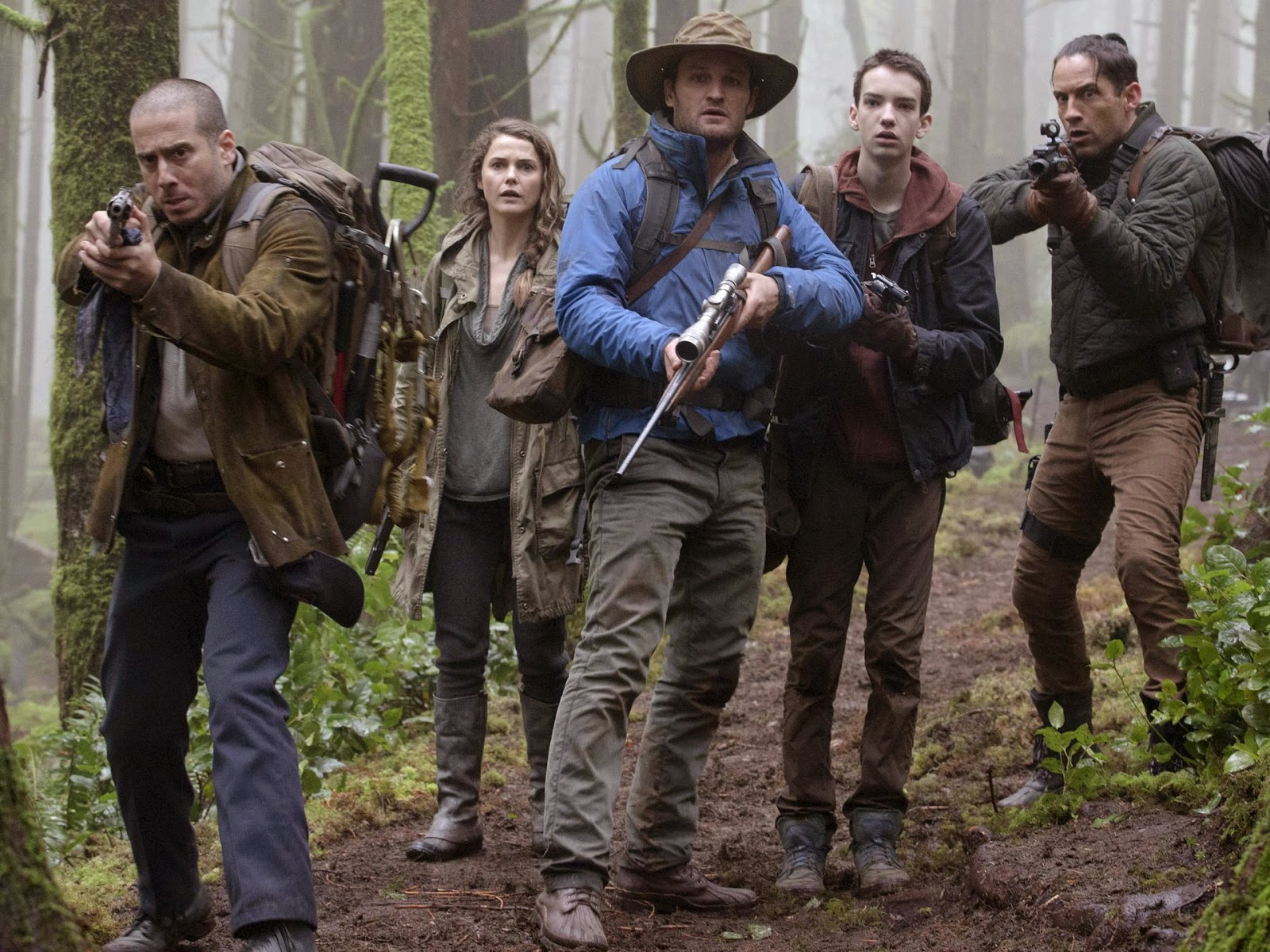
Review- In Dawn of the Planet of the Apes, it's been ten years since the Simian flu outbreak. Mankind has seemingly been wiped out by the disease while Caesar's established a thriving ape colony in the Muir Woods just outside San Fransisco. When a band of human survivors emerge desperate to gain access to hydroelectric dam that can provide power to their encampment, Caesar must grapple with the decision to remain isolated from humanity in order protect his people or work alongside the humans in hopes of co-existing peacefully.
Dawn of the Planet of the Apes saw a change in direction as Rupert Wyatt handed off the blockbuster baton to Matt Reeves. Reeves along with screenwriters Mark Bomba, Rick Jaffa, and Amanda Silver are then afforded the opportunity to thrust the viewer into a post-apocalyptic world that constantly swings the pendulum of being hopeful and hopeless. There are optimistic occasions where it seems ape and man can live alongside one another that are only contrasted by the horrors of warfare between two species.
Reeves and cinematographer Michael Seresin extenuate this disparity by capturing the natural beauty of California's prolific locales in the film's quieter, peaceful moments and shooting intense action sequences primarily in a dingy, disparaged urban environment. It really speaks wonders that Reeves and his technical crew were able to stage something as outrageous as primates wielding machine guns while riding horses and make it seem plausible. 
The Weta vfx artists also significantly stepped up their game as I still am unable to distinguish the motion-capture apes as being digital developments. The visual effects are undoubtedly an incredible achievement for the company that continually pushes the boundaries of technology in film. And I've got to give Michael Giacchino props for another sensational score full of captivating compositions.
In the acting department, Andy Serkis once again delivers a commanding performance via motion capture. Serkis is afforded an opportunity to intrinsically explore Caesar's responsibilities as a leader and father so Serkis imbues Caesar with the confidence, wisdom, and dedication that naturally accompanies said roles. Serkis is even backed by an exceptional primate posse including the likes of  Nick Thurston, Terry Notary, Karin Konoval, Judy Greer, and Larramie Doc Shaw as Blue Eyes, Rocket, Maurice, Cornelia, and Ash respectively. 
However Toby Kebbell challenges Serkis for the position of ruling motion-capture acting as his rampant, rage-induced primate Koba unleashes hell upon the humans and fellow apes. Kebbell gathers enough menace and intellect to portray Koba as a fearsome, undermining antagonist with understandable intentions, however radical those ideologies may be. It's precisely the quarrel between Caesar and Koba that evokes so many feuding philosophies found in history and cinema such as Malcolm X and Martin Luther King Jr. or Mufasa and Scar. 
On the human side of things, Jason Clarke takes up a trusting demeanor as Malcolm and the progression from unease to upmost confidence in Caesar is a fascinating journey. Meanwhile, Gary Oldman's one of the most reliable supporting actors around these days and he makes the most of his time onscreen with grit and gusto. Elsewhere, Keri Russell and Kodi Smitt-McPhee each offer some sufficient impressions for their allotted screen time as Ellie and Alexander.
In conclusion, Dawn of the Planet of the Apes succeeds at something only a scarce number of sequels ever accomplish. It significantly surpasses a fantastic first film and improves upon absolutely every aspect of the predeceasing chapter with an exhibition of technical mastery rarely seen in today's blockbuster franchises.

Film Assessment: A+