Showing posts with label James McAvoy. Show all posts

Friday, September 6, 2019

'It Chapter Two' Review

Synopsis: In the sleepy town of Derry, the evil clown Pennywise returns 27 years later to torment the grown-up members of the Losers' Club, who have long since drifted apart from one another.

Runtime: 169 minutes

MPAA Rating: R (for disturbing violent content and bloody images throughout, pervasive language, and some crude sexual material)

Who should see it? Adult fans of Stephen King and It (2017).
Directed by Andy Muschietti and penned by Gary Dauberman, It Chapter 2 adapts the remainder of Stephen King's beloved best-selling novel. Often, book fans are disheartened to discover specific scenes lost in the transition to the big screen. Well, fans of the source material will surely be delighted to learn It Chapter 2 is two hours and forty-nine minutes long. Though I haven't read the novel myself, I imagine It Chapter 2 is a faithful adaptation by virtue of its lengthy runtime. Not to mention, the added benefit of splitting the book into two movies. However, a film's running time can feasibly make-or-break the storytelling on display. In this case, It Chapter 2 felt drawn out and overstuffed.
Burdened by an over-reliance on flashbacks, It Chapter 2 must contend with advancing the present-day plot while "The Losers Club" confront their past trauma. The flashbacks are necessary to fill in gaps from its predecessor and inform the adult Losers' emotional response to their surroundings, but they derail the story's pace substantially. I suppose the filmmakers were reluctant to trim out the glut and hone in on a more focused narrative, but several scenes could have been abbreviated. Muschietti and company seem interested in delivering the most faithful adaptation possible, and though the ambition is admirable, a more economical use of screen time was achievable. On a brighter note, transitions between past and present were quite impressive, so hats off to editor Jason Ballantine for a job well done.
To take a detour from drawbacks, I appreciate the well-intentioned efforts of all involved. The cinematography, production design, and score effectively blend to establish a creepy atmosphere that the film scarcely abandons. Like the first, there are some cheap jump scares and I'd be reluctant to classify the onscreen events as "scary" (though horror's subjective). And also akin to its predecessor, It Chapter 2 is at its best when focused on "The Losers Club."
The teen and adult incarnations of "The Losers" are portrayed well by their respective casts. Depicting the middle-aged "Losers," Jessica Chastain, James McAvoy, Bill Hader, Isaiah Mustafa, Jay Ryan, James Ransone, and Andy Bean channel their striking characteristics to great effect. They're so well-cast that you conceivably envision the younger "Losers" maturing into them. Chastain, McAvoy, and Hader are notable stand-outs while the lesser-known cast members also demonstrate solid acting chops. Mustafa and Bean noticeably have less screen time as Mike and Stanley (a recurring issue from Chapter One), but their narrative significance somewhat compensates for that.
Jaeden Lieberher, Jeremy Ray Taylor, Sophia Lillis, Finn Wolfhard, Chosen Jacobs, Jack Dylan Grazer, and Wyatt Oleff each reprise their roles for flashbacks via the CG de-aging technique frequently showcased in Marvel movies as of late. However, the effectiveness of this technology varies drastically. Some of the children genuinely resembled their younger selves while the others had what I'd describe as unnaturally rubber faces. Given that most of these actors underwent puberty in-between installments, their voices are also altered in post-production, which was also quite noticeable. In an ideal world, this footage would have been shot during production of the first chapter, but I understand budgetary restraints, scheduling, and an incomplete script likely prohibited that from happening. In spite of these technological flukes outside their control, the young actors lend ample nuance to these characters once more. 
Returning as Pennywise, Bill Skarsgård plays the deranged clown quite well. However, as an antagonist, Pennywise put up a lousy effort attempting to stop the Losers where he'd often come and go as the plot dictated. While the Loser's mindset (realizing it's not real) occasionally resisted him, that wasn't always a factor in his sudden disappearances. 
Despite its flaws, fans of Stephen King needn't fear for the second chapter's buoyancy. Ambition, top-rate production value, and a skillful ensemble are enough to keep this sequel afloat, but It Chapter 2 is a bloated and uneven follow-up.

Film Assessment: B-

Sunday, June 9, 2019

'Dark Phoenix' Review

Synopsis: During a life-threatening space rescue mission, Jean Grey is hit by a cosmic force that transforms her into one of the most powerful mutants of all. Wrestling with an increasingly unstable power as well as her personal demons, Jean spirals out of control, tearing the X-Men family apart and threatening to destroy the very fabric of our planet.

Runtime: 113 minutes

MPAA Rating: PG-13 (for intense sequences of sci-fi violence and action, including some gunplay, disturbing images, and brief strong language)

Who should see it? Marvel fans who are eager to see the end of Fox's X-Men Saga.
Written and directed by longtime X-Men writer/producer Simon Kinberg as his feature directorial debut, Dark Phoenix is the twelfth and, presumably, final entry in 20th Century Fox's X-Men universe. In nineteen years, there have been six prior X-features, three spin-offs starring Wolverine, and two Deadpool side-adventures. Though the studio delivered a series of superhero installments with inconsistent quality and jumbled continuity, there were genuine gems among the bunch, and Bryan Singer's X-Men was at the forefront of the comic-book movie craze alongside Sam Raimi's Spider-Man in the early 2000s. Those films were largely responsible for driving interest in the cinematic superhero offerings seen today, so it's bitter-sweet to see the franchise come to an end on account of Disney's recent Fox acquisition.
One notable implication regarding the Disney/Fox merger is that Marvel Studios will finally have creative control over the Fantastic Four, X-Men, and other related comic entities. Free to integrate these popular comic characters into their cinematic universe, I imagine we'll see rebooted incarnations from Marvel and Disney soon enough. Of course, there are plenty of troubling concerns and silver linings pertaining to the merger, but that's a discussion for another day. Between numerous release delays and extensive reshoots, Dark Phoenix experienced a troubled production and many wondered if Dark Phoenix and The New Mutants would ever see the light of day under Disney's dominion. While the jury's still out on The New Mutants, Dark Phoenix finally flew into cinemas this weekend but is looking to crash and burn with the lowest respective Rotten Tomatoes score and opening weekend box office gross of the entire franchise.
Honestly, Dark Phoenix is far from the worst X-Men film though. X-Men Origins: Wolverine, X-Men: The Last Stand, and X-Men: Apocalypse are each more deserving of that distinction in my mind. Dark Phoenix contains plenty of interesting ideas which are unfortunately fumbled in execution and will be overlooked due to some cheesy moments and awful dialogue. However, the bad is balanced out by moderately engaging action, a gifted ensemble, and another astounding score from Hans Zimmer. I genuinely appreciated the opening fifteen-twenty minutes, but the film teeters out and loses steam in the second act's sea of angsty melodrama. Above all, the biggest issue facing Dark Phoenix is that we barely know this younger iteration of the X-Men, and Kinberg's narrative depends on audience investment.
Jean Grey, Cyclops, Nightcrawler, and Storm were all briefly introduced and scarcely developed as supporting presences in X-Men: Apocalypse. Apocalypse was overcrowded with characters, so barely anyone did anything remotely consequential in that movie or much less experienced character growth, but there needed to be at least one other film between Apocalypse and Dark Phoenix to flesh them out as individuals. Instead, the development occurs off-screen. As a result, I didn't really care about the team's melodrama because they'd barely been defined as characters.
As for the cast, most everyone gets a moment to shine in-spite of thin characterization. Sophie Turner never reaches her full potential as Jean Grey but does the best with what she's given and lends weight to the dramatic, under-written heel turn of her character. Turner sells Jean's conflicted and complex emotional state, as well as her menacing qualities when faced against her fellow mutants. On the other hand, Jessica Chastain portrays Vuk as an uninspired alien antagonist void of all personality. The character's meant to be detached, and her motivation's clearly laid out, but Vuk fails to resonate as a person of interest because it may as well be played by a cardboard cut-out of Chastain.
The First Class crew of James McAvoy, Michael Fassbender, Nicholas Hoult, and Jennifer Lawrence reprise their roles for the fourth time, finally ready to bow out as Professor X, Magneto, Beast and Mystique. Fassbender and McAvoy continue to be series MVPs, lending further nuance to the ongoing debate between Charles Xavier and Erik Lehnsherr, while Hoult's Hank McCoy grapples with an emotional dilemma and Lawrence arrives to set caked in cheaper-looking blue make-up to collect her paycheck and fulfill the remainder of her contract. Carrying over from Apocalypse, Tye Sheridan's Cyclops, Alexandra Shipp's Storm, Kodi Smit-McPhee's Nightcrawler, and Evan Peters' Quicksilver are unfortunately relegated to meager supporting roles with the occasional impressive display of their abilities. Their narrative contributions are inconsequential, and it's a shame that these characters were side-lined once more.
Viewers are ultimately left with a watchable superhero flick, but those are now a dime a dozen. The Fox X-Men franchise finally burnt out, but I'm looking forward to seeing what rises from the ashes in the capable hands of Kevin Feige and Marvel Studios. Hopefully, Marvel can reignite audience interest in these classic comic characters.

Film Assessment: C

Sunday, January 20, 2019

'Glass' Review

David Dunn now runs his own home security store while moonlighting as a brutal vigilante in a green poncho, referred to as "The Overseer." After tracking down and subsequently tussling with Kevin Wendell Crumb, the pair are placed in a psychiatric hospital. Supervising and studying them is Dr. Ellie Staple who specializes in a very particular illusion of grandeur... this who believe they are superheroes. They're not alone though, also under Staple's care is a heavily sedated Elijah Price. As the trio grow wary of their situation, plans are put in place for some orchestrated chaos. 
Since it's been two years, I'm going to write this review with the assumption you're aware of the end-twist in Split... 

**Spoiler Warning for Split**

That being, Split was secretly set in the same universe as M. Night Shyamalan's Unbreakable. Written and directed by M. Night Shyamalan, Glass is simultaneously a sequel to Unbreakable and Split, bringing those characters together for an exciting culmination. Now, Shyamalan's had a turbulent career as a writer/director, to say the least... His successful streak of The Sixth Sense, Unbreakable, and Signs was immediately followed by a series of critical and/or commercial duds. Eventually, it appeared as though Shyamalan had overcome that unpleasant portion of his filmography with an apparent resurgence via The Visit and Split. Needless to say, Glass will be probably his most polarizing film yet.
I can totally understand why someone would leave the theater loving or hating Glass. The expectations for Glass are surely through the roof considering Unbreakable fans have waited nineteen years for a sequel and Split only amplified that fan fervor by teasing that precise possibility two years ago. Some people were bound to leave disappointed regardless of what Shyamalan did. Glass is certainly not perfect, as Shyamalan's inconsistency as a filmmaker does ultimately prove a tad troublesome, but I viewed it as a fascinating deconstruction of the modern superhero movie.
Though certainly not subtle about it, Shyamalan subverts genre tropes audiences have come to love in their Marvel and DC comic-book film adaptations and provides commentary on the genre regarding its predictability and rigid story structure. This deviation from the perceived norm of a superhero story will undoubtedly upset many, but I perceived it as a refreshing change of pace. A deliberately slow-paced second act followed by some specific revelations in the third act also won't work for some, but I was riveted and entirely onboard for it all. By the way, I'd highly recommend seeing (or even rewatching) both Unbreakable and Split beforehand, as Glass operates as though the viewer is already familiar with both predeceasing films and doesn't waste much time catching up new audience members. Glass does at times seem to be serving too many masters in trying to be a satisfying follow-up to Unbreakable and Split, but ultimately, the characters, tone, and sensibilities of those films coalesce quite well. At the start, it does noticeably seem to jump back-and-forth from being an Unbreakable sequel to a Split sequel. It takes some time, but it did gel eventually, and I was particularly pleased with one late revelation which tied everything together very efficiently. 
Regarding other issues, there are some elements which carried over from Split that still didn't work for me such as The Beast. I'm sorry, but The Beast looks so ridiculous when he's running around on all fours, climbing walls, and even when he speaks due to McAvoy's facial mannerisms. It's laughable to be totally honest, and I can assure you that's why awards voting bodies didn't grant James McAvoy serious awards consideration for Split. There's one plot device in particular which seemingly exists to best showcase McAvoy's acting ability as he'd rapidly switch between the twenty-four personalities as the story demanded. It's impressive, but obviously around for that purpose in select scenes. 
Otherwise, my eyeballs were glued to the screen as cinematographer Mike Gioulakis masterfully lit the colorful costumes and vivid scenery. Despite being made on a $20 M budget self-financed by Shyamalan, Glass' production value is top-notch. I'd like to particularly highlight the crushing sound design and West Dylan Thordson's wide array of intense accompaniment. As per usual, Samuel L. Jackson is excellent as the titular character (though it could be debated he's not the lead or protagonist). Jackson convincingly communicates the genius mind and shattered vulnerability of Mr. Glass as he previously did in Unbreakable. In my eyes, he really stole the show as a mesmerizing mastermind, though I can see why some might point to James McAvoy as the prime performer.
On the subject of McAvoy, he once again provided splendid portrayals of Kevin's twenty-four plotting personalities (which I'll further refer to as "The Horde"). Though I still find The Beast quite silly in execution, McAvoy clearly gave the role his all and watching him further embody so many distinct individuals was a delight! As the sole other returning cast-member from Split (not qualifying Bruce Willis' cameo), Anya Taylor-Joy's Casey Cooke is an important inclusion. While Taylor-Joy doesn't have nearly as much screen-time as she did in Split, her character helps ground the proceedings through her history and complicated connection to Kevin and "The Horde." Despite being somewhat underutilized in the grand scheme of things, Taylor-Joy puts forth an exemplary performance. 
Last of the three "powered" characters, Bruce Willis lends a familiar stoicism and apprehension to David Dunn. Willis has notoriously not seemed to care about any recent performance of his, and while it may be a low bar, this is surely his best outing in years! Reprising the role of Dunn's son Joseph, Spencer Treat Clark was also quite good. 
Meanwhile, Sarah Paulman's Dr. Ellie Staple and Charlayne Woodard's Mrs. Price are noteworthy supporting players. Paulson particularly lends a calm composure and aura of mystique around the psychiatrist she plays, which paid off in one of the film's final revelations, while Woodard was wonderful whenever onscreen. 
In spite of a split critical reception, Glass shattered my expectations as a satisfying conclusion to Shyamalan's superhero trilogy, and for the time being, I'd say the Shyamalan resurgence remains unbreakable.

Film Assessment: B+

Thursday, July 27, 2017

'Atomic Blonde' Review

Atomic Blonde pits audiences in the thick of the Cold War. Pre-eminent MI-6 agent Lorraine Broughton has been sent into Berlin to work alongside ambiguous agent David Percival and retrieve a list containing classified intel on several secret agents that could compromise them all and potentially prolong the lasting international anxiety.
Atomic Blonde is directed by skilled stunt-coordinator and stuntman David Leitch with Kurt Johnstad spearheading the screenplay based on Antony Johnson and Sam Hart's graphic novel The Coldest City. Leitch has worked on many renowned action films over-the-years including the likes of The Matrix trilogy, The Bourne Ultimatum, and The Bourne Legacy but he's probably most well-known for co-directing John Wick alongside Chad Stahelski. Earlier this year, Stahelski struck out on his own to direct John Wick: Chapter 2 solo, but now it's Leitch's turn.
Leitch is currently set to direct next year's Deadpool 2, which is deep in the production process at this point (but you never know what could happen with all the director drama as-of-late), and after watching Atomic Blonde I'm fairly confident he'll be able to handle things on his own there. In Atomic Blonde, Leitch turns up the stylistic flourish that propelled John Wick to prominence but the film overall winds up feeling more akin to something like Hardcore Henry, another unique European-driven action film that couldn't help but succumb to the tropes of the genre.
Lorraine may be British, but she's definitely more Bourne than Bond. Leitch takes his years of stunt experience and utilizes it to offer Theron an unwieldy and unrestrained visceral fighting style that's simply thrilling to watch. It's such a relief to be able to see what's happening onscreen in an action movie because much of the last ten years has been dominated by gratuitous shaky-cam. However, the con to this was that Focus Features took note and plastered these sequences all over the marketing. I didn't ever go out of my way to watch an Atomic Blonde trailer. I saw the marketing material for the film almost exclusively in theaters and maybe once or twice as an ad in front of a YouTube video but while watching the film, I felt as though I'd seen nearly all the action already.
There was one brutal, bare-knuckles fisticuff in a staircase that I had not already seen a glimpse of that was so intense, even I felt a little winded when it was all over. As you can probably tell by now, Atomic Blonde rests its hat on the extraordinary execution of its action. I kept hoping something would rise to challenge the action, but nothing ever did.
Atomic Blonde's story is nothing special. I can guarantee you've seen this premise at least a dozen times before. The idea of a list leaking that could jeopardize an entire agency is nothing new and I'd be totally fine with that if the surrounding circumstances were more interesting. Everything about the plotting of Atomic Blonde just felt like every other generic action movie, the only difference being I had no idea why anything happened when it was all over.
In a spy movie you expect a number of double-crosses and surprises, but it was unfathomable to me how the motivations fueling all these characters were incredibly unexplainable. When the movie was over, the friend who joined me at the screening asked if I understood exactly what happened at the end and I was unable to provide an answer. I realized I had absolutely no idea because none of the plotting made a lick-of-sense. Information will inevitably be withheld from you during a spy film, but even with the additional information I couldn't quite piece everything together.
I think even poor plotting can be excused if you still manage to invest yourself in the characters, but I even had difficulty doing that. Atomic Blonde puts an outstanding amount of effort into make the viewer think Lorraine is cool by having her confidently smoking cigarettes, drinking vodka, and kicking butt like nobody's business. Unfortunately, none of that really worked for me as Charlize Theron was as insipid as Scarlett Johansson in Lucy. Theron's performance isn't bad per-say. It's simply soulless. In trying to be cool, Theron played things straight but to such an absurd degree that Lorraine lacks a personality all together. In comparing Lorraine to Johansson's other infamous agent Black Widow, you'll find shades of a complex past buried within both individuals but only Romanov exhibits a shred of humanity. 
Sofia Boutella strides in to redeem herself from The Mummy (2017) and add further credence that her scene-stealing turn in Kingsman: The Secret Service was no fluke. Boutella's French agent's an interesting side character who doesn't have quite enough screen time to fully flesh her character out, but she serves her narrative purpose well.
In the meantime, James McAvoy runs away with another outstanding supporting turn as David Percival. Percival's an unpredictable kooky agent that held his screen presence well opposite other seasoned performers and McAvoy proves his powerful performances aren't coming to an end anytime soon.  
 
Filling out the cast, John Goodman and Toby Jones fulfill the need for governmental entities and Eddie Marsan's Spyglass was a surprising standout. One last interesting thing to note is Atomic Blonde's unabashed use of '80s hits to fill the atmosphere. It's not exactly integral to the story like the soundtracks fueling Baby Driver or Guardians of the Galaxy Vol. 2, but it's a fun mix nonetheless.
In summary, I think you can wait to catch Atomic Blonde on cable or home media and your money might be best spent seeing some of the diverse selections that have emerged in the past month such as Baby Driver, The Big Sick, Spider-Man: Homecoming, War for the Planet of the Apes, or Dunkirk. Atomic Blonde, much like its proverbial heroine, boasts some slick style but can't carry the necessary, underlying substance. The film reminded me of Bond's favorite alcoholic beverage once it was over; shaken around quite a bit, but not particularly stirring.

Film Assessment: C+

Wednesday, February 1, 2017

'Split' Review


Sorry that it's taken so long for me to review Split but I've had a busy couple of weeks and I just got around to seeing it, so without further ado, here are my thoughts on Split.

'Split' Review


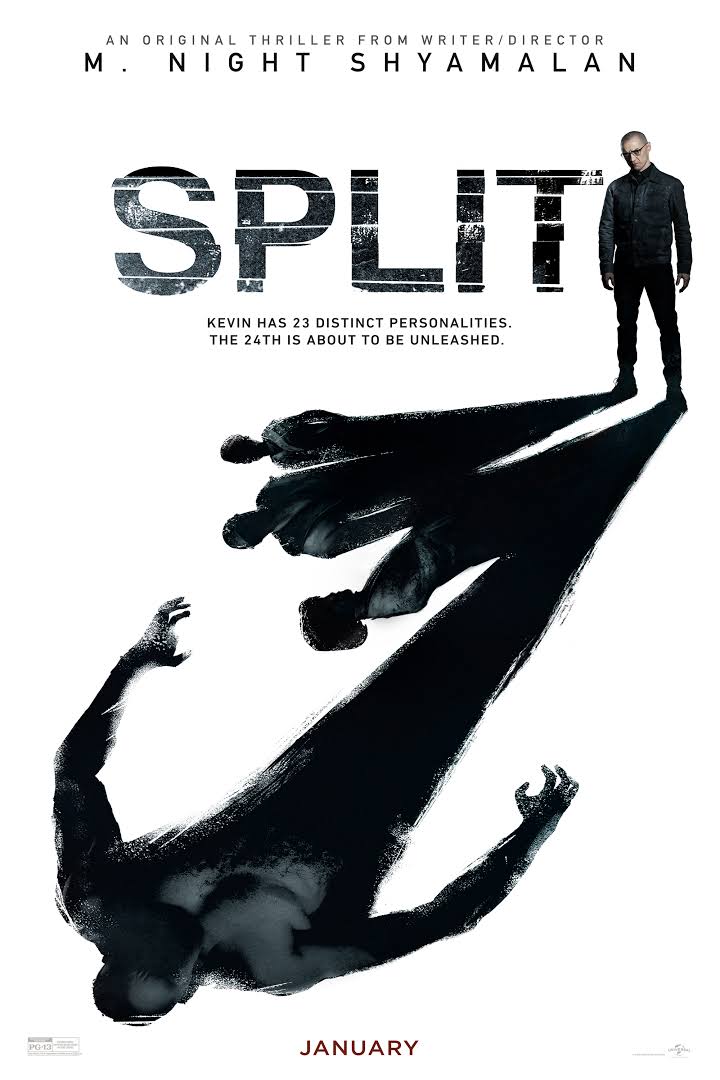
In Split, three teenage girls are kidnapped and held captive by a mysterious man. The twist is that Kevin has Dissociative Identity Disorder, with twenty-three distinct personalities and a twenty-fourth about to emerge called "The Beast." But if you can read a poster and have seen the trailer you could probably gather as much, while the proceeding events are fairly typical of most modern thrillers I'll avoid going into further detail to stay away from spoiling anything for those who have yet to see it. 
M. Night Shyamalan wrote and directed Split after last year's resurgence, The Visit, that officially broke his streak of what was becoming a very grotesque filmography, including The Last Airbender and After Earth to name a few stinkers. Shyamalan could have easily fallen back into the slumps with Split but a return to his low budget roots definitely did him some good as Split is easily Shyamalan's best film since Signs and a return to form for the formerly esteemed director, who has picked himself back up from his plummet into the realm of dreadfully forgettable blockbusters. 
Shyamalan's direction is attuned to the slightest detail in his efforts to build suspense. Split's supporting technical elements only amplify Shyamalan's vision with cinematographer Mike Gioulakis' nifty camerawork making the most out of the tight spaces, editor Luke Franco Ciarrocchi capably cuts everything together, and West Dylan Thordson's score serving as a chilling ambient undercurrent. Fans of Shyamalan's work are familiar with his tendencies to include many twists and turns throughout his films and Split is no exception with the occasional twist and a huge reveal at the end that will certainly cause massive Shyamalan fans to freak out. The drawbacks arise from Shyamalan's uninspired storytelling and sloppy supporting characterization. Ideally, the film would have been more suspenseful had a majority of its story been contained to a single location akin to both of last year's claustrophobic thrillers 10 Cloverfield Lane and Don't Breathe (On that note I think the font used for the opening credits is the same font used for 10 Clover Field Lane's logo). 
When Shyamalan ventures outside of Kevin's space (where the girl's are being held captive), the film comes to a screeching halt and uneven pacing emerges. While these diversions are seemingly unnecessary, they hold greater importance later on and were certainly imperative for the narrative. With this being said, it could have been tightened and refined to better serve the viewing experience rather than continuously deviating from the suspenseful ride. A slow burn is much more impactful if you can feel the palpable tension rising in the context of a confined space over a prolonged amount of time, something both of the aforementioned films captured expertly. The poorly placed character recollections and scenes outside Kevin's dwelling simply detract from the brewing tension and force Shyamalan back to square one each time he revisits the cramped quarters. 
Shyamalan also falls victim to enabling a few too many plot conveniences in his screenplay that are downright bothersome towards the film's finale. I can't really discuss these as openly as I'd like but trust me they make absolutely no sense under scrutiny. Another thing is that I still have yet to understand why Kevin needed to have twenty four personalities if we only see eight over the course of the film (and this includes his primary personality). Like why couldn't he have just had eight to simplify things? There was no desperate need to have twenty four personalities but I guess this was made with the intention of a sequel and there's gotta be SOMETHING to bring to the table we haven't previously seen. 
For my last nitpick, I have to say that Shyamalan encroached on some seriously outlandish ideas for the third act, considering that the film that had been fairly grounded in the previous two acts. Again, I won't spoil anything but it's really strange and takes the film in an unexpected and undesired direction but Shyamalan fortunately gets back on track before he concludes. 
As for characterization, Shyamalan's never really been one to flesh out his supporting players but aside from the two leads (Kevin and Casey) almost every other character was a forgettable one-dimensional caricature or literally a walking-talking plot device. Thankfully, Shyamalan neither writes the three teenagers to be unreasonably moronic or unbelievably intelligent but in collaboration with the three actresses manages to find the ideal middle ground for an authentic portrayal of how a teen would realistically behave in this situation. 
Anya Taylor-Joy, a breakout genre star last year after pivotal roles in both The Witch and Morgan, provides an incredibly layered heroine for the audience to support as Casey Cooke, an introverted recluse. Haley Lu Robinson and Jessica Sula make for serviceable side characters and fill the duties of their roles but are written to be so irrelevant that they're easily forgotten when not onscreen. 
Betty Buckley's psychiatrist Dr. Karen Fletcher essentially delivers expositional dialogue explaining Kevin's condition and moving the plot along. Simply put, she wasn't much of an actual character but the fault for that lies with the script not Buckley's performance. She's an excellent candidate but honestly this role could have gone to just about any actress and been just as impactful.
James McAvoy on the other hand was absolutely a scene-stealing presence throughout and this is most certainly McAvoy's most versatile role to date. McAvoy brilliantly gets in the headspace of eight different individuals inside Kevin (again... we don't see all twenty three/four) and portrays all of them with ever-changing physique, alternative mannerisms, and speech patterns that successfully capture the slightest details of the respective personas. He plays everything from an obsessive compulsive to a matriarch to a anxious nine year old boy, the latter of which is proving to be an audience favorite and source of many internet memes, etcetera. 
Perhaps the most unsettling aspect of Split is James McAvoy's commitment to the creepy characterizations, but beyond that the story doesn't offer up too much to unnerve the viewer due to uneven pacing and problematic storytelling. If it's any consolation, Split succeeds on the merits of its multifaceted antagonist, compelling protagonist, precise technical execution, and is one of Shyamalan's higher marks in his spotty career. 

Film Assessment: B-

Friday, May 27, 2016

'X-Men: Apocalypse' Review

Wednesday evening I attended an early screening of X-Men: Apocalypse and I'm just now publishing my review for a few reasons: first off, it will likely get the most attention today, secondly yesterday I was focused on a barrage of reviews for Alice in Wonderland, X-Men: First Class, and X-Men Days of Future Past - The Rogue Cut, and last but not least I had more time to reflect on the film to give a fairer review. Anyways, I've been looking forward to this film ever since watching the post credits scene of X-Men: Days of Future Past and so I've had about two years for my anticipation to build. Naturally this would mean my expectations were pretty high. Keep that in mind as you're reading my review because if you have tempered expectations this movie will probably be awesome in your eyes. 

'X-Men: Apocalypse' Review


When the early screening of X-Men: Apocalypse I attended Wednesday night ended, I found myself a bit underwhelmed. Therefore, I think it was for the best that I waited to review this film and let my opinion of it settle in. By no means is X-Men: Apocalypse a "bad movie", rather along the lines of underwhelming. X-Men: Apocalypse just wasn't able to measure up to it's predecessors in the young X-Men Trilogy (I'm not sure if there's an actual name for these or not but I'm referring to X-Men: First Class and X-Men Days of Future Past). 
Bryan Singer returns to helm his sequel to Days of Future Past, the first time he's directed two consecutive X-Men flicks since X-Men and X2, and X-Men: Apocalypse picks up a decade after Days of Future Past allowing Singer to tackle the 80's, something reflected in the believable hair, costume, and production design. 
There's actually a brief Star Wars reference where the characters discuss trilogies and Singer effectively takes a jab at X-Men: The Last Stand. Too bad the joke held true for this installment in comparison to First Class and Days of Future Past. It's a hilarious moment that Star Wars fans will definitely appreciate that takes full advantage of the 80's setting. 
Singer sizes down the scale of the film as there's no time travel elements to be found, but the stakes have never been higher for the X-Men as global destruction is certainly possible thanks to Apocalypse. The screenplay penned by Simon Kinberg finds itself muddled as there are just too many characters and storylines to properly service. The film tasked itself with not only continuing the saga of a younger Professor X, Magneto, Mystique, Quicksilver, and Beast, but also introducing a new baddie in Apocalypse, his subservient horseman, and younger versions of Cyclops, Jean Grey, and Nightcrawler. I can confidently say that Kinberg pulls most of it off. 
I say "most" as I found the creative team did a wonderful job depicting Cyclops, Jean Grey, and Nightcrawler and even continuing the ongoing arc from all the way back to First Class, but failed to give many of the characters the time and attention they deserved. For example, two of Apocalypse's horseman had no more than five lines of dialogue, with Storm having scarcely more than that to say. 
The Horsemen were basically around to give the X-Men someone to fight other than just Apocalypse and as fan service, not to say I didn't find the horseman cool just that some were underused. The makeup, costuming, and visual effects have never been better in the X-Men films as is to be expected with today's marvelous technology and modern filmmaking. However, there were a few spots here and there were some of the CGI looked a little fake. 
The film doesn't disappoint with it's action though, as there's one sequence featuring Magneto that's just heart wrenching, two showstopper sequences from Quicksilver that actually managed to top his incredible sequence in Days of Future Past, the action packed third act finale, and of course a cameo appearance from a fan favorite mutant in a gruesome sequence that will probably make any comic book fan a little giddy. If you've seen the final trailer you probably know who I'm referring to. 
So you're probably wondering if there's more to the movie than just spectacle to which I'll say there's a terrific cast amassed, whoever cast the new young mutants deserves a pat on the back. James McAvoy's back as a more seasoned Charles Xavier that I feel can finally adopt the monicker Professor X. 
Michael Fassbender gets a fresh arc for Magneto where he gets to really show off his dramatic acting chops and emotional gravitas that ties up his character arc in a satisfying manner (I wouldn't be surprised if he comes back in a future X-Men film though). 
Jennifer Lawrence's performance is quite bland as Mystique. It's difficult to tell if she really wants to be a part of this franchise anymore given her voiced complaints about Mystique's makeup and the franchise in general but it seems like she mailed this performance in due to contractual obligations. She's only in the Mystique guise when she's forced to be and just serves as an inspiration to the other mutants. Lawrence isn't terrible but her performance is certainly lacking compared to her previous turns as Mystique. 
Nicholas Hoult sadly is given very little to do as Hank McCoy, but if you want to get the most out of his performance I'd recommend watching both X-Men: First Class and X-Men: Days of Future Past - The Rogue Cut. He gets some awesome fight scenes as Beast in the third act and I can't praise the makeup work for his look as Beast enough. 
Evan Peters' Quicksilver is given significantly more to do as a result of the positive response to his turn in Days of Future Past. Quicksilver has a more emotional arc once he learns of his parentage, but that doesn't stop the speedster from having fun along the way. 
Newcomers, Sophie Turner, Tye Sheridan, and Kodi Smit-McPhee are all delightful as Jean Grey, Cyclops, and Nightcrawler. I particularly took a shine to Smit-McPhee's Nightcrawler and he's definitely my favorite character in this franchise after seeing him steal just about every scene he's apart of. 
The film also brings back Rose Byrne's Moira Mactaggert and Alex Till's Havok from First Class who I don't feel were vital to the film's story but had some great moments nonetheless. 
Oscar Isaac gets to go full baddie as Apocalypse, and I've got to say he was terrifying so I was satisfied with his portrayal. One little nitpick regarding Apocalypse was that his motive wasn't convincing and Apocalypse was evil for the sake of being evil and wanting power, etc. 
Under Apocalypse's control we find the four horseman, Magneto, Storm, Archangel, and Psylocke. Alexandra Shipp is serviceable as Storm but I don't think she's the definitive version like Turner's Jean Grey, Sheridan's Cyclops, and McPhee's Nightcrawler. Storm was cool in the action sequences she partook in but she didn't get enough development in my opinion. It's not like Berry's Storm was that developed either though. Ben Hardy's Angel/Archangel and Olivia Munn's Psylocke have virtually nothing to do as they're purely around for spectacle in the third act finale. 
When it comes down to it, there's enjoyment to be had and the film is fairly good. but just didn't meet my expectations. I can say that it excites me to think of the possibility of a 90's followup featuring the same cast but it's a shame that X-Men: Apocalypse just ultimately serves to setup that potential sequel rather than stand on it's own. Longtime fans of the X-Men movies should have a good time as it's shameless entertainment, but just be aware that the film ultimately feels like hollow spectacle and is missing the heart and care given to First Class and Days of Future Past.

Film Assessment: C+