Showing posts with label Sarah Paulson. Show all posts

Sunday, January 20, 2019

'Glass' Review

David Dunn now runs his own home security store while moonlighting as a brutal vigilante in a green poncho, referred to as "The Overseer." After tracking down and subsequently tussling with Kevin Wendell Crumb, the pair are placed in a psychiatric hospital. Supervising and studying them is Dr. Ellie Staple who specializes in a very particular illusion of grandeur... this who believe they are superheroes. They're not alone though, also under Staple's care is a heavily sedated Elijah Price. As the trio grow wary of their situation, plans are put in place for some orchestrated chaos. 
Since it's been two years, I'm going to write this review with the assumption you're aware of the end-twist in Split... 

**Spoiler Warning for Split**

That being, Split was secretly set in the same universe as M. Night Shyamalan's Unbreakable. Written and directed by M. Night Shyamalan, Glass is simultaneously a sequel to Unbreakable and Split, bringing those characters together for an exciting culmination. Now, Shyamalan's had a turbulent career as a writer/director, to say the least... His successful streak of The Sixth Sense, Unbreakable, and Signs was immediately followed by a series of critical and/or commercial duds. Eventually, it appeared as though Shyamalan had overcome that unpleasant portion of his filmography with an apparent resurgence via The Visit and Split. Needless to say, Glass will be probably his most polarizing film yet.
I can totally understand why someone would leave the theater loving or hating Glass. The expectations for Glass are surely through the roof considering Unbreakable fans have waited nineteen years for a sequel and Split only amplified that fan fervor by teasing that precise possibility two years ago. Some people were bound to leave disappointed regardless of what Shyamalan did. Glass is certainly not perfect, as Shyamalan's inconsistency as a filmmaker does ultimately prove a tad troublesome, but I viewed it as a fascinating deconstruction of the modern superhero movie.
Though certainly not subtle about it, Shyamalan subverts genre tropes audiences have come to love in their Marvel and DC comic-book film adaptations and provides commentary on the genre regarding its predictability and rigid story structure. This deviation from the perceived norm of a superhero story will undoubtedly upset many, but I perceived it as a refreshing change of pace. A deliberately slow-paced second act followed by some specific revelations in the third act also won't work for some, but I was riveted and entirely onboard for it all. By the way, I'd highly recommend seeing (or even rewatching) both Unbreakable and Split beforehand, as Glass operates as though the viewer is already familiar with both predeceasing films and doesn't waste much time catching up new audience members. Glass does at times seem to be serving too many masters in trying to be a satisfying follow-up to Unbreakable and Split, but ultimately, the characters, tone, and sensibilities of those films coalesce quite well. At the start, it does noticeably seem to jump back-and-forth from being an Unbreakable sequel to a Split sequel. It takes some time, but it did gel eventually, and I was particularly pleased with one late revelation which tied everything together very efficiently. 
Regarding other issues, there are some elements which carried over from Split that still didn't work for me such as The Beast. I'm sorry, but The Beast looks so ridiculous when he's running around on all fours, climbing walls, and even when he speaks due to McAvoy's facial mannerisms. It's laughable to be totally honest, and I can assure you that's why awards voting bodies didn't grant James McAvoy serious awards consideration for Split. There's one plot device in particular which seemingly exists to best showcase McAvoy's acting ability as he'd rapidly switch between the twenty-four personalities as the story demanded. It's impressive, but obviously around for that purpose in select scenes. 
Otherwise, my eyeballs were glued to the screen as cinematographer Mike Gioulakis masterfully lit the colorful costumes and vivid scenery. Despite being made on a $20 M budget self-financed by Shyamalan, Glass' production value is top-notch. I'd like to particularly highlight the crushing sound design and West Dylan Thordson's wide array of intense accompaniment. As per usual, Samuel L. Jackson is excellent as the titular character (though it could be debated he's not the lead or protagonist). Jackson convincingly communicates the genius mind and shattered vulnerability of Mr. Glass as he previously did in Unbreakable. In my eyes, he really stole the show as a mesmerizing mastermind, though I can see why some might point to James McAvoy as the prime performer.
On the subject of McAvoy, he once again provided splendid portrayals of Kevin's twenty-four plotting personalities (which I'll further refer to as "The Horde"). Though I still find The Beast quite silly in execution, McAvoy clearly gave the role his all and watching him further embody so many distinct individuals was a delight! As the sole other returning cast-member from Split (not qualifying Bruce Willis' cameo), Anya Taylor-Joy's Casey Cooke is an important inclusion. While Taylor-Joy doesn't have nearly as much screen-time as she did in Split, her character helps ground the proceedings through her history and complicated connection to Kevin and "The Horde." Despite being somewhat underutilized in the grand scheme of things, Taylor-Joy puts forth an exemplary performance. 
Last of the three "powered" characters, Bruce Willis lends a familiar stoicism and apprehension to David Dunn. Willis has notoriously not seemed to care about any recent performance of his, and while it may be a low bar, this is surely his best outing in years! Reprising the role of Dunn's son Joseph, Spencer Treat Clark was also quite good. 
Meanwhile, Sarah Paulman's Dr. Ellie Staple and Charlayne Woodard's Mrs. Price are noteworthy supporting players. Paulson particularly lends a calm composure and aura of mystique around the psychiatrist she plays, which paid off in one of the film's final revelations, while Woodard was wonderful whenever onscreen. 
In spite of a split critical reception, Glass shattered my expectations as a satisfying conclusion to Shyamalan's superhero trilogy, and for the time being, I'd say the Shyamalan resurgence remains unbreakable.

Film Assessment: B+

Sunday, June 10, 2018

'Ocean's Eight' Review

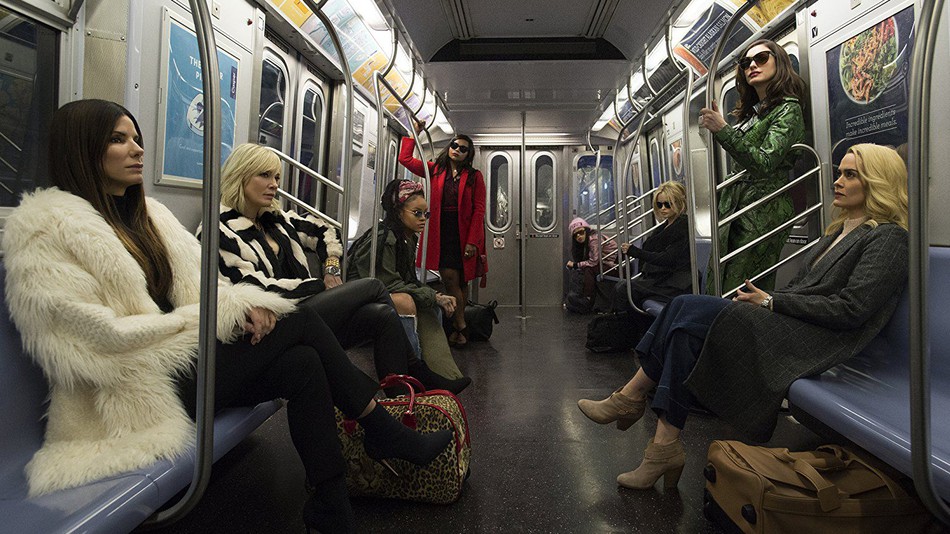
After being released from a five year prison sentence, Debbie Ocean sets out to recruit an all-female crew and pull off the heist of a lifetime by stealing a $150 million necklace during New York City's annual Met Gala.
Ocean's Eight functions as an extension of sorts to the pre-existing Ocean's Trilogy, and this is made abundantly clear in the film's opening where it's confirmed that Debbie is Danny Ocean's sister (this is in the trailers). Since I had absolutely no attachment to the Ocean's Trilogy on behalf of never having seen the films prior to a few days ago, I wasn't perturbed when this all-female reboot was announced. In fact, I was somewhat intrigued by the A-list talent assembled for the project and thought the reboot had huge potential. However, I was very surprised not to see a similar backlash which befell 2016's Ghostbusters, since that film was also a gender-swapped reboot. I suppose this is simply because the 1984 Ghostbusters is much more beloved than any Ocean's installment, plus the blowback was lessened by the fact Ocean's Eleven (2001) was already a remake and this spin-off happens in the same universe. 
The lady-led soft reboot was spearheaded by Gary Ross who took up directorial duties, wrote the story treatment solo, and penned the screenplay alongside Olivia Milch. Unfortunately, these are the areas in which I found Ocean's Eight to be the most lacking. While certainly a competently made film, Ocean's Eight lacks its own voice in the ever-growing heist genre and this is largely because Ross seems reluctant to put his own stamp on the film. Where Steven Soderbergh has made an effort to put his own spin on heist films with Logan Lucky and his Ocean's Trilogy, Ross simply retreads old ground with the same franchise blueprints. It's almost as though Warner Bros. saw the toxic fanboy reaction to Ghostbusters (2016) and decided it would be best to play things as safe as possible with a familiar story and nothing new aside from an almost entirely female ensemble. As a result, there's very little to differentiate Ocean's Eight from any of the other installments in the Ocean's franchise or any other heist film for that matter. 
It just felt as though Ocean's Eight was going through the motions of the conventional heist formula. One thing that was particularly bothersome was that **very minor spoiler warning, I guess?**  the heist went off without a hitch. All of the obstacles felt like they were easily overcome in a matter of seconds, so this heist which is supposed to be ridiculously difficult didn't feel like it was much of a challenge for these ladies. Therefore, the heist was devoid of tension and I was never concerned for the characters or their wellbeing (which is another issue altogether). In spite of this, the heist was actually my favorite portion of the film and the section I found to be the most entertaining. There are some decent twists at the end, even though a few were fairly predictable, but the remaining runtime was overinflated with standard setup and an additional twenty-thirty minutes after the heist. Not to mention the wasted time from two scenes that were practically advertisements for Subway and Tinder. They weren't as egregious as the product placement in Power Rangers (2017) or Transformers, but it was enough for me to roll my eyes in the theater. 
Otherwise, the script was lackluster and the characters were underdeveloped and fairly uninteresting. Much of the screen-time is dedicated towards recruiting a crew for the heist, explaining the heist, preparing for the heist, and then executing the heist. Ocean's Eight doesn't dedicate much time towards developing the characters or establishing much camaraderie between the crew so I ultimately didn't care about them. You could also tell that some of the lines that were supposed to be scene-ending zingers didn't really land, and it was really awkward whenever a joke fell flat.
Even though it may seem as if I'm simply ranting about mediocrity, there were elements I appreciated including a couple Ocean's Trilogy cameos, cool transitions effects, the elegant costumes, a funky, upbeat Ocean's-inspired score from Daniel Pemberton, and most importantly, the cast. The film largely works because of the talent it has at its disposal. These actresses elevate their thinly drawn characters and pepper in a little extra personality, but they were mostly typecast to play exaggerated versions of themselves or female versions of their male counterparts from the Ocean's Trilogy. The performances across the board were fine, but there was hardly a standout aside from Anne Hathaway playing a vain actress. When you hear the names Sandra Bullock, Cate Blanchett, Anne Hathaway, Helena Bonham Carter, Sarah Paulson, Mindy Kaling, Awkwafina, and Rihanna, there's a degree of star power associated with those names, and I was mostly disappointed to see so many of these actresses blend into the background.
While not nearly the worst of the Ocean’s franchise, I still felt Ocean's Eight conned me out of two hours. A sequel seems likely based on Ocean's Eight scoring the franchise's highest weekend debut, and I'm actually all in for that regardless of my issues. With a solid ensemble and the potential to easily top this entry, I just hope Warner Bros. lets Ross venture outside the box next time or at least hires someone willing to get their hands dirty and take some risks.

Film Assessment: C+

Friday, December 22, 2017

'The Post' Review

While The Post won't expand nationwide till January 12th, I was fortunate enough to see an early screening during my fall internship, so I'm granting readers early insight into the film as a reward for your patience with my delayed reviews.

'The Post' Review


Nominated For: Best Picture and Best Actress; Meryl Streep.

The Post reports the true story of the widespread Pentagon Papers leak by American press. When portions of Secretary of Defense Robert McNamara's commissioned 1967 report on the Vietnam War are leaked and published in an expose by The New York Times, President Nixon and the US Government impose a court injunction to prevent the Times from publishing any further. The first female newspaper publisher, Katharine Graham, is then faced with an impossible alternative; join the fight to protect the first amendment by publishing the report in her own paper, The Washington Post, or stand by and allow the government censorship to continue.
The Post is directed by Steven Spielberg, who I consider to be one of the most talented and influential filmmakers that ever lived, and marks Spielberg's first collaboration with the pair of esteemed actors, Tom Hanks and Meryl Streep. Hanks and Spielberg have frequently collaborated on a number of projects (including Saving Private Ryan, Catch Me If You Can, and Bridge Of Spies to name a few), but this is the first time either have worked with Streep. Due to the pedigree of those involved and the simple fact that Spielberg-directed films don't come around too often, The Post naturally rose towards the top of my most anticipated awards contenders. 
I recall that the project came together quite quickly after President Trump's inauguration as Spielberg, Hanks, and Streep all seemingly signed on immediately afterwards because of the film's remarkable relevance to Trump's distrust of mainstream media. While I won't engage in a discussion over those semantics in this review, I can say the parallels between Nixon and Trump's administrations are abundant and clear so I can't wait to read the tweets it will incur from our nation's leader. Due to the startling similarities and caliber of the project, I'm fairly certain that The Post will emerge a very viable awards frontrunner for Best Picture at the very least. 
Now that the elephant in the room has been addressed, I can confirm this film is as masterfully made as any other movie on Spielberg's résumé. Everything from the editing and cinematography to the production and costume design feel finely tuned by an experienced artist, so you're absolutely certain that you're watching a film from Spielberg. Longtime collaborator and celebrated composer John Williams also scores The Post, and while I wouldn't place it among Williams' more iconic work, the score never slouches to sounding mundane or average. 
The attributed screenwriters behind The Post are Liz Hannah and Josh Singer. Oddly enough, Singer cowrote another newspaper-driven awards contender two years ago, Spotlight. Despite the fact that Spotlight and The Post are both largely set in a newsroom and touch on publishing controversial content, Hannah and Singer approach the vastly different subject matter from a different angle. Where Spotlight largely focused on investigative journalism, The Post has more to do with the intricacies of publication, freedom of the press, and gender bias in the workplace.
The Post tackles this subject matter appropriately and intelligently by offering an objective look into both sides of the controversial choice presented to Katharine Graham. In spite of the film's clear slant against censorship of the press, Spielberg doesn't forget to stress the detriments of publishing classified documents. Those surrounding Graham naturally have differing stances on the issue, and Spielberg ensures everyone's opinion is rightfully presented in a fair, balanced manner, so when all is said-and-done, The Post runs a story that incorporates every outlook on the topic.
One touch that I really appreciated was how The Post constantly deviated from convention. When the paper's inevitably brought to court, Spielberg doesn't mull over every intricate detail of the court proceedings or overdramatize the entire court case. Instead, he focuses on the outcome and reasoning behind it, because that's what really matters. 
As for performances, Meryl Streep and Tom Hanks are without a doubt two of the greatest actors working today, so of course their acting is astounding. However, I'd daresay that Streep offers a genuine, humane performance as Katharine Graham that will remind you why she has 20 Oscar nominations to her name. Streep's work here may just be her best performance given in years and is unlike anything I've seen from her to date. Matching her beat-for-beat, Hanks imbues Ben Bradlee with his trademark charm and an underlying eagerness while exhibiting his own exceptional acting abilities. All the while, the supporting ensemble consisting of Sarah Paulson, Bob Odenkirk, Tracy Letts, Bradley Whitford, Bruce Greenwood, Matthew Rhys provide a rock solid foundation for Spielberg to work with.
All things considered, I wouldn't publicize The Post with the headline of being the best film of the year or even declare it to stand near the peak of Spielberg's remarkable and robust résumé. Nevertheless, The Post is a feature deserving of wide circulation for the mature and measured context it brings to an important, timely subject matter.

Film Assessment: A-