Showing posts with label M. Night Shyamalan. Show all posts

Sunday, January 20, 2019

'Glass' Review

David Dunn now runs his own home security store while moonlighting as a brutal vigilante in a green poncho, referred to as "The Overseer." After tracking down and subsequently tussling with Kevin Wendell Crumb, the pair are placed in a psychiatric hospital. Supervising and studying them is Dr. Ellie Staple who specializes in a very particular illusion of grandeur... this who believe they are superheroes. They're not alone though, also under Staple's care is a heavily sedated Elijah Price. As the trio grow wary of their situation, plans are put in place for some orchestrated chaos. 
Since it's been two years, I'm going to write this review with the assumption you're aware of the end-twist in Split... 

**Spoiler Warning for Split**

That being, Split was secretly set in the same universe as M. Night Shyamalan's Unbreakable. Written and directed by M. Night Shyamalan, Glass is simultaneously a sequel to Unbreakable and Split, bringing those characters together for an exciting culmination. Now, Shyamalan's had a turbulent career as a writer/director, to say the least... His successful streak of The Sixth SenseUnbreakable, and Signs was immediately followed by a series of critical and/or commercial duds. Eventually, it appeared as though Shyamalan had overcome that unpleasant portion of his filmography with an apparent resurgence via The Visit and Split. Needless to say, Glass will be probably his most polarizing film yet.
I can totally understand why someone would leave the theater loving or hating Glass. The expectations for Glass are surely through the roof considering Unbreakable fans have waited nineteen years for a sequel and Split only amplified that fan fervor by teasing that precise possibility two years ago. Some people were bound to leave disappointed regardless of what Shyamalan did. Glass is certainly not perfect, as Shyamalan's inconsistency as a filmmaker does ultimately prove a tad troublesome, but I viewed it as a fascinating deconstruction of the modern superhero movie.
Though certainly not subtle about it, Shyamalan subverts genre tropes audiences have come to love in their Marvel and DC comic-book film adaptations and provides commentary on the genre regarding its predictability and rigid story structure. This deviation from the perceived norm of a superhero story will undoubtedly upset many, but I perceived it as a refreshing change of pace. A deliberately slow-paced second act followed by some specific revelations in the third act also won't work for some, but I was riveted and entirely onboard for it all. By the way, I'd highly recommend seeing (or even rewatching) both Unbreakable and Split beforehand, as Glass operates as though the viewer is already familiar with both predeceasing films and doesn't waste much time catching up new audience members. Glass does at times seem to be serving too many masters in trying to be a satisfying follow-up to Unbreakable and Split, but ultimately, the characters, tone, and sensibilities of those films coalesce quite well. At the start, it does noticeably seem to jump back-and-forth from being an Unbreakable sequel to a Split sequel. It takes some time, but it did gel eventually, and I was particularly pleased with one late revelation which tied everything together very efficiently. 
Regarding other issues, there are some elements which carried over from Split that still didn't work for me such as The Beast. I'm sorry, but The Beast looks so ridiculous when he's running around on all fours, climbing walls, and even when he speaks due to McAvoy's facial mannerisms. It's laughable to be totally honest, and I can assure you that's why awards voting bodies didn't grant James McAvoy serious awards consideration for Split. There's one plot device in particular which seemingly exists to best showcase McAvoy's acting ability as he'd rapidly switch between the twenty-four personalities as the story demanded. It's impressive, but obviously around for that purpose in select scenes. 
Otherwise, my eyeballs were glued to the screen as cinematographer Mike Gioulakis masterfully lit the colorful costumes and vivid scenery. Despite being made on a $20 M budget self-financed by Shyamalan, Glass' production value is top-notch. I'd like to particularly highlight the crushing sound design and West Dylan Thordson's wide array of intense accompaniment. As per usual, Samuel L. Jackson is excellent as the titular character (though it could be debated he's not the lead or protagonist). Jackson convincingly communicates the genius mind and shattered vulnerability of Mr. Glass as he previously did in Unbreakable. In my eyes, he really stole the show as a mesmerizing mastermind, though I can see why some might point to James McAvoy as the prime performer.
On the subject of McAvoy, he once again provided splendid portrayals of Kevin's twenty-four plotting personalities (which I'll further refer to as "The Horde"). Though I still find The Beast quite silly in execution, McAvoy clearly gave the role his all and watching him further embody so many distinct individuals was a delight! As the sole other returning cast-member from Split (not qualifying Bruce Willis' cameo), Anya Taylor-Joy's Casey Cooke is an important inclusion. While Taylor-Joy doesn't have nearly as much screen-time as she did in Split, her character helps ground the proceedings through her history and complicated connection to Kevin and "The Horde." Despite being somewhat underutilized in the grand scheme of things, Taylor-Joy puts forth an exemplary performance. 
Last of the three "powered" characters, Bruce Willis lends a familiar stoicism and apprehension to David Dunn. Willis has notoriously not seemed to care about any recent performance of his, and while it may be a low bar, this is surely his best outing in years! Reprising the role of Dunn's son Joseph, Spencer Treat Clark was also quite good. 
Meanwhile, Sarah Paulman's Dr. Ellie Staple and Charlayne Woodard's Mrs. Price are noteworthy supporting players. Paulson particularly lends a calm composure and aura of mystique around the psychiatrist she plays, which paid off in one of the film's final revelations, while Woodard was wonderful whenever onscreen. 
In spite of a split critical reception, Glass shattered my expectations as a satisfying conclusion to Shyamalan's superhero trilogy, and for the time being, I'd say the Shyamalan resurgence remains unbreakable.

Film Assessment: B+

Wednesday, February 1, 2017

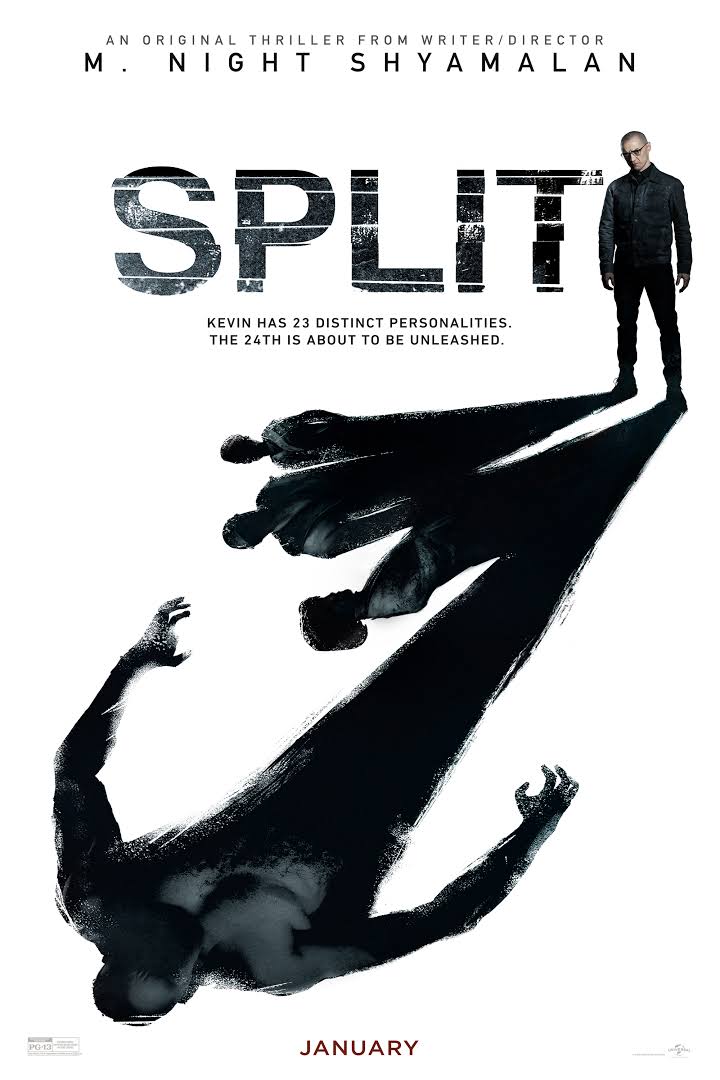
'Split' Review


Sorry that it's taken so long for me to review Split but I've had a busy couple of weeks and I just got around to seeing it, so without further ado, here are my thoughts on Split.

'Split' Review


In Split, three teenage girls are kidnapped and held captive by a mysterious man. The twist is that Kevin has Dissociative Identity Disorder, with twenty-three distinct personalities and a twenty-fourth about to emerge called "The Beast." But if you can read a poster and have seen the trailer you could probably gather as much, while the proceeding events are fairly typical of most modern thrillers I'll avoid going into further detail to stay away from spoiling anything for those who have yet to see it. 
M. Night Shyamalan wrote and directed Split after last year's resurgence, The Visit, that officially broke his streak of what was becoming a very grotesque filmography, including The Last Airbender and After Earth to name a few stinkers. Shyamalan could have easily fallen back into the slumps with Split but a return to his low budget roots definitely did him some good as Split is easily Shyamalan's best film since Signs and a return to form for the formerly esteemed director, who has picked himself back up from his plummet into the realm of dreadfully forgettable blockbusters. 
Shyamalan's direction is attuned to the slightest detail in his efforts to build suspense. Split's supporting technical elements only amplify Shyamalan's vision with cinematographer Mike Gioulakis' nifty camerawork making the most out of the tight spaces, editor Luke Franco Ciarrocchi capably cuts everything together, and West Dylan Thordson's score serving as a chilling ambient undercurrent. Fans of Shyamalan's work are familiar with his tendencies to include many twists and turns throughout his films and Split is no exception with the occasional twist and a huge reveal at the end that will certainly cause massive Shyamalan fans to freak out. The drawbacks arise from Shyamalan's uninspired storytelling and sloppy supporting characterization. Ideally, the film would have been more suspenseful had a majority of its story been contained to a single location akin to both of last year's claustrophobic thrillers 10 Cloverfield Lane and Don't Breathe (On that note I think the font used for the opening credits is the same font used for 10 Clover Field Lane's logo). 
When Shyamalan ventures outside of Kevin's space (where the girl's are being held captive), the film comes to a screeching halt and uneven pacing emerges. While these diversions are seemingly unnecessary, they hold greater importance later on and were certainly imperative for the narrative. With this being said, it could have been tightened and refined to better serve the viewing experience rather than continuously deviating from the suspenseful ride. A slow burn is much more impactful if you can feel the palpable tension rising in the context of a confined space over a prolonged amount of time, something both of the aforementioned films captured expertly. The poorly placed character recollections and scenes outside Kevin's dwelling simply detract from the brewing tension and force Shyamalan back to square one each time he revisits the cramped quarters. 
Shyamalan also falls victim to enabling a few too many plot conveniences in his screenplay that are downright bothersome towards the film's finale. I can't really discuss these as openly as I'd like but trust me they make absolutely no sense under scrutiny. Another thing is that I still have yet to understand why Kevin needed to have twenty four personalities if we only see eight over the course of the film (and this includes his primary personality). Like why couldn't he have just had eight to simplify things? There was no desperate need to have twenty four personalities but I guess this was made with the intention of a sequel and there's gotta be SOMETHING to bring to the table we haven't previously seen. 
For my last nitpick, I have to say that Shyamalan encroached on some seriously outlandish ideas for the third act, considering that the film that had been fairly grounded in the previous two acts. Again, I won't spoil anything but it's really strange and takes the film in an unexpected and undesired direction but Shyamalan fortunately gets back on track before he concludes. 
As for characterization, Shyamalan's never really been one to flesh out his supporting players but aside from the two leads (Kevin and Casey) almost every other character was a forgettable one-dimensional caricature or literally a walking-talking plot device. Thankfully, Shyamalan neither writes the three teenagers to be unreasonably moronic or unbelievably intelligent but in collaboration with the three actresses manages to find the ideal middle ground for an authentic portrayal of how a teen would realistically behave in this situation. 
Anya Taylor-Joy, a breakout genre star last year after pivotal roles in both The Witch and Morgan, provides an incredibly layered heroine for the audience to support as Casey Cooke, an introverted recluse. Haley Lu Robinson and Jessica Sula make for serviceable side characters and fill the duties of their roles but are written to be so irrelevant that they're easily forgotten when not onscreen. 
Betty Buckley's psychiatrist Dr. Karen Fletcher essentially delivers expositional dialogue explaining Kevin's condition and moving the plot along. Simply put, she wasn't much of an actual character but the fault for that lies with the script not Buckley's performance. She's an excellent candidate but honestly this role could have gone to just about any actress and been just as impactful.
James McAvoy on the other hand was absolutely a scene-stealing presence throughout and this is most certainly McAvoy's most versatile role to date. McAvoy brilliantly gets in the headspace of eight different individuals inside Kevin (again... we don't see all twenty three/four) and portrays all of them with ever-changing physique, alternative mannerisms, and speech patterns that successfully capture the slightest details of the respective personas. He plays everything from an obsessive compulsive to a matriarch to a anxious nine year old boy, the latter of which is proving to be an audience favorite and source of many internet memes, etcetera. 
Perhaps the most unsettling aspect of Split is James McAvoy's commitment to the creepy characterizations, but beyond that the story doesn't offer up too much to unnerve the viewer due to uneven pacing and problematic storytelling. If it's any consolation, Split succeeds on the merits of its multifaceted antagonist, compelling protagonist, precise technical execution, and is one of Shyamalan's higher marks in his spotty career. 

Film Assessment: B-