Showing posts with label Steven Spielberg. Show all posts

Friday, August 10, 2018

Throwback Thursday Review: 'Jaws'

With this weekend's release of The Meg, I knew I couldn't pass up the chance to review Jaws. It's a little late, but that's because I watched both Jaws and The Meg on Thursday night. I've also seen Eighth Grade and BlacKkKlansman in the last week, but haven't reviewed either yet because I was focused on preparing my 500th Blog Post. Also, since my youngest sister will be entering the eighth grade this year, I'd like to take her to see Eighth Grade before writing my review on it. Therefore, that review may not come till the tail-end of the weekend or early into next week depending on when I publish the other aforementioned reviews. Anyways, I'd also like to give my readers a heads-up that this may be my last Throwback Thursday Review for awhile. The reason being that the fall semester is about to start and I've decided to cut back on these types of reviews since I'll be even busier in the coming weeks.

'Jaws' Review


Nominated For: Best Picture, Best Film Editing, Best Sound, and Best Original Score.
Won: Best Film Editing, Best Sound, and Best Original Score.

In Jaws, an epic battle of man vs. nature ensues as a local sheriff, a marine biologist, and an old seafarer team up to hunt down a great white shark which is attacking beachgoers along the coast of Amity Island.
Based on Peter Benchley's 1974 novel of the same name, Jaws was steered by a rookie director named Steven Spielberg and written by Benchley and Carl Gottlieb. Believe it or not, but Spielberg had only directed a few features at the time of release. Back then, he mostly dabbled in the realms of shorts and television... But Jaws was the film where he truly made a name for himself, and rightfully so! Jaws was unprecedented in more ways than one, but it essentially invented the "summer blockbuster." Twenty three years later, and the summer's stacked with these event-type films. It's crazy to think that Steven Spielberg revolutionized the movie-going business at only twenty-seven years old... 
Beyond changing the landscape of Hollywood though, Jaws has remained an iconic touchstone of pop culture. Regardless of whether you've seen the film or not, you're likely familiar with the classic line "you're gonna need a bigger boat" as well as John Williams' sensational score. Upon hearing "Da-dum... Da-dum... Da-dum-Da-dum-Da-dum," you may get even a little uneasy because you know danger is imminent. Well, you can send all your appreciation towards the music maestro John Williams for that! Music is an essential component of any film, and that's certainly the case with Jaws. While the entire score is masterful, it is perhaps Williams' shark theme which most effectively eases audiences into the ebb and flow of the film. As the shark gets nearer, the music intensifies. This is a constant throughout, so the viewer unconsciously begins to associate the ominous two-note theme with the imminent arrival of the great white. From that point on, you're involuntarily anxious anytime you hear the shark's specific score. 
I'm pointing this out because the music makes up for the shark's conspicuous hour and a half long absence. Why, you ask? I'll get there, but hold your seahorses. Jaws infamously had a troubled production, with the three malfunctioning mechanical shark models chief among the problems that faced Spielberg. This lead to frequent rewrites in the midst of shooting at sea and a disgruntled morale amongst the cast and crew. The shark was named Bruce after Spielberg's lawyer, and it was ultimately decided the star shark would have minimal screen-time. It may seem like sacrilege, but it was a brilliant move in the long run for further drawing out the suspense. Spielberg instead relied on William's score, the technical filmmaking, and expressive reactions from the actors to sell Bruce's brutality. It's not till about an hour and twenty minutes in that the shark even emerges for a first full appearance. The reason this entrance is incredibly effective though is that there's absolutely no music leading up to it. Since viewers grew used to the preceding build-up of William's score, Bruce sneaks up on the audience just as he does to Brody. It's the ultimate earned jump-scare. 
Another element which I adore about Jaws is Chief Brody's reasonable caution in determining a solution to the shark problem plaguing Amity Island. He reads up on Great Whites, enlists an expert, and all the while, critical exposition is conveyed through a mixture of visual means and dialogue. He doesn't rush into the deep waters to face the problem right away, but rather, ensures he has a rock-solid plan before committing to a confrontation. There are also additional layers of his dedication to his family rational fear of the sea which further ground him as a relatable protagonist.
Perhaps one of the best scenes in the film though is one in which the characters are simply sitting around talking about scars onboard the Orca. It's interesting conversation which further fleshes out the three individuals while adding a nice touch of humanity to ground the action at sea. It's also in the scene's best interest to have such talented performers as Roy Schneider, Robert Shaw, and Richard Dreyfuss at its disposal. As Brody, Hooper, and Quint, the three have a buoyant, lighthearted camaraderie with one another which perfectly tows the line between being believed as a newly formed friendship or footage of the actors simply hanging out with one another. Their performances coupled with the sharp script make it incredibly easy to become invested in the survival of these characters during the thrilling third act. 
I'm sure you've heard it a million times before, but Jaws is just as gripping today as I'm sure it was forty-three years ago. It's an exercise in tension that's masterfully made and incredibly effective in every respect. Through Jaws, Steven Spielberg pioneered the "summer blockbuster" and jump-started his career as a filmmaker for the masses. All these years later, it's really no surprise that Jaws would still be floating around as one of Spielberg's finest films.

Film Assessment: A+

Wednesday, June 27, 2018

Throwback Thursday Review: 'The Lost World: Jurassic Park'

After a hectic round of reviews two weeks ago, things have settled down a bit here on my blog. I recently returned from a trip and had planned to prepare this review beforehand so I could publish it while I was away, but alas, that didn't end up happening so I'm publishing it now instead. For those wondering, I saw Jurassic World: Fallen Kingdom last Saturday and will have a review online relatively soon. As for content through July, you can look forward to Throwback Thursday Reviews of Mission: Impossible II, Mission: Impossible III, The Equalizer, and Mamma Mia!, Triple-R Reviews for Sicario, Ant-Man, Mission: Impossible - Ghost Protocol, and Mission: Impossible - Rogue Nation, and reviews of new releases Sicario: Day of the Soldado, Ant-Man and the Wasp, Skyscraper, The Equalizer 2, Mamma Mia! Here We Go Again, Mission: Impossible - Fallout, and Teen Titans Go! To The Movies.

'The Lost World: Jurassic Park' Review


Nominated For: Best Visual Effects.

The Lost World: Jurassic Park accompanies Ian Malcolm as he journeys to Isla Sorna, an island neighboring Isla Nublar where the creatures inhabiting Jurassic Park were bred, on behalf of John Hammond so that he and his team may observe and document the dinosaurs before InGen can exploit them for financial gain once more.
The Lost World is a curious case in the Jurassic franchise. It's unique in being the first follow-up to Jurassic Park and the only franchise sequel which was directed by Steven Spielberg, featured a John Williams score, and based on another Michael Crichton novel like the original. After the success of the first film, Crichton felt pressured to write a second novel based on fan demand and Spielberg's willingness to adapt a sequel. The Lost World was actually the only sequel Crichton ever wrote, so additional installments were based on entirely original ideas as a result. In the case of The Lost World, screenwriter David Koepp returned to pen the second entry and loosely adapted Crichton's novel per Spielberg's instructions by preserving Spielberg's favorite concepts from the novel with a largely original story at the core. Aside from those differentiating factors, The Lost World may as well have became the template for every other Jurassic Park sequel as it prioritized spectacle over story in just about every instance. 
Even with Spielberg at the helm, The Lost World has the bearings of a blockbuster meant to make its way from one set-piece to the next. As a result, it's simply a slog because the exposition this time around is tiring and tedious while the new characters hardly have a personality and are little more than walking, talking plot devices. You're meant to be concerned about the character's safety due to their affiliation with another character rather than any goodwill they've established themselves. The characters' stupid choices only make it more difficult to invest in their actions. For instance, all the audience really learns about Malcolm's daughter Kelly is that she's a young gymnast related to Ian. She stows away to accompany Ian on his expedition because she doesn't want to be left behind, but it's not till the dinosaurs attack that she realizes what a dumb decision she's made. What then follows is an hour and a half in which she mostly whines and screams before eventually taking out a velociraptor in the film's silliest moment. Beyond bonding with her father, she doesn't have any arc of her own and is a nuisance to the other characters and audience. 
The Spielbergian sense of awe and wonder that occupied the original is present in but a scene or two, and we've already seen the dinosaurs so it's no longer impressive and awe-inspiring. In its place, Spielbergian suspense. Despite my growing indifference to the Jurassic sequels, Spielberg's influence on key sequences in The Lost World can't be ignored. The sequence where the trailer dangles over the cliff ledge is absolutely brilliant to say the least and the T-Rex attack on San Diego is quite entertaining to watch. In regards to the technical elements, Janusz Kaminski's cinematography is quite captivating, there's some clever editing from Michael Kahn, the visual effects and animatronics are on-par with the original for the most part, and John Williams' score doesn't disappoint. I won't deny that The Lost World is a well-constructed film with a few stand-out sequences, but it lacks the heart and soul of the original.
Sure, there are flashes of brilliance sprinkled throughout The Lost World. Even I'll admit that much, but these bright spots ultimately don't elevate the weak foundation of a lackluster script. I've sourced most of my complaints already, but my biggest gripe is that I didn't care about any characters aside from Ian Malcom (whom I already had a vested interest) and the film is largely a series of characters making bad ideas. David Koepp goes out of his way to address any possible gaps in logic that may accompany the introduction of Isla Sorna by explaining any and all questions away via exposition. The retcon is effective, but I wish the same care had gone into justifying character motivation. 
For instance, Ian Malcolm is the character from the original you'd expect to have absolutely no desire to ever be involved with dinosaurs again. Malcolm says as much in a conversation with John Hammond. However, Malcolm changes his mind immediately upon learning Sarah Harding is already on the island. Now, I understand that Malcolm went to Site B to rescue Harding because she's his girlfriend. That much is obvious, and I think Koepp expects that's more than enough to explain the sudden shift away, but I don't feel the film itself ever justified her importance to him beyond that connection. When they're reunited, you don't really get a sense of why Malcolm cares so much. They have chemistry, but Malcom's continuously trying to save her while she either enabling other's mistakes or making her own. 
We're also told time and time again that Sarah is an experienced animal behaviorist and paleontologist (Hammond even proclaims her to be a foremost expert in the field), but her knowledge is scarcely shown in her interactions with the creatures. Despite her awareness of the peril posed by interacting with the young stegosaurus and tyrannosaurus rex, she carries on without a care in the world only to find severe consequences in both instances. I suppose you could chalk it down to her strong will and ambition, but you'd think a behaviorist would be more careful in her study of these dangerous dinosaurs. It's just frustrating to witness because Sarah isn't particularly well-developed and Malcolm's decision to go to the island never feels fully justified because their relationship is merely an afterthought when all is said-and-done. Koepp just needed an excuse to get Malcolm on the island, so he took the shortest path possible. 
Meanwhile, the performances across the board are hit or miss. Jeff Goldblum, of course, can do no wrong imbuing Ian Malcolm with his trademark sardonic wit and levelheaded rationale. Julianne Moore, Vince Vaughn,Vanessa Chester, and Richard Schiff are all equally acceptable as Sarah Harding, Nick Van Owen, Kelly Curtis, and Eddie Carr, but bring little personality to their one-note characters so they're largely static and uninteresting. Richard Attenborough, Joseph Mazzelo, and Ariana Richards also briefly reprise their respective roles from the original to great effect. 
As for a highlight, Pete Postlethwaite delights in the role of a cartoonish game hunter named Roland Tembo and stands out as an intriguing presence. Those who hired him are sadly textbook greedy, corporate types though.
The Lost World: Jurassic Park may not have completely been a lost cause, but it was still an ill-advised effort at the very least because it rarely ventured anywhere near the excellence of original. While it may not have been fossilized as the worst Jurassic sequel, it's still a significant step-down from the first and should have been a red herring to audiences and Universal Studios that Jurassic Park sequels were a very, very bad idea. 

Film Assessment: C+

Monday, June 11, 2018

Throwback Thursday Review: 'Jurassic Park'

I apologize for what must seem like an onslaught of reviews these past few days, but I simply knew I had to write this when I learned today was the 25th anniversary of Jurassic Park. I had originally intended to share this review back in March to coincide with the release of Spielberg's Ready Player One, but that plan fell through when I took a brief hiatus from this format. Anyways, things worked out nicely in the end because I'm now able to share this on the actual anniversary. For the rest of the week, look forward to my Throwback Thursday Review of The Incredibles in addition to reviews of new releases Tag (2018) and Incredibles 2. I'll be preparing my Throwback Thursday Review of The Lost World: Jurassic Park to share while I'm away next week and then I'll certainly be reviewing Jurassic World: Fallen Kingdom when I return. If you're wondering about the other Jurassic films, I'm saving those reviews for another time. 

'Jurassic Park' Review


Nominated For: Best Sound, Best Sound Editing, and Best Visual Effects. 
Won: Best Sound, Best Sound Editing, and Best Visual Effects. 

Jurassic Park ventures alongside a select group chosen to tour and approve an island theme park off the coast of Costa Rica that is populated by dinosaurs recreated from prehistoric DNA. When the preview tour goes awry and the dinosaurs break out of their enclosures, the excursion soon becomes a scramble for survival. 
Jurassic Park was directed by the astounding Steven Spielberg and featured a screenplay written by David Koepp and Michael Crichton which served as an adaptation of Crichton's own novel. It's often said that no one makes a movie like Spielberg, and that statement couldn't be any closer to the truth. Just take a glance at the man's body of work, and you'll soon see his range and flexibility as a filmmaker. He's helmed a film in just about every genre from action-adventure to holocaust dramas... Hold on a second... He actually directed two films attributed to those categories in the same year when both Jurassic Park and Schindler's List were released in 1993 with overlapping productions. As I was saying, the man can make whatever he'd like whenever he'd like, but his sense of Spielbergian awe and wonder remains present through just about all of it. Even his lesser work is enhanced by his special touch.
With that being said, I consider Jurassic Park to be top-tier Spielberg and it still reigns supreme amongst his filmography in my eyes (perhaps coming in second to Raiders of the Lost Ark). From the very get-go, Spielberg hones in on establishing the exposition and the film's underlying foundation as both exciting and informative. It all starts with men simply moving a crate, but the atmosphere of the scene makes the opening all the more mysterious and intense before a worker's suddenly killed by a velociraptor. Four minutes in and Spielberg's already hooked the audience's attention so he can start to steadily reel them in and ease them into his story before delivering the exhilarating, edge-of-your-seat action they all came to see. In the meantime, he and the writers must introduce all the major players along with furthering the story and educating the audience on some crucial dino-behavior for later. 
It's actually quite important that Spielberg took his time before he brought out the dangerous dinosaurs. He took the Jaws approach, and it only made the grand entrances for the Tyrannosaurus Rex and the Velociraptors all the more satisfying and suspenseful. For the first hour, we've gotten to know the characters and learned everything we need to know about these creatures. Now, we find ourselves invested in their survival when it matters most. The stakes are high for our heroes and we actually care about their safety, which is more than most Jurassic Park sequels can say. 
On that note, I'd like to briefly discuss why no Jurassic Park sequel will ever top the original. While I admit there are other franchises out there with additional installments I enjoy more than the first, the Jurassic franchise is currently batting 0-3. Why is that, you ask? Well, Jurassic Park was lighting-in-a-bottle and it's incredibly difficult to recreate the conditions that lead this film to become the masterpiece we still cherish today. Even with Spielberg behind the camera on The Lost World, the results weren't quite as great as one might hope. Who knows? Maybe Jurassic World: Fallen Kingdom or the inevitable Jurassic World 3 might be the next great thing? However, I sincerely doubt it because it's already incredibly difficult for other films to measure up to Jurassic Park, let alone those within the franchise. 
On a brighter note, the practical and digital effects hold up remarkably well. The animatronics and CG-creations weave together seamlessly for an incredibly immersive experience that's only further enhanced by the sensational sound design, Dean Cundey's captivating camerawork, and one of John Williams' greatest film scores. Williams themes actually are the lynchpins that hold it all together as the accompaniment echoes the triumphant feelings of awe and wonder associated with the park and ratchets up the tension tremendously in the suspenseful scenes. 
As for the cast, everyone nails it as Sam Neill, Laura Dern, Jeff Goldblum, Richard Attenborough, Samuel L. Jackson, and Wayne Knight lend the proper personality to their respective roles. Neill's Alan Grant is as stern as can be while Dern's sweet and badass as Ellie Sattler. Then Ian Malcolm is pretty much peak-Goldblum, Attenborough perfectly personifies Hammond as warm-hearted yet misguided, Jackson keeps it cool, and Knight's schtick is quite amusing. 
Also exceptional are the young child performers Joseph Mazzello and Ariana Richards as Tim and Lex. It's through their eyes that the entire experience is given an extra layer of authenticity as they look on in both horror and amazement at the wide assortment of dinosaurs. While they each may have slipped from the more mainstream movies in the time since, I'm sure they'll be forever remembered for the astonishing work they provided at such a young age. 
To simply call Jurassic Park a beloved blockbuster classic would be a massive understatement. It's endlessly iconic from start-to-finish and I can't imagine it will ever go extinct. It's really no secret that I strongly suspect Jurassic Park will forever be fossilized as one of the best action-adventure films to ever roam the Earth. 

Film Assessment: A+

Friday, March 30, 2018

'Ready Player One' Review

Nominated For: Best Visual Effects. 

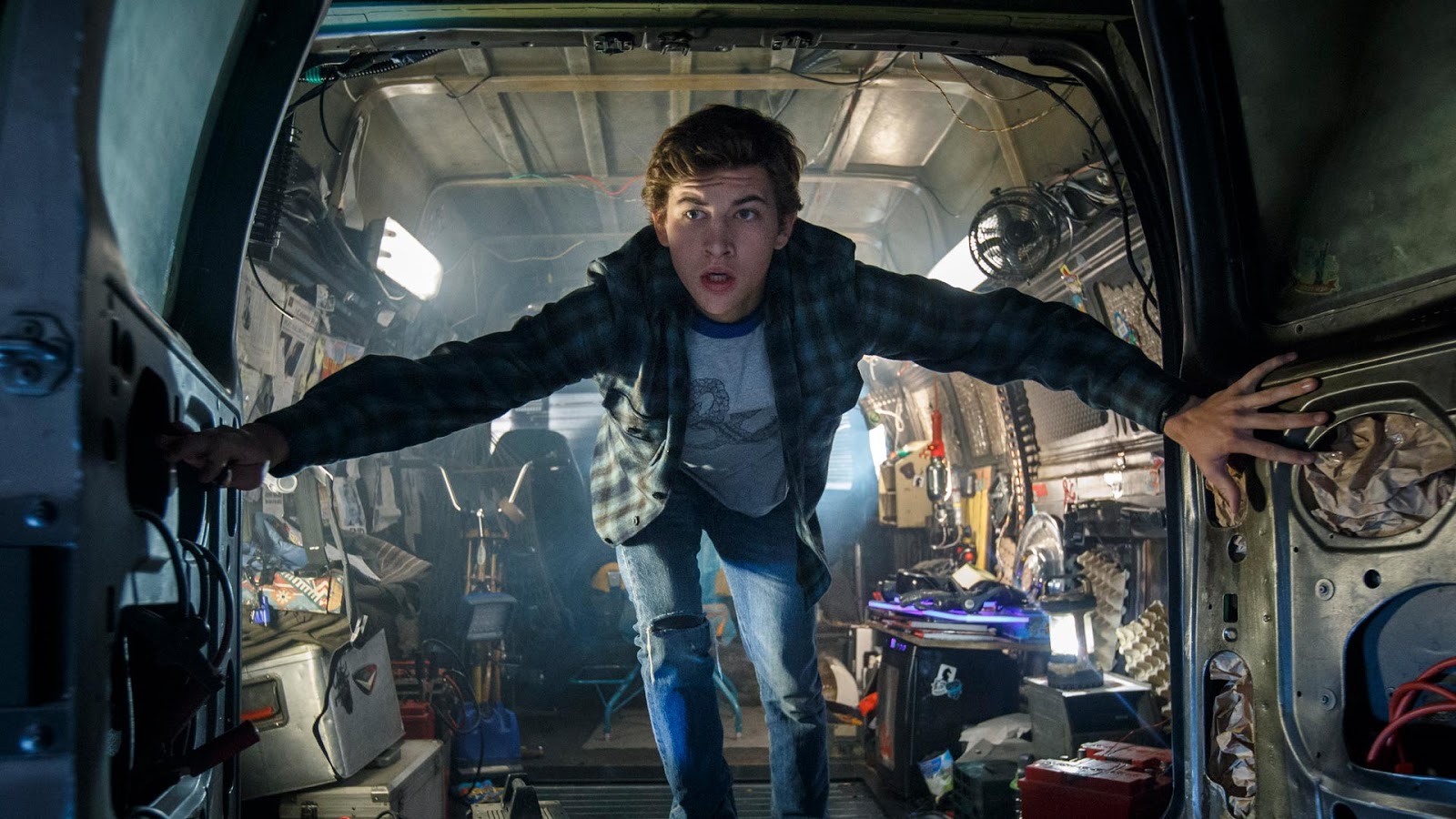
Set in the dystopian future of 2045, people escape the harsh realities of life by spending a majority of their time in the OASIS, a vast virtual reality invented by the brilliant and eccentric entrepreneur James Halliday. Inside the OASIS, anything is possible. Users are able to endlessly customize their avatars and unlock unique items to help them in their quests. The only limit is your imagination. However, once Halliday dies, it's revealed to the world that he's hidden an Easter egg inside the OASIS that will grant the finder full ownership of the game in addition to Halliday's massive fortune. Ready Player One accompanies the unlikely young hero Wade Watts as he races against time and other users of the OASIS to locate all three keys left behind by Halliday so he can unlock the highly sought-after Easter egg. 
Functioning as Steven Spielberg's triumphant return to the big budget blockbuster, Ready Player One is helmed by the beloved director and features a screenplay co-penned by Zak Penn and Ernest Cline which adapts Cline's best selling novel. It's hard not to be ecstatic for a new Spielberg movie so, of course, I was overly enthusiastic going into Ready Player One. We don't get too many flicks from Spielberg these days, and I know there will inevitably be a tragic time where we never see another, so I relish in whatever he has to offer, whether it be The Post or The BFG. Where Steven Spielberg's career of-late has mostly pertained to dramas, Ready Player One presented itself as an opportunity for the genius filmmaker to get in touch with his blockbuster roots, and that idea alone excited me very much. 
I haven't read Cline's novel, but I was well aware there would be a heavy emphasis on '80s pop-culture due to the film's marketing material. On the surface, Ready Player One may look like a candy-coated nostalgia fest, but I can assure you the references are incorporated tastefully and there's an in-universe reason for it all. It's actually quite fitting that a film about a hidden Easter egg would be crammed full of them and also be released on Easter weekend. I can assure you that's no coincidence. Geeks are sure to be giddy whenever they spot references to a character, weapon, location, or vehicle they recognize from their favorite video games or movies, but that's not the sole source of the film's whimsy. While many homages had me smiling ear-to-ear, I was ultimately engaged by the characters, the focal mystery, the breathtaking, fully-realized OASIS, an exceptional score from Alan Silvestri, and the sheer spectacle of it all. 
It's no secret that Spielberg knows how to handle an action sequence, so it then comes at no surprise that Ready Player One would be littered with instances invigorating activity. As a child of the late '90s, I missed out on seeing Spielberg's more noteworthy motion pictures in theaters. Therefore, I saw them at home plopped in front of the television screen and missed out on the complete cinematic experience one desires from a Spielberg production. For the last decade or so, Spielberg has made many well-crafted films that I've had the pleasure of seeing in the theater, but none of them really carried that trademark "Spielberg magic." Wednesday night, I watched Ready Player One in IMAX and felt the Spielbergian sense of awe and wonder for the first time in awhile. It was glorious, and well worth the price of admission. So much that I intend to see Ready Player One at least once more this weekend.
However, my enthusiasm going into Ready Player One was paired with a couple caveats. The first of which being that it would be an indulgent nostalgia parade. I've already touched on that, but another one of my concerns was that the overall design of the OASIS and the avatars looked very video game-ish and the shift from the OASIS-to-reality might be jarring. Fortunately, this proved not to be the case. While the aesthetic of the OASIS does certainly resemble the graphics found in a modern high-end video game, that's kind of the point. It's a virtual reality after all. With that being said, the visual effects are absolutely outstanding. The environment and avatars of the OASIS are richly rendered and exhibit a wide array of vibrant colors that are truly a treat for the eyes. Editors Sarah Broshar and Michael Kahn also ensured the transitions between worlds were smooth and managed to keep the flow of the movie at a lively pace. 
Where the film doesn't fully deliver is fleshing out the nuts and bolts of the real world. By design, the OASIS is infinitely more interesting than reality, so it's not a stretch to say humanity would become obsessed with this form of escapism. Just look around you for goodness sakes. Everyone's already addicted to the internet. The commentary on that addiction is Ready Player One's poignant truth and part of the reason Ready Player One should be seen aside from the aforementioned attributes. Anyways, it's easy to imagine something like the OASIS taking off in our own world so the futuristic dystopian society depicted doesn't require significant suspension of disbelief.
What becomes questionable under further scrutiny is how the evil IOI even operates. You vaguely understand the inner workings, but the legality remained fuzzy. This becomes most problematic at the end when the audience is shown something that suggests their activities weren't legal. This probably won't bother you if you can set logic aside, but it may drive others insane. I simply viewed it as an unclear area of this universe. Otherwise, strap in for an exciting ride!
Leading said ride is Tye Sheridan as Wade Watts/Parzival (the second name being his OASIS username). Sheridan imbues Watts with traits one would expect from an unsure hero who's also a huge nerd, and he hit the sweet spot as an ideally awkward audience entry point. He's a likable lead, but never charming enough to upend his geek cred.
Opposite Sheridan, Olivia Cooke is the sure standout in the role of Samantha (also known as Art3mis in the OASIS). Cooke plays Art3mis as a stoic badass with some underlying insecurities, and seeing her eventually come to embrace those will undoubtedly inspire others as well. Sheridan and Cooke carry a captivating chemistry between them so their on-screen pairing was undoubtedly one of the film's highlights. Rounding out their friend group are Lena Waithe, Phillip Zhao, and Win Morisaki who were all equally endearing characters as Aech, Sho, and Daito respectively. 
Surrounding the young cast, veteran actors Mark Rylance, Simon Pegg, and Ben Mendelsohn leave substantial impressions in their varying roles of Halliday, Ogden Morrow, and Sorrento. Mark Rylance's good natured temperament and subdued personality lent itself well to Halliday and it's always a delight to see Simon Pegg in something! I'd rather not spoil his role for anyone, so I've decided to just skim right over it... Meanwhile, Mendelsohn made for an excellent antagonist and elevated what could have been a cliché corporate baddie to an intimidating force of evil.
Now let's be honest folks... Some of you are considering seeing Black Panther again this weekend, aren't you? Haven't you seen that enough by now? All jokes aside, Ready Player One currently isn't tracking very well for its opening weekend considering it's a Spielberg film (currently in the range of $52-55 M for the four day Easter weekend) and that saddens me. While that number's fairly high in comparison to everything Spielberg's made since Indiana Jones and The Kingdom of the Crystal Skull, Ready Player One honestly deserves better. If for nothing else, you should really be see Ready Player One on the biggest screen possible for the cinematic Spielberg experience. It's a celebration of pop-culture like no other and will be the most exhilarating Easter egg hunt you'll witness all weekend. 

Film Assessment: A-

Friday, December 22, 2017

'The Post' Review

While The Post won't expand nationwide till January 12th, I was fortunate enough to see an early screening during my fall internship, so I'm granting readers early insight into the film as a reward for your patience with my delayed reviews.

'The Post' Review


Nominated For: Best Picture and Best Actress; Meryl Streep.

The Post reports the true story of the widespread Pentagon Papers leak by American press. When portions of Secretary of Defense Robert McNamara's commissioned 1967 report on the Vietnam War are leaked and published in an expose by The New York Times, President Nixon and the US Government impose a court injunction to prevent the Times from publishing any further. The first female newspaper publisher, Katharine Graham, is then faced with an impossible alternative; join the fight to protect the first amendment by publishing the report in her own paper, The Washington Post, or stand by and allow the government censorship to continue.
The Post is directed by Steven Spielberg, who I consider to be one of the most talented and influential filmmakers that ever lived, and marks Spielberg's first collaboration with the pair of esteemed actors, Tom Hanks and Meryl Streep. Hanks and Spielberg have frequently collaborated on a number of projects (including Saving Private Ryan, Catch Me If You Can, and Bridge Of Spies to name a few), but this is the first time either have worked with Streep. Due to the pedigree of those involved and the simple fact that Spielberg-directed films don't come around too often, The Post naturally rose towards the top of my most anticipated awards contenders. 
I recall that the project came together quite quickly after President Trump's inauguration as Spielberg, Hanks, and Streep all seemingly signed on immediately afterwards because of the film's remarkable relevance to Trump's distrust of mainstream media. While I won't engage in a discussion over those semantics in this review, I can say the parallels between Nixon and Trump's administrations are abundant and clear so I can't wait to read the tweets it will incur from our nation's leader. Due to the startling similarities and caliber of the project, I'm fairly certain that The Post will emerge a very viable awards frontrunner for Best Picture at the very least. 
Now that the elephant in the room has been addressed, I can confirm this film is as masterfully made as any other movie on Spielberg's résumé. Everything from the editing and cinematography to the production and costume design feel finely tuned by an experienced artist, so you're absolutely certain that you're watching a film from Spielberg. Longtime collaborator and celebrated composer John Williams also scores The Post, and while I wouldn't place it among Williams' more iconic work, the score never slouches to sounding mundane or average. 
The attributed screenwriters behind The Post are Liz Hannah and Josh Singer. Oddly enough, Singer cowrote another newspaper-driven awards contender two years ago, Spotlight. Despite the fact that Spotlight and The Post are both largely set in a newsroom and touch on publishing controversial content, Hannah and Singer approach the vastly different subject matter from a different angle. Where Spotlight largely focused on investigative journalism, The Post has more to do with the intricacies of publication, freedom of the press, and gender bias in the workplace.
The Post tackles this subject matter appropriately and intelligently by offering an objective look into both sides of the controversial choice presented to Katharine Graham. In spite of the film's clear slant against censorship of the press, Spielberg doesn't forget to stress the detriments of publishing classified documents. Those surrounding Graham naturally have differing stances on the issue, and Spielberg ensures everyone's opinion is rightfully presented in a fair, balanced manner, so when all is said-and-done, The Post runs a story that incorporates every outlook on the topic.
One touch that I really appreciated was how The Post constantly deviated from convention. When the paper's inevitably brought to court, Spielberg doesn't mull over every intricate detail of the court proceedings or overdramatize the entire court case. Instead, he focuses on the outcome and reasoning behind it, because that's what really matters. 
As for performances, Meryl Streep and Tom Hanks are without a doubt two of the greatest actors working today, so of course their acting is astounding. However, I'd daresay that Streep offers a genuine, humane performance as Katharine Graham that will remind you why she has 20 Oscar nominations to her name. Streep's work here may just be her best performance given in years and is unlike anything I've seen from her to date. Matching her beat-for-beat, Hanks imbues Ben Bradlee with his trademark charm and an underlying eagerness while exhibiting his own exceptional acting abilities. All the while, the supporting ensemble consisting of Sarah Paulson, Bob Odenkirk, Tracy Letts, Bradley Whitford, Bruce Greenwood, Matthew Rhys provide a rock solid foundation for Spielberg to work with.
All things considered, I wouldn't publicize The Post with the headline of being the best film of the year or even declare it to stand near the peak of Spielberg's remarkable and robust résumé. Nevertheless, The Post is a feature deserving of wide circulation for the mature and measured context it brings to an important, timely subject matter.

Film Assessment: A-

Thursday, September 8, 2016

Throwback Thursday Review: 'Saving Private Ryan'

This week I'm reviewing Saving Private Ryan because this weekend's big release is Sully, another film starring Tom Hanks helmed by a well known director. Next week I will pick up where I left off on my Harry Potter reviews leading up to Fantastic Beasts and Where to Find Them with my thoughts on Harry Potter and the Prisoner of Azkaban. The following week I will review The Magnificent Seven (1960) to tie in with the release of it's reboot The Magnificent Seven (2016). Till then you can expect reviews of Sully and Snowden, the number of reviews on new movies per week will dwindle for a while since it's September now.

'Saving Private Ryan' Review


Nominated For: Best Picture, Best Director; Steven Spielberg, Best Actor; Tom Hanks, Best Original Screenplay, Best Film Editing, Best Cinematography, Best Art Decoration, Best Makeup, Best Sound, Best Sound Editing, and Best Original Score.
Won: Best Director; Steven Spielberg, Best Film Editing, Best Cinematography, Best Sound, and Best Sound Editing.

Saving Private Ryan is Steven Spielberg's foray into war films depicting the invasion on the beaches of Normandy and the 2nd Ranger Battalion's mission to rescue one soldier. I'll daresay it, Steven Spielberg is the best film directors of our time despite missteps like Indiana Jones and the Crystal Skull or The Lost World: Jurassic Park. Spielberg wasn't afraid to accurately depict how gruesome war was with Saving Private Ryan, brilliantly executing large scale battle scenes with stakes, innovative camerawork, great practical effects, and most importantly an investment in character.
One of Saving Private Ryan's greatest triumphs is the screenplay's emphasis on character, the characters all feel like fully fleshed out human soldiers rather than plot devices or one note caricatures that can be found in many lousy scripts to this day. Robert Rodat's screenplay has memorable dialogue that is deeply rooted in character, everything that happens matters in some form or another. The film's visuals aren't always gorgeous, if you take into account the grotesque depiction of battle, but there are some incredible shots amidst the insanity. The film's sound is also quite the achievement, as I never felt I was watching fake gunfights, and John Williams composes yet another moving score.
Saving Private Ryan features a massive ensemble cast, and to discuss them all individually would be nightmare, but Tom Hanks' Captain Miller was a particular standout. Other great turns within the 2nd Ranger Battalion included Tom Sizemore, Edward Burns, Barry Pepper, Adam Goldberg, Vin Diesel, Giovanni Ribisi, and Jeremy Davies. Matt Damon and Paul Giamatti also perform excellently in their militaristic roles as the gold-hearted Private Ryan and a snippy Sergeant Hill.
In summary, Saving Private Ryan is just about the perfect war film showcasing superior efforts in all areas, redefining the genre, and remains to be one of Spielberg's greatest films to date!

Film Assessment: A+