Showing posts with label Ridley Scott. Show all posts

Thursday, December 28, 2017

'All the Money in the World' Review

Nominated For: Best Supporting Actor; Christopher Plummer.

All the Money in the World briefs audiences on the kidnapping of sixteen year old John Paul Getty III in July 1973 and his distraught mother's desperate attempt to convince the boy's wealthy grandfather J. Paul Getty to pay the ransom. Getty refuses and enlists former federal agent Fletcher Chase to find out what's happened to his grandson, so Chase and Gail Harris wind up in an unexpected alliance as they strive to rescue the boy by any means necessary. 
You may or may not have heard about all of All the Money in the World's behind the scenes drama, but after sexual harassment allegations arose surrounding Kevin Spacey, the decision was made to remove Spacey from the film, reshoot all his scenes with Christopher Plummer replacing him as Getty, and release the film as scheduled. While I'm not sure the decision to remove Spacey affected the finished product all too much, it paid off thanks to the wonderful work from director Ridley Scott and actor Christopher Plummer. By the way, it's not like Scott and his crew just reshot a couple scenes considering Getty is in a substantial amount of the film... The fact they did it all in two weeks AND managed to release the films a few weeks later is absolutely astounding to me.
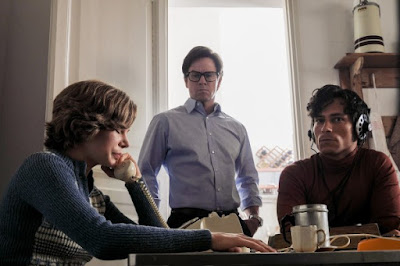
However, I must be completely honest in saying that otherwise I wasn't very impressed. There are a few exceptions to that statement of course, but don't be fooled into thinking All the Money in the World is truly one of the year's best films simply because they seamlessly subbed out Spacey... Ridley Scott is a director whom I especially admire for creating such fantastic films as AlienBlade Runner, and The Martian, but All the Money in the World lacks the director's unique style to differentiate it from any other bio-pic out there. Scott utilizes a desaturated color scheme that was terribly tiring to look at, and I'm honestly surprised it didn't put me to sleep when contemplating the film is also built around a dialogue-heavy screenplay. On the whole, the film's competently made, but it's a little long so the pacing drags and you start to realize this story may not have been meant for the film medium.
David Scarpa adapts John Pearson's book and still comes out short-changed after dramatizing things. What confounds me most though is how fascinating the story seems, yet how underwhelming Scarpa's script managed to be. The film's quite dialogue heavy, which is fine if the things said come across as interesting in execution, but there are large stretches that are boring or commonplace. There's unique elements in the kidnapping, but viewers are mostly left watching Harris wait for clues to find her son or beg Getty to pay the ransom, and that gets quite taxing after awhile. 
On the flip side of that coin, All the Money in the World features some fine performances. Michelle Williams brings both strength and vulnerability to the role of Gail Harris, shining as a determined mother against adversity. She's worried, but never frantic. Committed, but never unwavering. Williams discovers an effective balance between the extremes and ensures all her moments count so her acting prowess doesn't go unnoticed. Charlie Plummer (who is not related to Christopher Plummer) does well playing John Paul Getty III as a disparaged captive, while French actor Romain Duris imbues an unexpected humanity and warmth as the kid's captor, Cinquanta.
Elsewhere, Mark Wahlberg just kind of acts as an extension of himself and Christopher Plummer takes charge as J. Paul Getty. I never really saw much of Spacey from the trailers, but I think Plummer's the better casting choice. For one, it's age-appropriate casting (a rarity these days) and I didn't have to watch Kevin Spacey act with a peculiar facial prosthesis. Secondly, Plummer is commanding in the role. Plummer plays the cold, distanced, stingy old man perfectly. I'm not entirely sure how Spacey would have performed, but I'm kind of glad that the decision to remove him was made. I can only imagine how the scandal would have loomed over the film...
While I'm impressed by the peak performances and Ridley Scott's ability to reshoot a substantial amount of the film in about two weeks, All the Money in the World didn't have much else going for it to earn my interest. If you want my two cents, All the Money in the World isn't worth all the attention in the world. 

Film Assessment: C+

Thursday, October 5, 2017

Throwback Thursday Review: 'Blade Runner: The Final Cut'

I've decided for the time being I'm going to proceed with publishing my Throwback Thursday Reviews as scheduled, but I will still work on getting my delayed reviews out there. I've just found myself very busy lately and decided the best course of action would be to take it one step at a time and slowly catch up, because trying to write reviews for eight different films at once is overwhelming to say the least. For those wondering what's happened to my reviews for newer releases, just go read my Fall 2017 Important Update where I explain everything. I will assuage my reader's concerns though by letting them know I've completed writing reviews for It (2017)mother!Kingsman: The Golden Circle, and The LEGO Ninjago Movie. They're all currently sitting in draft and I plan on releasing each one when the respective film drops on Blu-ray (Again, I explain this in the aforementioned update). Anyways, this week I'm reviewing The Final Cut of Blade Runner as Blade Runner 2049 hits theaters tonight. For those who don't know, Blade Runner is infamously known for having five different versions of the film that have been released theatrically. I so happen to be reviewing The Final Cut because that version is the most easily obtainable, but perhaps later I'll dedicate time to watching and reviewing the alternative versions. This review will also include some slight spoilers to discuss a popular theory.

'Blade Runner: The Final Cut' Review 


Nominated For: Best Visual Effects and Best Art Direction-Set Decoration.

Blade Runner depicts a futuristic reality where replicants, synthetic beings with enhanced physical capabilities, are genetically engineered to be nearly indistinguishable from humans and sent to work in Earth's off-world colonies. After the Nexus-6 models (stronger, faster, supreme replicants) revolt, replicants are declared illegal on Earth and a special police task force known as "Blade Runners" are tasked with locating and retiring any replicants found on Earth. Once a group of ruthless and resourceful replicants hijack a ship and make their way to 2019 Los Angeles, the Blade Runners are forced to recall the accomplished operative Rick Deckard from retirement to help hunt the rogue replicants down. 
Blade Runner is a neo-noir science-fiction film directed by Ridley Scott that features a screenplay written by Hampton Fancher and David Peoples, based on the novel “Do Androids Dream Of Electric Sheep?” by Philip K. Dick. Blade Runner has a particularly peculiar past as the film has risen to be regarded as a cult classic in spite of its initial intrepid reception and especially troubled production. There have been five major versions of the film, but it's the film's first release (the U.S. theatrical cut) that is widely regarded as the inferior incarnation due to studio meddling and unnecessary voice over narration. Even director Ridley Scott has adamantly voiced his displeasure with various versions of Blade Runner, and stands by The Final Cut as his definitive cut of the film.
Blade Runner was Ridley Scott's follow-up to Alien, and it's clear that he invested himself to fabricating a fictional world just as expansive and interesting as the one surrounding his horrific sci-fi classic. Scott's direction assists the film in maintaining the elements of a classic noir amidst a futuristic backdrop, holding everything together seamlessly. One area in which The Final Cut of Blade Runner truly triumphs though is in showing-rather-than-telling the audience everything that happens. There's thematic significance to practically every neon-infused frame, and the slightest details prove to be instrumental in analyzing the film. It's a slow burn, but I became even more entranced with the events every second I continued watching and I've only pondered it over more and more since completing my first viewing. Blade Runner is ultimately so fascinating because the screenplay contains endless ambiguity and poses questions about the essence and intricacies of life, similarly to many movies about artificial intelligence today. The fact that these ideas are relevant today is mind-boggling considering the film predicted a future two years out. 
Blade Runner is thirty five years old as of 2017, yet the effects hold up marvelously. Jordan Cronenwoeth's crisp cinematography perfectly captures the scenic design's neon florescent glow, and the unconventional editing choices made by Terry Rawlings and Marsha Nakashima grab the viewer's attention. Underneath all of the visually apparent accomplishments of Blade Runner, Vangelis' synthesized score sounds nothing short of spectacularly grandiose. The underlying electronic music pulsates like the plasma universally found in neon signs, a perfect parallel to the onscreen environment of this dystopian future. The technical techniques utilized in Blade Runner are timeless to say the least.
It's always strange to watch a film you've never seen when you've encountered numerous internet discussions about it over the years. In the case of Blade Runner, there was talk of unicorns and replicants. I didn't know what any of it meant at the time, but I kept it in mind when I watching the film so I could try and unravel the maddening mysteries. The one contentious debate that dictated my viewing most was keeping my eyes peeled for any clues suggesting Deckard was/wasn't a replicant. I watched Deckard like a hawk the entire time just to see where this idea originated, and for the record, I totally think Deckard's a replicant due to all the evidence stacked against him in The Final Cut
As Rick Deckard, Harrison Ford delivers a performance entirely independent of his other iconic roles. The warmth of Ford's beloved roguishly-charming personas is absent, and in its place is a grizzled, bitter hard-drinking ex-cop. I'm also of the belief that Deckard's colder characteristics and inherent empathy towards Rachael could count as additional evidence towards him being a replicant or just point towards him just being a tired, grumpy man with a thing for replicants. The idea could swing either way, but I'd like to think it lends credence to him being a replicant.
Sean Young's alluring replicant Rachael functions as the film's femme fatale, yet Rachael sets herself apart due to her inherent innocence. As Rachael's identity unravels, Young communicates subtle changes in personality and continually subverts the viewer's expectation for Rachael. You'd expect her to fall more in line with replicant behavior upon learning the truth about herself, but the character actually becomes more humane as the story unfolds. It's an effective twist on the audience's assumption that's well-founded in the screenplay and implemented incredibly thanks to Young.
Scattered throughout the cast, Edward James Olmos, M. Emmet Walsh, William Sanderson, and Joe Turkel are able to make their discrete mark as the enigmatic Eduardo Gaff, the hard-nosed Blade Runner boss Harry Bryant, the jittery J.F. Sebastian, and the insightful corporate head Eldon Tyrell. Olmos' Gaff leaves the largest impression because of the way his character factors into the proceedings with origami creations and dubious dialogue. When accounting for his words and actions, you'll see subtle suggestions that Deckard may be a replicant, so just keep that in mind if you're going to give Blade Runner a watch before seeing Blade Runner 2049.
However, it's Rutger Hauer's Roy Batty that runs away as the film's stand-out performance. Hauer lends such menace and conviction to Roy Batty that the replicant wound up being one of the most unnerving antagonists I've seen on film in quite some time. Batty's motivations are also entirely understandable, to the point that most audience members would probably behave the same way if they were in his shoes. Underneath Hauer, Daryl Hannah, Brion James, and Joanna Cassidy each imbue the respective replicants in Barry's entourage with a distinct disposition of being an adept acrobat, a foolhardy soldier, and a lethal temptress as Pris, Leon, and Zhora.
It may have taken me twenty years to finally sit down and watch it, but it's now abundantly clear why Blade Runner is held in such high regard. Thanks to a brilliant blend of classic film noir and sci-fi, dedicated direction, and timeless special effects, it's easy to see why Blade Runner is one of the most influential science-fiction films ever created. 

Film Assessment: A+

Sunday, May 21, 2017

'Alien: Covenant' Review

Sorry that all my Alien Anthology reviews this past week have been published later than expected but I should be making up for that soon with early reviews for BaywatchWonder Woman, and Baby Driver all on the way. I'm trying something different with this review and if it's well received, I'll be going back and altering previous reviews and use the template for future reviews.

'Alien: Covenant' Review


Alien: Covenant escorts the coupled crew of the colony ship Covenant bound for prospective planet Origae-6. En route the Covenant encounters a space storm and whilst making repairs, the crew receives a foreboding human transmission. The crew investigate its source only to find an even closer planet and head there in hopes of discovering a pristine paradise. Of course, as things always do in these Alien flicks, nothing goes according to plan and the crew are forced to fend for themselves on an unfamiliar world against an unknown entity. 
Alien: Covenant takes place between Prometheus and the original Alien, acting as a bridge between the two in more ways then one would suspect. Ridley Scott returns to the director's chair after experimenting with Prometheus and brings both his creative children together for an impressive amalgamation. The best way for me to describe Alien: Covenant would be that a studio executive locked Prometheus and Alien in a room and told them to play nice, only to return a while later and discover the two are now the best of pals. However, it's worth noting that Alien: Covenant bears the resemblance of a Prometheus sequel more than the guise of an Alien prequel. 
Jack Paglen and Michael Green set the story while John Logan and Dante Harper penned the film's screenplay, building upon the groundwork Prometheus laid out to weave a satisfying tale that answers some pressing questions Prometheus ignored (don't expect answers to every disregarded inquiry though). Ridley Scott and his team of screenwriters effectively meld the excellent elements of each (Prometheus and Alien) to great effect, finding a deft balance between horror and philosophy. At times the film strays too close to the plotting of both those films, feeling a tad formulaic and predictable, but Alien: Covenant will still successfully startle and surprise viewers. If you haven't watched Prometheus or the promotional Alien: Covenant prologues released on YouTube, I'd recommend checking them out before seeing Alien: Covenant to enhance your understanding of things but none of them are essential viewing and it won't affect your level of uneasiness if you opt out of watching any of them. 
Ridley Scott and crew demonstrate terrific technical prowess with commanding cinematography, magnificent visual effects, and striking scenery. Dariusz Wolski's camerawork amplified the serene essence in the film's quiet moments and instantly instilled a frantic vitality when things got terrifying. On the long list of Alien: Covenant's accolades, the hair, make-up, and production design teams collaborated seamlessly along with the vfx artists to craft some chilling chest-bursting sequences and an idyllic aesthetic to juxtapose opposite the gruesome bloodbath. The computer generated Xenomorphs manage to move with a fervent frenzy that simply can't be brought to life any other way so hats off to the animators behind that monstrosity. Meanwhile, Jed Kurzel's musical score fittingly intensified the proceedings. Kurzel's compositions strike a sweet spot, boasting vacant volume and an eerily intense, ethereal sound matching the duality of Scott's vision. 
Elsewhere, Alien: Covenant accommodates an accomplished ensemble who exceeded my expectations. Katherine Waterston offers an all-encompassing performance demonstrating her range, thus making Daniels a serviceable female lead. Billy Crudup also digs deep as Captain Oram and Danny McBride's serious turn as Tennessee was a shocking delight. The remaining crew members are serviceably portrayed by Demián Najera, Carmen Ejogo, Jussie Smollett, Callie Hernandez, Amy Seimetz, Nathaniel Dean, Alexander England, Benjamin Rigby, Uli Latukefu, and Tess Haubrich respectively, but these characters wound up feeling shallow in the grand scheme of things. I can say the ensemble worked together well as the sense of the crew's camaraderie is felt from the very beginning, aided by the fact each character has a spouse among the crew. The real scene stealer unsurprisingly turns out to be Michael Fassbender, who's definitely a proven commodity at this point. Michael Fassbender exceptionally brings a two-pronged performance playing the respectable robot Walter and reprising his role as sinister synthetic David. Fassbender excels in both facets, impressively playing against himself as two different droids with a similar basis. I won't say much else about these characters because that would approach the dreaded spoiler territory but I can say there's one scene that will make Fassbender fangirls around the world squeal in giddy joy. 
In conclusion, I highly advise a trip to the theater to see Alien: Covenant for fans of horror or the Alien franchise itself. If you're wondering about tamer offerings, I can vouch that Guardians of the Galaxy Vol. 2 holds up well for repeat viewings (I've now seen it three times) or you could give poor King Arthur a hand at lifting that epic sword and check out King Arthur: Legend of the Sword (which hasn't had the greatest run at the box office). However, Alien: Covenant definitely delivered the thrill-ride I was hoping for and stands as another strong science fiction entry in this summer season's blockbuster catalogue. Alien: Covenant is tense, riveting, and bursting all-around with accomplished aspects, making it the most satisfying suspenseful sci-fi epic this franchise has seen in years!

Film Assessment: B+

Friday, May 19, 2017

Throwback Thursday Review: 'Prometheus'

I apologize for yet another delayed review but this week's Throwback Thursday is over Prometheus to coincide with the release of its sequel Alien: Covenant. If you happened to miss any of my Alien Anthology series of Retrospective Reviews, you can find those at the subsequent blue hyperlinks: AlienAliensAlien 3, and Alien: Resurrection. Next week I'll be finishing out my series of Pirates of the Caribbean reviews as I review Pirates of the Caribbean: On Stranger Tides to tie in with Pirates of the Caribbean: Dead Men Tell No Tales. Other reviews you can expect to see over the course of May and June include Throwback Thursday Reviews over CarsThe Mummy (1999)Cars 2Transformers: Age of Extinction, and Despicable Me 2 and new reviews for Alien: CovenantBaywatchWonder WomanThe Mummy (2017)Cars 3Transformers: The Last KnightBaby Driver, and Despicable Me 3.

'Prometheus' Review


Nominated For: Best Visual Effects.

Prometheus follows an expeditionary team to the far reaches of space as they believe they've discovered a hint towards the origins of humanity. The team arrive to planet LV-223 (not LV-426, the planet shown in Alien and Aliens) and soon discover the answers they seek will lead them to horrifying conclusions.
At the time of Prometheus's release, it was ambiguous exactly how Prometheus fit into the Alien-universe. Since then, it's been given the distinction of being a quasi-prequel to Alien. This essentially means Prometheus certainly exists within the Alien Anthology but isn't a direct setup to Alien. After 33 years, Ridley Scott returned to his roots to helm Prometheus and thankfully delivered one of the Anthology's most coherent creative works in quite some time, for more on this read my reviews of Alien 3 and Alien: Resurrection
Even when accounting for Prometheus' flaws, distinctive and persistent philosophical ponderings surround the story. From beginning to end, Scott and his terrific technical crew paint a pretty picture using space as their canvas. Scott and cinematographer Dariosz Wolski capture exceptionally breathtaking images of the hushed, lovely landscape while the vfx team create resonant renderings that pair perfectly with the immense, spectacular sets constructed by the prime production designers. Marc Streintenfeld's sumptuous space score bodes well as accompaniment, filling the vacuum of space with ethereal tones played by a swelling, harmonious orchestra.
However, Prometheus is easily one of the most frustrating movies I've seen in recent memory because it poses plenty of questions but doesn't ever get around to granting any clear-cut answers. I'm not particularly bothered by a few dangling threads but screenwriters Jon Spaihts and Damon Lindelof leave Prometheus' monumental mysteries to be ill-defined, only painting broad strokes but never retracing their steps to refine any blemishes. I'm sure this was intentional incorporation into the grand scheme of Prometheus' philosophical nature but it's not fortuitous that they didn't fill in any gaping plot-holes. I will say that turns things around with a thrilling third act but up to that point you'll be peeved by the dumb decisions the expedition team partake in. This team is made up of intellectuals so their brainless behavior on the planet's surface is inexcusable.
Unfortunately, many of the crew members feel vaguely characterized as only the prominent players are given substantial depth and corresponding complexity. This in turn detracts from the supporting ensemble's subsequent portrayals but magnifies the principal characters. Noomi Rapace offers an excellent portrayal of devout archeologist Dr. Elizabeth Shaw, playing into the frantic uncertainty Prometheus provides. Rapace's Shaw isn't quite up to par with Ripley as a fascinating female lead but she's superb nevertheless. On the other hand, Emum Elliott showcases a steel-faced wooden portrayal of Shaw's partner and love interest Charlie Holloway. Guy Pearce also has an odd arc as an aged Peter Weyland. Charlize Theron and Idris Elba are sufficient as mission director Vickers and charming captain Janek respectively, each adding a dosage of star power to the mix. Elsewhere the crew composed of Logan Marshall Green, Sean Harris, Rafe Spall, Benedict Wong, and Kate Dickie are fine in their distinctive roles but none of the bunch bring anything particularly memorable to their characters.
On all accounts, it is certainly Michael Fassbender who steals the show. Fassbender's intricate android David is the most interesting character among the bunch as he demonstrates unconventional, individualistic autonomy. Fassbender brings a clout of gravitas that melds well with David and projects an ominous and unsettling disposition that plays out perfectly.
In conclusion, Prometheus boasts proficient performances, tremendous technical work, a splendid space score, and accomplished aesthetic but gets dragged down by presenting weighty philosophical questions and failing to conjure an adequate answer to any of them.

Film Assessment: C

Wednesday, May 10, 2017

Retrospective Review: 'Alien'

Today I'm introducing a new form of review called a Retrospective Review. The basic idea is to provide another opportunity for me to review older films aside from Throwback Thursday Reviews as these reviews won't always tie into a corresponding release. However, the first couple Retrospective Reviews are all coming this week as an excuse for me to review the Alien Anthology, seeing as my Throwback Thursday Review schedule didn't have enough room built into it to review any of the Alien films. This week I'm reviewing all four Alien films' theatrical cuts and will save my thoughts on the respective Director's Cuts for another review down the line so be on the lookout for an Aliens review soon. Also, there will be some spoilers in the review considering the film's age and popularity.

'Alien' Review


Nominated For: Best Art Direction and Best Visual Effects.
Won: Best Visual Effects.

Alien escorts the crew of commercial space-vessel Nostromo as they are awakened from cryo-sleep to investigate an intergalactic SOS. The crew board the alien starship and stumble across a nest of eggs when suddenly a parasitic organism leaps out, attaching itself to one of the crew members. The crew return to the ship and are able to remove the face-hugger, only to discover the creature spawned offspring when a little alien bursts out of Kane's chest and retreats into the ship's depths. The crew are left to fight for their lives as they're picked off one-by-one by the ever-evolving extraterrestrial.
Alien is widely regarded to be one of the best sci-fi horror outings ever created, considered a true hallmark of the science fiction/horror genre. Alien was directed by Ridley Scott, an unproved directorial commodity at the time who has since more than made his mark on science fiction. Scott understood that the task at hand didn't simply call upon him to make a "scary" movie but to authenticate tension over the course of two hours. The tense atmosphere of Alien is one that slowly creeps up on you, not unlike the titular Xenomorph, building and building for a quick release only to further escalate that foundation. The sense of uneasiness derives from a concoction of every technical element on display; the remarkable visual effects, the grungy production design, the vacant score, and the smart screenplay.
The special effects in Alien are timeless, it's been 38 years since Alien was first released yet the aesthetic still works. The creature design remains creepy as ever, the filthy set design projects the guise the ship's been lived in, and the production design, editing, and cinematography meld seamlessly enhancing the claustrophobic nature of the Nostromo. Jerry Goldsmith's spacial score mimicks the vacuum of space with a void sound at the film's start, steadily crescendoing to communicate a sense of unease in the film's more precarious moments. Goldsmith's compositions effectively transition between conveying a sense of comfort and urgency instantaneously, and the steady build of suspense allows for successful scares and a swelling of anxiety throughout the two hour runtime.
Screenwriters Dan O'Bannon and Ronald Shusett set the stage for a slow burn but as I've already attested to, the build pays off exceptionally well. O'Bannon and Shusett also cleverly wrote the proceedings so that you're not quite sure who the true protagonist is for a large portion of the plot proceedings. While that's grown increasingly more common amidst the horror genre, I thought it worked even better than usual in Alien. The writing duo do an admirable job crafting the crew as the dynamic between them adds further authenticity to their individual roles onboard the ship and the bond they share.
The crew's chemistry works no only thanks to the script but the powerful performances on display. Sigourney Weaver, Tom Skerritt, Veronica Cartwright, Harry Dean Stanton, John Hurt, Ian Holm, and Yaphet Kotto make up the company of the Nostromo and each provides a unique role in the story and an innate likability so you feel for these characters.
Weaver in particular stands out as Ripley, in-large part because she survives the whole she-bang but also because Ripley's such a fantastic female character. It's not too often that franchise bolster a female lead and even when they do, they typically succumb to tropes of a poorly written female character. However, Ripley's a strong female character that's not an annoyance or sex appeal. Ripley's an everyday woman placed in a scary situation but maintains a clear head throughout, following protocol at every turn. Weaver brings a levelheaded nature and a sense of relatable paranoia to her character that sucks you into the ongoing events.
Other actors who deserve an additional shoutout include Ian Holm's eerie portrayal of an analytical android Ash, Tom Skerritt's charming Captain Dallas, and Bolaji Badejo for making a menacing movie monster of the Xenomorph. In summary, Alien has truly stood the test of time. After thirty eight years Alien still chills and thrills, cementing its status as a magnum opus of sci-fi horror.

Film Assessment: A+

Monday, October 12, 2015

'The Martian' Review

Nominated For: Best Picture, Best Actor; Matt Damon, Best Adapted Screenplay, Best Production Design, Best Sound Editing, Best Sound Mixing, and Best Visual Effects.

The Martian is a phenomenal film and honestly one of the best movies I have seen all year! The Martian has an incredible cast, great visuals, production design, writing, directing and a compelling story. If I were to compare The Martian to the more recent space films Gravity and Interstellar, I would say I preferred it better than both. I wasn't really a fan of Gravity but I really did enjoy Interstellar and I think one of the things I loved about The Martian was the light tone and the humor in what should be a dark, desperate situation. It was a great contrast and something that was definitely missing from Gravity and Interstellar as both of those were darker films. However despite the light tone, the film was aware of when it needed to be serious and when Mark Watney, the astronaut stranded on Mars, was in a grave situation the film went to that dark place when necessary.  I really liked watching Watney adapt to all of the challenges that can happen in space and see him work to do what can be considered by many to be impossible. the way the story was crafted kept the film interesting and I was never bored despite the somewhat long runtime. Also there are a few fun references to Lord of the Rings and one to Iron Man that caught me by surprise as I didn't really expect the references but I did enjoy them. Ridley Scott did a great job bringing all of the elements of this film came together to make it quite enjoyable. The visuals were very beautiful yet felt real and at times I forgot the film wasn't actually filmed on Mars, which goes to show how great the production design, cinematography, and visual effects came together to create a realistic immersive film experience. The cast were all incredible and worked quite well together on screen but the standout was definitely Matt Damon. It was incredible to see him act alone and really convey what it would be like to wake up stuck on a planet far away from home. Damon did a great job channeling the attitude of the everyman astronaut that the audience can root for. I was very impressed with his performance but he had an incredible supporting cast that all worked well together and never overshadowed Damon. The supporting characters never felt like they were invading the story or felt unnecessary each really adding to the compelling story about trying to bring a man home. The all star cast composed of Jessica Chastain, Kate Mara, Sebastian Stan, Jeff Daniels, Donald Glover, Sean Bean, Michael Peña, and Chiwetal Ejiofor really all added to the experience and created interesting supporting characters that felt necessary to the story. Overall, The Martian is an incredible must see film. If you feel that it looks too similar to either Gravity or Interstellar I can tell you that it is a completely different film with a different story, set of circumstances that I prefer to the latter.

Film Assessment: A-