Showing posts with label Chiwetel Ejiofor. Show all posts

Saturday, July 20, 2019

'The Lion King' (2019) Review

Nominated For: Best Visual Effects.

Synopsis: In the African savanna, a future king is born. Simba idolizes his father and takes his royal destiny to heart. But not everyone in the kingdom celebrates the new cub's arrival. Scar, former heir to the throne, has plans of his own. The battle for Pride Rock is soon ravaged with betrayal, tragedy, and drama, ultimately resulting in Simba's exile. With help from a curious pair of newfound friends, Simba must mature and take back what is rightfully his.

Runtime: 118 minutes

MPAA Rating: PG (for sequences of violence and peril, and some thematic elements)

Who should see it? Families and fans of Disney's live-action remakes.
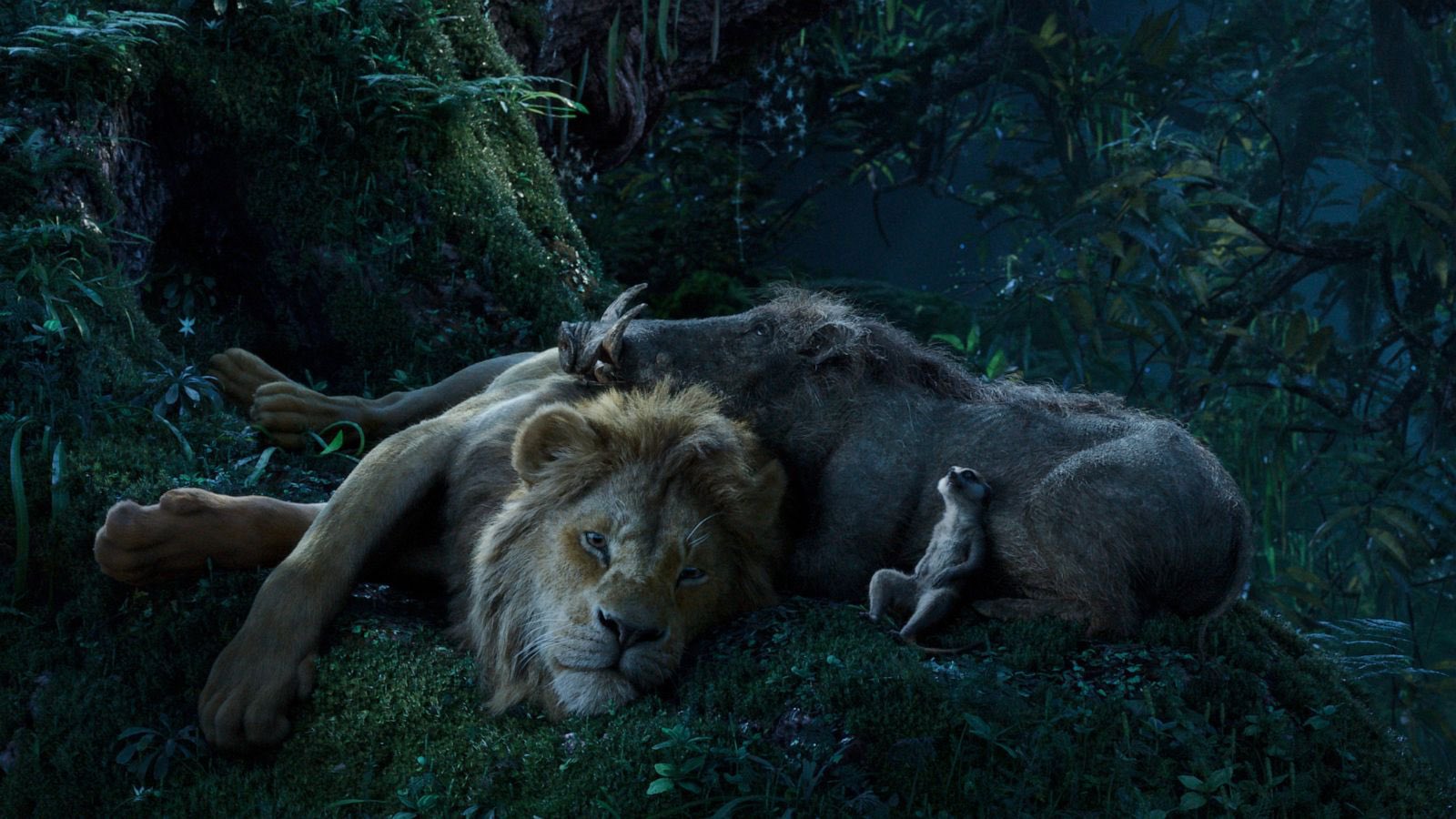
Adapted from the iconic 1994 animated incarnationThe Lion King is directed by Jon Favreau as Disney's latest "live-action" retelling. Considering the 2019 version was rendered from scratch, it's challenging to categorize The Lion King as animated or live-action since it's the first of its kind. Favreau and Disney classified this uncharted territory as "live-action filmmaking techniques with photorealistic computer-generated-imagery" which is essentially jargon for a CG-production. Utilizing the groundbreaking technology that was employed in the making of Avatar and The Jungle Book (2016), animators meticulously recreated much of the original film's classic iconography to appear alarmingly photorealistic. Though certainly a remarkable technical achievement, this innovation comes at a steep cost. 
The Lion King is undeniably an impressive two-hour visual effects demonstration, but it sorely lacks the personality and energy of the original. This is largely because Favreau set parameters for his team of animators and vfx artists, which only allowed the animals to express emotion as they would in real life. As a result, the disembodied voices of an A-list ensemble are solely responsible for conveying their characters' emotional responses. Yet, vocal performances from veteran actors also fell flat. I'm unsure if this stemmed from Favreau's direction or the acting talent themselves, but the voice-over was mostly monotonous delivery of familiar dialogue. Jeff Nathanson adapted Irene Mecchi, Jonathan Roberts, and Linda Woolverton's screenplay while Brenda Chapman received story credit as the animated film's story supervisor. However, none of the other twenty-five writers or credited crew involved with the first film were recognized. I'm aware that Timon and Pumbaa's trademark motto "Hakuna Matata" means "no worries," but I have several.
For a remake so beholden to the original, I'm baffled to learn this is the case on account of semantics concerning protections and residuals from Writer's Guild and the Animation Guild. Credit logistics aside, The Lion King retains approximately 80-85% of the first film's dialogue and replicates almost the entirety of its predecessor's visuals. A few additional scenes serve as supplemental story material to overtly explain the story's subtleties, which didn't really need to be shown. Otherwise, it's basically a shot-for-shot recreation with minor tweaks. Worst among these changes is the replacement of Hans Zimmer's score with Beyoncé's original song "Spirit" in the scene where Simba decides to return to Pride Rock. The scene, which is supposed to be a profound moment with an epic accompaniment, is instantly cheapened by a typical Beyoncé song that is hysterically out-of-place. Not to mention, Mufasa reappears to Simba as a generic cloud that only resembles a lion during instantaneous flashes of lighting. Favreau's insistence on grounding this tale in realism increasingly grew more and more absurd when I realized singing animals were part of the equation.
Chief among my complaints, The Lion King's larger-than-life musical numbers were staged in literally the least exciting way imaginable. The photorealistic approach naturally confined Favreau's creativity in this regard, but animals simply walked or ran around their environment while singing. It was rather dull to watch, and the lyric annunciation and syncopated rhythms of the songs are changed to better suit the actors I suppose. Without the heightened exaggeration and vibrant colors front-and-center in the 1994 animation, these songs are hardly any fun. The cast's singing ability is there for the most part, though there are some glaring exceptions such as Seth Rogan's Pumbaa. It's mercifully brief, but nobody involved bother trying to mask it via auto-tuning as Disney did earlier this year in Aladdin (2019).
Maybe, I'm being a bit harsh in actively comparing this reimagining to the first film. However, it's nearly impossible to avoid doing so since it borrows so much and is a downgrade in almost every respect. I've attested to the emotional disconnect intentionally inserted by Jon Favreau, and that decision alone seems to have stifled the possibilities that accompany bringing this story to life. Even standing entirely on its own, this iteration lacks the emotional vitality necessary to tell this story. The effects are incredible, but everything is a soulless rendering. Young Simba is admittedly a cute cub, but he's hardly capable of emoting. When Mufasa was trampled by a stampede of wildebeests (spoiler alert?), Simba's vacant expressions matched my own. Otherwise, Hans Zimmer probably earned the easiest paycheck of his life as his score is virtually identical aside from a couple new refrains and slight occasional re-arrangements.
I briefly addressed the ensemble, but I was amazed to see such high-profile talent lend performances devoid of personality when they seemed like ideal casting choices. JD McCrary, Shahadi Wright, Donald Glover, and Beyoncé portray Simba and Nala respectively at varying stages of life. The quartet's voices shine in the musical numbers but are otherwise serviceable. The legendary James Earl Jones reprises the role of Mufasa, and even he failed to spark life into a character which he'd already made iconic. Perhaps, it's due to his age, but that doesn't explain the other's inconspicuous contributions. Amongst the supporting cast, John Oliver's Zazu and John Kani's Rafiki are unusually restrained when compared to their animated counterparts while Afre Woodard's Sarabi practically serves as set decor. 
Not all is lost, though. Billy Eichner and Seth Rogan were sure-fire stand-outs as Timon and Pumbaa and the sole source of successful comic relief. The rapport between Eichner and Rogan is unique, but true to the spirit of Nathan Lane and Ernie Sabella's dynamic from the original. The duo breaks the fourth wall in fun and exciting new ways, but it occurred a little too often and risked veering towards being Deadpool-esque at times. However, I will admit to breaking out in a fit of laughter at the subversive and abrupt ending to their amusing remix of "The Lion Sleeps Tonight."
Chiwetel Ejiofor's Scar speaks with a hushed intensity that sets him in the shadow of Jeremy Irons' eccentric take. The cunning and manipulative tendencies remain, but the larger-than-life malevolence is stripped away. Florence Kasumba, Keegan-Michael Key, and Eric André portray the prominent trio of hyenas and are equally subdued.
Given the enormous success of Disney's other live-action re-imaginings, a remake of The Lion King was inevitable. After seeing The Jungle Book, I'll admit that I was also interested in seeing Jon Favreau take a stab at it. I now deeply regret that request as in the theater I often sang to myself, "Oh, I just can't wait for this to be over."

Film Assessment: D+

Friday, November 4, 2016

'Doctor Strange' Review

Doctor Strange is perhaps Marvel Studios' strangest endeavor yet. Marvel Studios has sustained this boom of the comic book movie genre by continually exploring new avenues. Sure, they may not have had a truly memorable villain since Loki but Marvel should be commended for it's ability to take obscure comic book heroes and make them part of the mainstream consciousness. Now, it's time for the Sorcerer Supreme to enter the fold and bring magic into the Marvel Cinematic Universe. I've been quite excited for Doctor Strange since it's announcement and subsequently my anticipation has grown with each new trailer, and the special IMAX event I attended a few weeks ago that showcased fifteen minutes of footage from the film only amplified my excitement a thousandfold, so without further ado it's time to learn what I thought of the Sorcerer Supreme's first outing after two viewings.

'Doctor Strange' Review


Nominated For: Best Visual Effects.

In Doctor Strange an arrogant noteworthy neurosurgeon, Stephen Strange, finds himself in shambles after a horrific car accident destroys the nerve endings in his hands. Strange exhausts all his resources to find a cure and it's only when he's on his last leg that he hears tale of Kamar Taj, the gathering place for the masters of the mystic arts. Naturally, Strange ventures there and his life is changed forever once he's introduced to another plane of existence and means to manipulate matter through magic. He then must train to help defend the multiverse from otherworldly threats that seek to destroy not only our world, but the multiverse at large.
Doctor Strange is the fourteenth feature film to join the ever-expanding Marvel Cinematic Universe and despite being the fourteenth film in the franchise it manages to break new ground by exploring the supernatural side of the MCU.
Doctor Strange only stands to benefit from being a part of the Marvel Cinematic Universe, seeing as the groundwork for the Sorcerer Supreme's debut was lain far earlier than many would expect thanks to a Stephen Strange name-drop in Captain America: The Winter Soldier, the vibrant color palette and out of this world visuals from Guardians of the Galaxy, and the small trip into the Quantum Realm in Ant-Man. Even though Doctor Strange is a part of the MCU, it manages to feel like it's own standalone corner of the universe. Sure, they pepper in a few references pointing towards the Avengers but the references are done in such a way that you understand why these sorcerers haven't interacted with the greater Marvel universe to this point.
Scott Derrickson takes up the position of director and with his foresight manages to effectively bring Doctor Strange into the MCU. Derrickson does an excellent job translating Steve Ditko's psychedelic renderings to the big screen with next level visual effects that blew my mind, thanks to the team of visual effects artists, and the sound design and production design further the authenticity of these spells and alterations to reality. Magic in Doctor Strange is distinct from things you would find in Harry Potter or Lord of the Rings and truly unlike any cinematic magic I've seen.
The action sequences Derrickson and his crew employ are some of the most visually inventive action sequences Marvel has executed to date, always daring to go places no person would ever think of as matter and reality itself are shaped to conform to the will of the inhabitants of Kamar Taj and the other magicians of the MCU. The cinematography is also quite eye-catching as it dives straight into these kaleidoscopic foldings of reality, the combination of which easily making Doctor Strange Marvel's boldest visual palette yet. I've seen the film once in 2D and once in IMAX 3D and must say that this is a case where I feel 3D makes a significant difference in terms of viewing experience and it's the best way to experience these spellbinding visuals.
With that being said, the story arcs in the screenplay penned by Derrickson, Jon Spaihts, and C. Robert Cargill evoke a lot of Marvel's previous origin stories but I think that has more to do with the similarity of the source material. For example, how Stephen Strange starts out extremely arrogant but becomes a hero through tragedy like Tony Stark, the means to the end are different but the general arc is similar. This doesn't bother me, considering that the plot specifics are remarkably different but some viewers may find it a tad annoying.
People also may draw comparisons to Inception and Batman Begins, but the similarities are vague in that Doctor Strange takes Inception's dreamlike reality folding to a whole other level in the mirror dimension and Bruce Wayne and Stephen Strange seek different training and forms of help. The script admittedly has less humor than typical Marvel faire such as Ant-Man or Guardians of the Galaxy, but when the gags hit they landed with a splash.
The screenplay does a great job of placing focus on characters that deserve it, for example Rachel Palmer as the love interest is a secondary character and her character arc never stepped over Strange's arc, she was given the ideal amount of screen time and attention. I'd say Michael Giacchino's oriental-inspired score is worth noting for bringing a sense of heroism, eastern influence, and further adding to the trip visuals. With a A-list cast, the performances in Doctor Strange are unsurprisingly bar none.
Benedict Cumberbatch is drop dead perfect in the role of Stephen Strange. Cumberbatch played the arrogant prick to a tee and then makes a convincing changed likable hero as the film progresses and I can't wait to see his interaction with the Avengers in Avengers: Infinity War.
People can complain as much as they want about the "whitewashing" or "gender-bending" of the Ancient One but Tilda Swinton makes a grand wise Yoda-like mentor to Strange and the other sorcerers of Kamar Taj.

Chiwetel Ejiofor's Karl Mordo makes a fun companion to Strange and their difference of opinion makes for an interesting peer dynamic. Benedict Wong plays Wong to be a steel-faced librarian of Kamar Taj but despite his serious expression, when placed opposite Cumberbatch allows for some of the film's funniest moments.
Rachel McAdams doesn't have too much to do as Christine Palmer but when she's on screen she has a vital role as Strange's support system. Could she have been replaced with any doctor? Yeah, but McAdams' chemistry with Strange is great and she brings a sense of realism to the film as a ER nurse.
Mads Mikkelsen's Kaecilius is admittedly another flat Marvel villain but he at least has a sense of purpose and motive. Mikkelsen in fact elevates the role through his natural gravitas, feeling like a foreboding ominous presence when onscreen, but beyond that is another wasted villain due to lack of development.
In conclusion, I wouldn't say Doctor Strange is Marvel's best or it's worst effort to date but it definitely hinges towards the top of the list as their most ambitious and unique origin story thus far thanks to the mind blowing visual effects, technical prowess, strong and clear direction, compelling characters, superb performances, and a fun bunch of compositions from Giacchino.

Film Assessment: A-

Monday, October 12, 2015

'The Martian' Review

Nominated For: Best Picture, Best Actor; Matt Damon, Best Adapted Screenplay, Best Production Design, Best Sound Editing, Best Sound Mixing, and Best Visual Effects.

The Martian is a phenomenal film and honestly one of the best movies I have seen all year! The Martian has an incredible cast, great visuals, production design, writing, directing and a compelling story. If I were to compare The Martian to the more recent space films Gravity and Interstellar, I would say I preferred it better than both. I wasn't really a fan of Gravity but I really did enjoy Interstellar and I think one of the things I loved about The Martian was the light tone and the humor in what should be a dark, desperate situation. It was a great contrast and something that was definitely missing from Gravity and Interstellar as both of those were darker films. However despite the light tone, the film was aware of when it needed to be serious and when Mark Watney, the astronaut stranded on Mars, was in a grave situation the film went to that dark place when necessary.  I really liked watching Watney adapt to all of the challenges that can happen in space and see him work to do what can be considered by many to be impossible. the way the story was crafted kept the film interesting and I was never bored despite the somewhat long runtime. Also there are a few fun references to Lord of the Rings and one to Iron Man that caught me by surprise as I didn't really expect the references but I did enjoy them. Ridley Scott did a great job bringing all of the elements of this film came together to make it quite enjoyable. The visuals were very beautiful yet felt real and at times I forgot the film wasn't actually filmed on Mars, which goes to show how great the production design, cinematography, and visual effects came together to create a realistic immersive film experience. The cast were all incredible and worked quite well together on screen but the standout was definitely Matt Damon. It was incredible to see him act alone and really convey what it would be like to wake up stuck on a planet far away from home. Damon did a great job channeling the attitude of the everyman astronaut that the audience can root for. I was very impressed with his performance but he had an incredible supporting cast that all worked well together and never overshadowed Damon. The supporting characters never felt like they were invading the story or felt unnecessary each really adding to the compelling story about trying to bring a man home. The all star cast composed of Jessica Chastain, Kate Mara, Sebastian Stan, Jeff Daniels, Donald Glover, Sean Bean, Michael Peña, and Chiwetal Ejiofor really all added to the experience and created interesting supporting characters that felt necessary to the story. Overall, The Martian is an incredible must see film. If you feel that it looks too similar to either Gravity or Interstellar I can tell you that it is a completely different film with a different story, set of circumstances that I prefer to the latter.

Film Assessment: A-