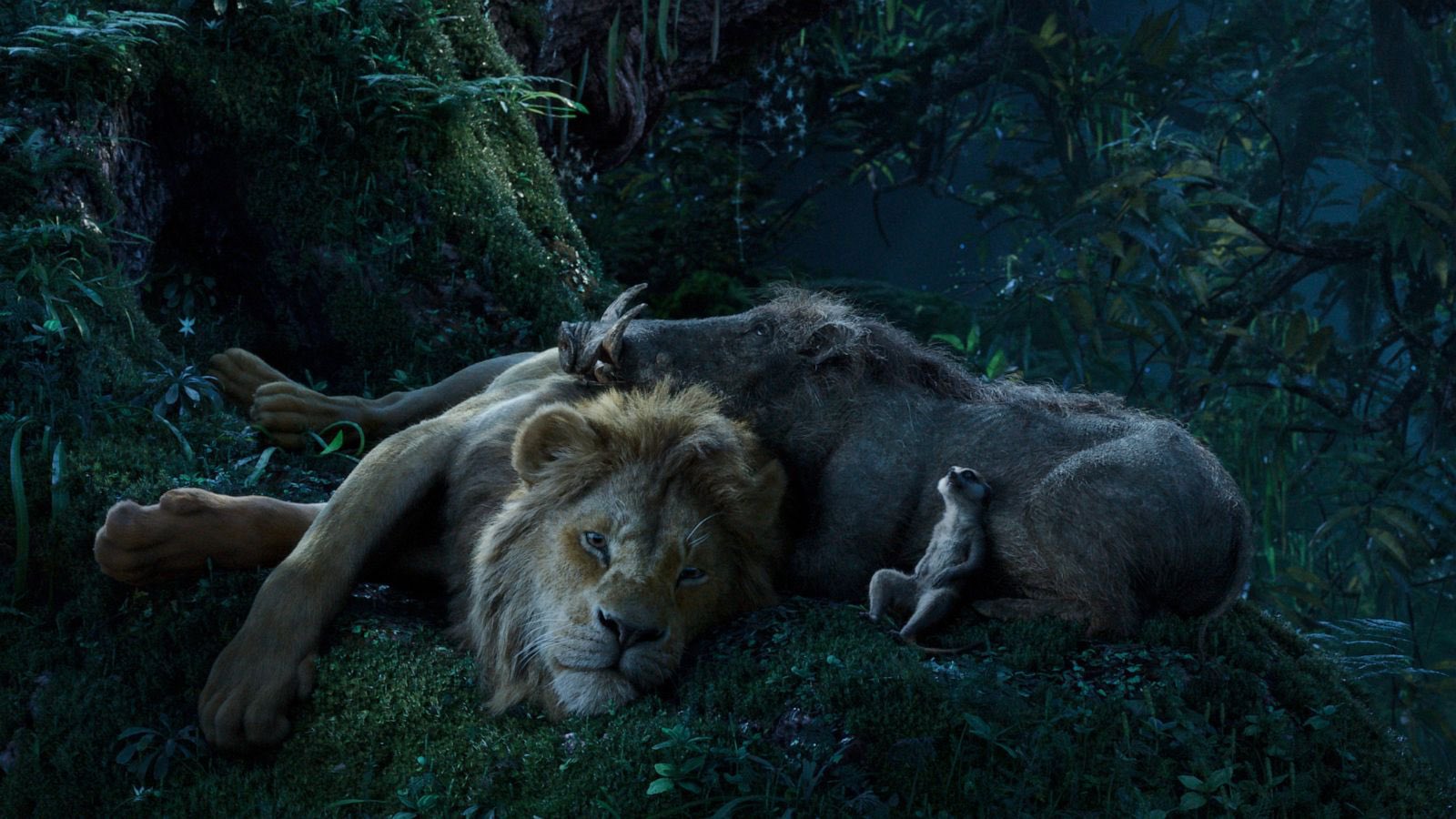
Nominated For: Best Visual Effects.
Synopsis: In the African savanna, a future king is born.
Simba idolizes his father and takes his royal destiny
to heart. But not everyone in the kingdom celebrates the new cub's arrival. Scar, former heir to the throne, has plans of his own. The battle for Pride Rock is soon ravaged with betrayal, tragedy, and drama, ultimately resulting in Simba's exile. With help from a curious pair of newfound friends, Simba must mature and take back what is rightfully his.
Runtime: 118 minutes
MPAA Rating: PG (for sequences of violence and peril, and some thematic elements)
Who should see it? Families and fans of Disney's live-action remakes.
Adapted from the iconic
1994 animated incarnation,
The Lion King is directed by Jon Favreau as Disney's latest "live-action" retelling. Considering the 2019 version was rendered from scratch, it's challenging to categorize
The Lion King as animated or live-action since it's the first of its kind. Favreau and Disney classified this uncharted territory as "live-action filmmaking techniques with photorealistic computer-generated-imagery" which is essentially jargon for a CG-production. Utilizing the groundbreaking technology that was employed in the making of
Avatar and
The Jungle Book (2016), animators meticulously recreated much of the original film's classic iconography to appear alarmingly photorealistic. Though certainly a remarkable technical achievement, this innovation comes at a steep cost.
is undeniably an impressive two-hour visual effects demonstration, but it sorely lacks the personality and energy of the original. This is largely because Favreau set parameters for his team of animators and vfx artists, which only allowed the animals to express emotion as they would in real life. As a result, the disembodied voices of an A-list ensemble are solely responsible for conveying their characters' emotional responses. Yet, vocal performances from veteran actors also fell flat. I'm unsure if this stemmed from Favreau's direction or the acting talent themselves, but the voice-over was mostly monotonous delivery of familiar dialogue. Jeff Nathanson adapted Irene Mecchi, Jonathan Roberts, and Linda Woolverton's screenplay while Brenda Chapman received story credit as the animated film's story supervisor. However, none of the other twenty-five writers or credited crew involved with the first film were recognized. I'm aware that Timon and Pumbaa's trademark motto "Hakuna Matata" means "no worries," but I have several.

For a remake so beholden to the original, I'm baffled to learn this is the case on account of semantics concerning protections and residuals from Writer's Guild and the Animation Guild. Credit logistics aside,
The Lion King retains approximately 80-85% of the first film's dialogue and replicates almost the entirety of its predecessor's visuals. A few additional scenes serve as supplemental story material to overtly explain the story's subtleties, which didn't really need to be shown. Otherwise, it's basically a shot-for-shot recreation with minor tweaks. Worst among these changes is the replacement of Hans Zimmer's score with Beyoncé's original song "Spirit" in the scene where Simba decides to return to Pride Rock. The scene, which is supposed to be a profound moment with an epic accompaniment, is instantly cheapened by a typical Beyoncé song that is hysterically out-of-place. Not to mention, Mufasa reappears to Simba as a generic cloud that only resembles a lion during instantaneous flashes of lighting. Favreau's insistence on grounding this tale in realism increasingly grew more and more absurd when I realized singing animals were part of the equation.
Chief among my complaints,
The Lion King's larger-than-life musical numbers were staged in literally the least exciting way imaginable. The photorealistic approach naturally confined Favreau's creativity in this regard, but animals simply walked or ran around their environment while singing. It was rather dull to watch, and the lyric annunciation and syncopated rhythms of the songs are changed to better suit the actors I suppose. Without the heightened exaggeration and vibrant colors front-and-center in the 1994 animation, these songs are hardly any fun. The cast's singing ability is there for the most part, though there are some glaring exceptions such as Seth Rogan's Pumbaa. It's mercifully brief, but nobody involved bother trying to mask it via auto-tuning as Disney did earlier this year in
Aladdin (2019).
Maybe, I'm being a bit harsh in actively comparing this reimagining to the first film. However, it's nearly impossible to avoid doing so since it borrows so much and is a downgrade in almost every respect. I've attested to the emotional disconnect intentionally inserted by Jon Favreau, and that decision alone seems to have stifled the possibilities that accompany bringing this story to life. Even standing entirely on its own, this iteration lacks the emotional vitality necessary to tell this story. The effects are incredible, but everything is a soulless rendering. Young Simba is admittedly a cute cub, but he's hardly capable of emoting. When Mufasa was trampled by a stampede of wildebeests (spoiler alert?), Simba's vacant expressions matched my own. Otherwise, Hans Zimmer probably earned the easiest paycheck of his life as his score is virtually identical aside from a couple new refrains and slight occasional re-arrangements.

I briefly addressed the ensemble, but I was amazed to see such high-profile talent lend performances devoid of personality when they seemed like ideal casting choices. JD McCrary, Shahadi Wright, Donald Glover, and Beyoncé portray Simba and Nala respectively at varying stages of life. The quartet's voices shine in the musical numbers but are otherwise serviceable. The legendary James Earl Jones reprises the role of Mufasa, and even he failed to spark life into a character which he'd already made iconic. Perhaps, it's due to his age, but that doesn't explain the other's inconspicuous contributions. Amongst the supporting cast, John Oliver's Zazu and John Kani's Rafiki are unusually restrained when compared to their animated counterparts while Afre Woodard's Sarabi practically serves as set decor.

Not all is lost, though. Billy Eichner and Seth Rogan were sure-fire stand-outs as Timon and Pumbaa and the sole source of successful comic relief. The rapport between Eichner and Rogan is unique, but true to the spirit of Nathan Lane and Ernie Sabella's dynamic from the original. The duo breaks the fourth wall in fun and exciting new ways, but it occurred a little too often and risked veering towards being Deadpool-esque at times. However, I will admit to breaking out in a fit of laughter at the subversive and abrupt ending to their amusing remix of "The Lion Sleeps Tonight."
Chiwetel Ejiofor's Scar speaks with a hushed intensity that sets him in the shadow of Jeremy Irons' eccentric take. The cunning and manipulative tendencies remain, but the larger-than-life malevolence is stripped away. Florence Kasumba, Keegan-Michael Key, and Eric André portray the prominent trio of hyenas and are equally subdued.
Given the enormous success of Disney's other live-action re-imaginings, a remake of
The Lion King was inevitable. After seeing
The Jungle Book, I'll admit that I was also interested in seeing Jon Favreau take a stab at it. I now deeply regret that request as in the theater I often sang to myself, "Oh, I just can't wait for this to be over."
Film Assessment: D+