Friday, March 30, 2018

'Ready Player One' Review

Nominated For: Best Visual Effects. 

Set in the dystopian future of 2045, people escape the harsh realities of life by spending a majority of their time in the OASIS, a vast virtual reality invented by the brilliant and eccentric entrepreneur James Halliday. Inside the OASIS, anything is possible. Users are able to endlessly customize their avatars and unlock unique items to help them in their quests. The only limit is your imagination. However, once Halliday dies, it's revealed to the world that he's hidden an Easter egg inside the OASIS that will grant the finder full ownership of the game in addition to Halliday's massive fortune. Ready Player One accompanies the unlikely young hero Wade Watts as he races against time and other users of the OASIS to locate all three keys left behind by Halliday so he can unlock the highly sought-after Easter egg. 
Functioning as Steven Spielberg's triumphant return to the big budget blockbuster, Ready Player One is helmed by the beloved director and features a screenplay co-penned by Zak Penn and Ernest Cline which adapts Cline's best selling novel. It's hard not to be ecstatic for a new Spielberg movie so, of course, I was overly enthusiastic going into Ready Player One. We don't get too many flicks from Spielberg these days, and I know there will inevitably be a tragic time where we never see another, so I relish in whatever he has to offer, whether it be The Post or The BFG. Where Steven Spielberg's career of-late has mostly pertained to dramas, Ready Player One presented itself as an opportunity for the genius filmmaker to get in touch with his blockbuster roots, and that idea alone excited me very much. 
I haven't read Cline's novel, but I was well aware there would be a heavy emphasis on '80s pop-culture due to the film's marketing material. On the surface, Ready Player One may look like a candy-coated nostalgia fest, but I can assure you the references are incorporated tastefully and there's an in-universe reason for it all. It's actually quite fitting that a film about a hidden Easter egg would be crammed full of them and also be released on Easter weekend. I can assure you that's no coincidence. Geeks are sure to be giddy whenever they spot references to a character, weapon, location, or vehicle they recognize from their favorite video games or movies, but that's not the sole source of the film's whimsy. While many homages had me smiling ear-to-ear, I was ultimately engaged by the characters, the focal mystery, the breathtaking, fully-realized OASIS, an exceptional score from Alan Silvestri, and the sheer spectacle of it all. 
It's no secret that Spielberg knows how to handle an action sequence, so it then comes at no surprise that Ready Player One would be littered with instances invigorating activity. As a child of the late '90s, I missed out on seeing Spielberg's more noteworthy motion pictures in theaters. Therefore, I saw them at home plopped in front of the television screen and missed out on the complete cinematic experience one desires from a Spielberg production. For the last decade or so, Spielberg has made many well-crafted films that I've had the pleasure of seeing in the theater, but none of them really carried that trademark "Spielberg magic." Wednesday night, I watched Ready Player One in IMAX and felt the Spielbergian sense of awe and wonder for the first time in awhile. It was glorious, and well worth the price of admission. So much that I intend to see Ready Player One at least once more this weekend.
However, my enthusiasm going into Ready Player One was paired with a couple caveats. The first of which being that it would be an indulgent nostalgia parade. I've already touched on that, but another one of my concerns was that the overall design of the OASIS and the avatars looked very video game-ish and the shift from the OASIS-to-reality might be jarring. Fortunately, this proved not to be the case. While the aesthetic of the OASIS does certainly resemble the graphics found in a modern high-end video game, that's kind of the point. It's a virtual reality after all. With that being said, the visual effects are absolutely outstanding. The environment and avatars of the OASIS are richly rendered and exhibit a wide array of vibrant colors that are truly a treat for the eyes. Editors Sarah Broshar and Michael Kahn also ensured the transitions between worlds were smooth and managed to keep the flow of the movie at a lively pace. 
Where the film doesn't fully deliver is fleshing out the nuts and bolts of the real world. By design, the OASIS is infinitely more interesting than reality, so it's not a stretch to say humanity would become obsessed with this form of escapism. Just look around you for goodness sakes. Everyone's already addicted to the internet. The commentary on that addiction is Ready Player One's poignant truth and part of the reason Ready Player One should be seen aside from the aforementioned attributes. Anyways, it's easy to imagine something like the OASIS taking off in our own world so the futuristic dystopian society depicted doesn't require significant suspension of disbelief.
What becomes questionable under further scrutiny is how the evil IOI even operates. You vaguely understand the inner workings, but the legality remained fuzzy. This becomes most problematic at the end when the audience is shown something that suggests their activities weren't legal. This probably won't bother you if you can set logic aside, but it may drive others insane. I simply viewed it as an unclear area of this universe. Otherwise, strap in for an exciting ride!
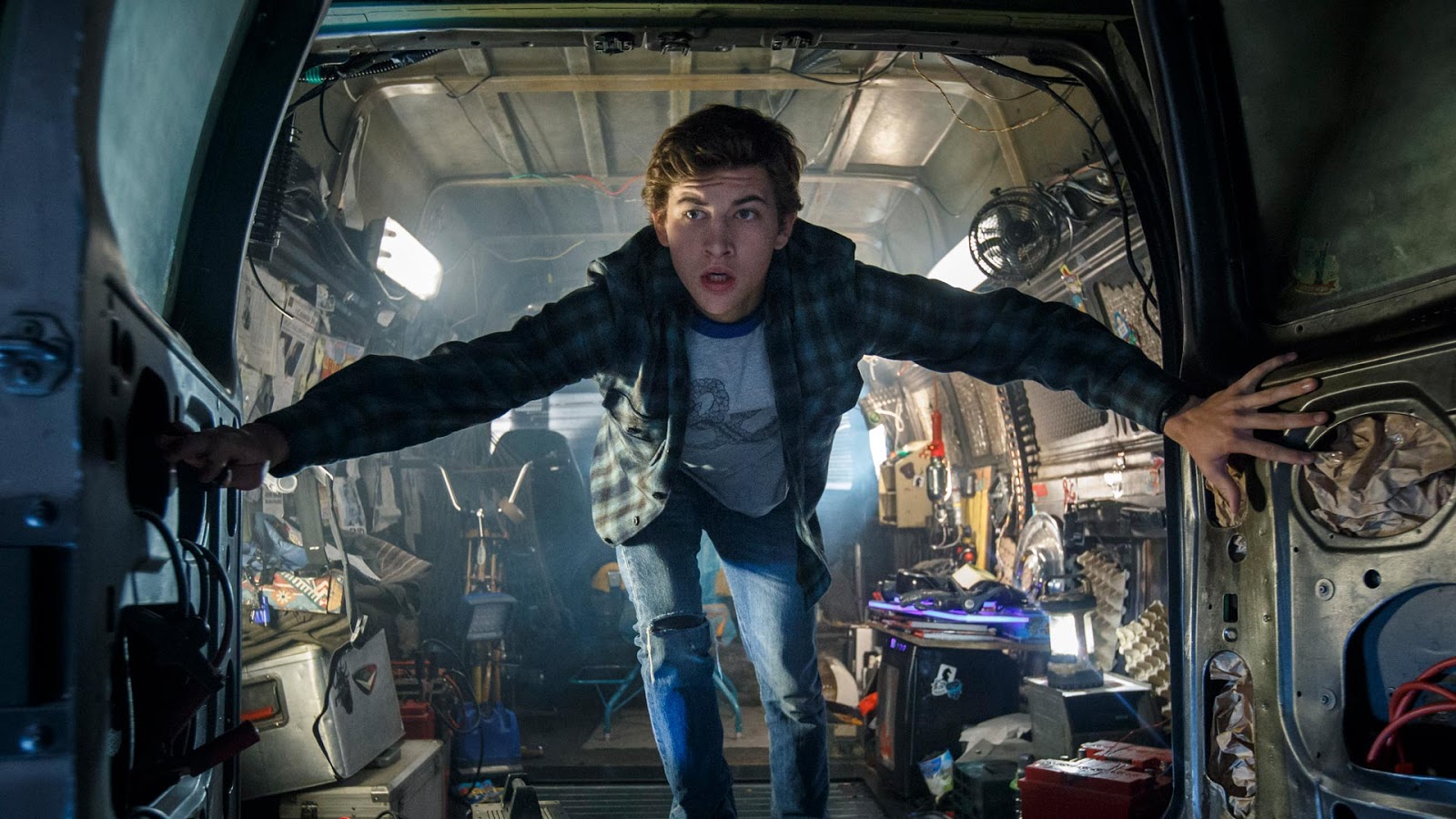
Leading said ride is Tye Sheridan as Wade Watts/Parzival (the second name being his OASIS username). Sheridan imbues Watts with traits one would expect from an unsure hero who's also a huge nerd, and he hit the sweet spot as an ideally awkward audience entry point. He's a likable lead, but never charming enough to upend his geek cred.
Opposite Sheridan, Olivia Cooke is the sure standout in the role of Samantha (also known as Art3mis in the OASIS). Cooke plays Art3mis as a stoic badass with some underlying insecurities, and seeing her eventually come to embrace those will undoubtedly inspire others as well. Sheridan and Cooke carry a captivating chemistry between them so their on-screen pairing was undoubtedly one of the film's highlights. Rounding out their friend group are Lena Waithe, Phillip Zhao, and Win Morisaki who were all equally endearing characters as Aech, Sho, and Daito respectively. 
Surrounding the young cast, veteran actors Mark Rylance, Simon Pegg, and Ben Mendelsohn leave substantial impressions in their varying roles of Halliday, Ogden Morrow, and Sorrento. Mark Rylance's good natured temperament and subdued personality lent itself well to Halliday and it's always a delight to see Simon Pegg in something! I'd rather not spoil his role for anyone, so I've decided to just skim right over it... Meanwhile, Mendelsohn made for an excellent antagonist and elevated what could have been a cliché corporate baddie to an intimidating force of evil.
Now let's be honest folks... Some of you are considering seeing Black Panther again this weekend, aren't you? Haven't you seen that enough by now? All jokes aside, Ready Player One currently isn't tracking very well for its opening weekend considering it's a Spielberg film (currently in the range of $52-55 M for the four day Easter weekend) and that saddens me. While that number's fairly high in comparison to everything Spielberg's made since Indiana Jones and The Kingdom of the Crystal SkullReady Player One honestly deserves better. If for nothing else, you should really be see Ready Player One on the biggest screen possible for the cinematic Spielberg experience. It's a celebration of pop-culture like no other and will be the most exhilarating Easter egg hunt you'll witness all weekend. 

Film Assessment: A-

Wednesday, March 28, 2018

'Isle of Dogs' Review

Nominated For: Best Animated Feature and Best Original Score.

In the near future (twenty years from now), snout fever (aka "dog flu") ravages the canine population of Megasaki City. By executive decree of Mayor Kobayashi, all dogs are hereby banished to a gargantuan garbage-dump otherwise referred to as Trash Island. Isle of Dogs then follows a determined twelve-year-old boy named Atari as he hijacks a miniature plane and flies across the river in search of his bodyguard-dog, Spots. Once he crashes on Trash Island, a pack of mangy mutts join him on his epic odyssey to find and rescue his long lost friend. 
Isle of Dogs is the ninth feature length film to be written and directed by the idiosyncratic Wes Anderson. If you've ever seen a Wes Anderson production, you have a clear idea of what you should expect from an acclaimed auteur of his pedigree. There will be whip pans, symmetric shot composition, an obsessive attention to detail, colorful settings, obscure older music, quirky characters, and abundant instances of offbeat humor. Of course, all of these elements can be found within Isle of Dogs since the film champions Anderson's unique, eccentric style as its most defining attribute.
If you're a fan of Anderson's work, you'll likely be drawn to see Isle of Dogs because it's the distinctive director's return to stop-motion animation after his first foray utilizing the medium in 2009, Fantastic Mr. Fox. His obsessive-compulsive nature as a filmmaker simply means he's suited to deal with stop-motion because the process is absurdly tedious and requires an incredible attention-to-detail. In order for the models to move with an authentic fluidity, animators have to continually adjust puppets with the slightest alterations between individual photographed frames. It's truly a testament to the ability of these animators that I often forgot I was watching stop-motion because there was such a lifelike look to it all. It's really remarkable, and I'd consider it to be among the finest stop-motion animation I've ever seen on film. 
Like any other Wes Anderson production, the art direction, production design, cinematography, and score are all exceptionally executed as can be expected. Stylistically, the film pays homage to the traditional Japanese epic, and Japan in general, in so many ways. Tristan Oliver's cinematography excellently communicated a sense of scale and intimacy/aggression (depending on the scene's context) while sticking to the symmetrical shot composition characteristic of all Anderson's work. All the while, the film is immensely energized by the beat of Alexandre Desplat's percussive score that stands out as a unique addition to the two-time Oscar winning composer's resume. 
Meanwhile, the film is facing some online controversy of cultural appropriation... I'm not quite sure what exactly is being interpreted as such, but I didn't think there was anything in the film that could be construed as offensive. Perhaps I'm not "woke" enough to understand it, but I believe these claims are grossly over-exaggerated. If you see the film and think otherwise, feel free to let me know what I'm missing. I'd actually say Anderson does a great deal to honor Japanese culture by casting ethnically appropriate actors for the Japanese human roles, homaging Japanese cinema, art, and architecture, and incorporating elements of cultural significance. That's not even to mention the fact that Anderson made the stylistic choice for all the Japanese characters to speak in Japanese throughout the entire film. 
A title card appears in the beginning to inform the audience in addition to letting everyone know there won't be subtitles either. Fortunately, the dog barks have been translated to English and an interpreter and outside narrator are incorporated for occasional English translations. I'm sure this will be met with a divisive reaction from American audiences because we'd like to understand everything. I felt the decision paid off for the most part, but it admittedly impaired the narrative from as I found it difficult to completely connect with characters I didn't always understand. Although I respect Anderson's commitment to the concept, subtitles would have been immensely beneficial.
While I appreciated the broad overarching themes regarding the canine breed's celebrated characteristics of bravery, loyalty, and unconditional love, the film's storytelling is a little ruff (pun intended). This isn't to say film's story is entirely problematic, but rather to note it stands out as superficial when compared to Anderson's other work. The film relies heavily of the whimsical charm of these junkyard dogs cracking quips in deadpan, which worked wonders by the way. Otherwise, it's as if Anderson is holding audiences at an arm's distance from the human characters due to the aforementioned decision not to translate all the Japanese dialogue. There's enough expression for audiences to pick up on distinctive personalities, but they simply weren't fleshed out or developed as much as I'd have liked. 
Isle of Dogs does however feature an especially distinguished cast composed of Bryan Cranston, Scarlett Johansson, Francis McDormand, Greta Gerwig, Liev Schreiber, Kunichi Nomura, Koyu Rankin, Ken Watanabe, and common Anderson collaborators such as Bill Murray, Edward Norton, Jeff Goldblum, Bob Balaban, F. Murray Abraham, and Tilda Swinton voicing an assortment of humans and hounds. To discuss them all individually would be a logistical nightmare, but do know that each actor added a great deal of charm and lent themselves well to their respective roles. Cranston is undoubtedly the standout as the surly stray alpha dog, Chief, and I have to say Koyu Rankin did remarkably well for his first role in a feature film in spite of the Japanese language barrier I brought up earlier. 
Before I wrap things up, I suppose I ought to mention that adults will have more to take away from Isle of Dogs than children. I realize the appeal of cute dogs and a young protagonist might make it appear to be made with children in mind, but that couldn't be further from the truth. There's not really much in the way of inappropriate humor, but the comedy is dark on occasion and the story itself is fairly mature. Significant portions of the film also move at a slower pace that I can't really envision kids enjoying, especially when the humor will fly over their heads. One other thing well worth mentioning is that you may look to see where you can watch Isle of Dogs after reading this review to learn it may not be playing at a theater near you just yet. That is because the film's had an especially limited release roll-out from Fox Searchlight. They'll be expanding in the coming weeks, but I'm unsure when the wide release date is. I was fortunate enough to attend an advanced screening of the film though and wanted to share a review regardless of that.
I may not consider Isle of Dogs to be one of my favorite films from Wes Anderson, but Anderson sure is one sly dog, because I can't dispute the fact I left the theater with my tail wagging (metaphorically, of course). It's taken three months, but Anderson's given audiences the first animated feature worth barking about this year!

Film Assessment: B+

Saturday, March 24, 2018

'Pacific Rim: Uprising' Review

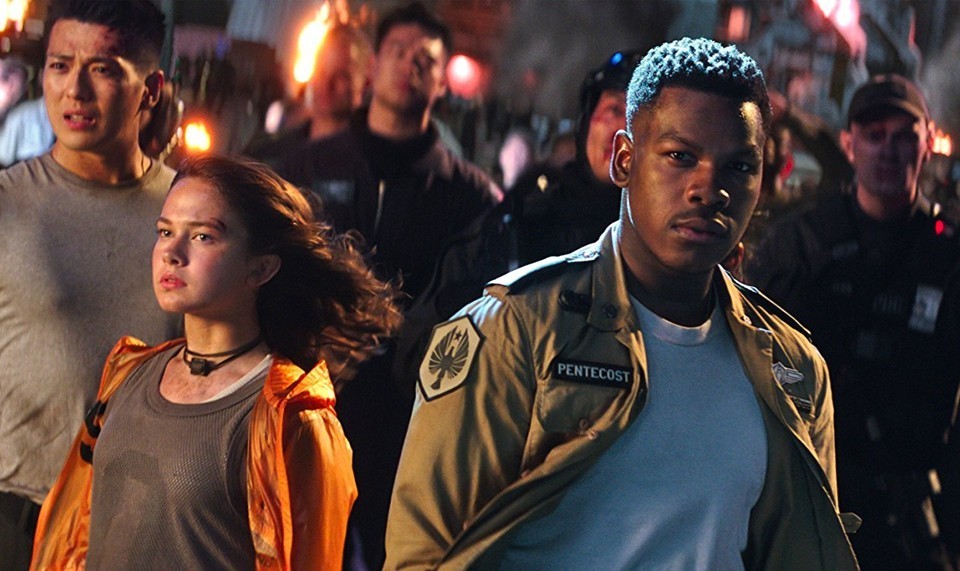
In the decade since the Pan Pacific Defense Corps sealed the inter-dimensional breach and ended the Kaiju War, humanity has continued developing Jaeger technology as a contingency to combat Kaiju. Pacific Rim: Uprising drifts alongside Jake Pentecost, a once-promising pilot-turned-petty scrapper whose father heroically sacrificed himself to ensure the monstrous Kaiju would be defeated once and for all. When Jake is caught with fellow scrapper Amara Namani, the two are presented with the choice of either joining the corps or going to jail. They choose the former, so Jake is then tasked with training a new generation of Jaeger pilots (including Amara) alongside rival ranger Nate Lambert. However, everything changes once a rogue Jaeger bursts onto the scene and prompts a Kaiju resurgence.
Did that plot synopsis seem needlessly convoluted? Well, I made my best effort to streamline the plot and that long-winded paragraph was all I could conjure... Pacific Rim: Uprising is in fact needlessly convoluted, which is actually odd when considering its predecessor (Pacific Rim) met the criteria of a unique flourishing franchise by being simultaneously stylish and simplistic. Visionary director Guillermo del Toro was largely responsible for that film's success since he was passionate about the project and well aware of the reality he was making a "B" movie centered on mechs fighting monsters. Unfortunately del Toro didn't return to direct Uprising, so the sequel sorely lacks the creative spark that made the first film special. Instead, Steven DeKnight took command of the franchise for his feature length film debut while del Toro went on to win a few Oscars for his work on The Shape of Water. Not a bad trade-off on del Toro's end, but del Toro's absence lead Uprising to become a far less interesting, commoditized imitation of the original so it was franchise fans who wound up suffering. On the bright side, The Shape of Water got made!
In case you couldn't already tell, Pacific Rim: Uprising pales in comparison to Pacific Rim in just about every way imaginable. While I'll admit that John Boyega's a bright spot in the cluttered cast, the visual effects are noteworthy, and the action sequences can be fun at times, Uprising's plagued by an onslaught of issues that had me dreading the possibility it was covertly Transformers 6. Michael Bay wasn't involved in this production whatsoever, but I'd have totally believed anyone who told me he was because this film is full of everything people dread about the latest Transformers installments. The humor's very juvenile and painfully unfunny, the fight sequences amount to bots bashing monsters through skyscrapers, there was occasionally a heavy emphasis on slo-motion, and they even incorporated a young girl determined to join the fight just like in Transformers: The Last Knight. Transformers wasn't the only film franchise that came to mind while I was watching though... There were several startling similarities to Independence Day: Resurgence and Power Rangers (2017) that I won't go into for the sake of length...
Now, lets take a second to talk about the sloppy script written by Emily Carmichael, Kira Snyder, T.S. Nowlin, and Steven DeKnight. The general turn of events was pretty predictable, but there were numerous occasions where DeKnight and the screenwriters presented an interesting subversion of expectations only to turn around and surprise the audience again by going along with precisely what you thought the "twist" was all along. I wouldn't mind this if it only happened once or twice, but it happened fairly often and simply grew annoying. The characters were also written fairly inconsistently as they'd frequently act differently than they did earlier without any underlying development or growth to explain why. The writers established mental roadblocks setup for the characters that weren't really dealt with at all, and one was a direct rip-off of the first that I won't expand upon to avoid spoiling anything for you. 
If there was one thing that made the entire experience unbearable though, it would have to be the cringeworthy attempts at comedic relief. One prime example is an entire scene which takes place in a kitchen where John Boyega's character is making himself a bowel of ice cream and adding various toppings while speaking to Scott Eastwood's character. It was one of the strangest scenes I've seen in a theater so far this year. The ice cream itself wasn't what was weird though... Sure, it felt out of place and unnecessary by itself, but the way it was heavily incorporated into the scene to cheekily function as a comedic device was really awkward in execution. It was laughably stupid, so I guess it achieved its purpose? Don't even get me started on the dreadful dialogue sprinkled throughout though... 
Anyways, I had no idea that a battle between monsters and mechs could become so uninteresting so quickly, but Steven DeKnight proved it's possible. Uprising's aesthetic isn't very dynamic from a visual standpoint since the film has a very flat color palette, so the fight sequences became stale quite quickly. While the action fits the fun formulaic mold audiences may be satisfied with, it's all incomprehensibly edited and I was never awestruck by any radically cool visuals, so the action is also a step-down from the first in terms of impressive spectacle. With that being said, I'm not a big fan of the sleeker Jaeger design compared to the previous rough, rugged look and the Kaiju creature design seemed to be uninspired in comparison as well. Another troublesome component was that the ending was poorly paced. In the third act, everyone takes their sweet time to really react while the world is on the brink of destruction, so you're left wondering how the Kaiju didn't successfully destroy the world in the time it takes for them to act.
As a charismatic lead, John Boyega is undoubtedly one of the sole saving graces of Pacific Rim: Uprising. It's such a shame he was stuck in such a crummy film though. Surrounding Boyega are a bunch of actors who are either obviously inexperienced or remarkably bland. Scott Eastwood's Nate is as stale as can be. Newcomer Cailee Spaeny seems to have potential to emerge as a quality actress in the years to come, but I found her character to be kind of annoying. Just about every other cast member proved to be unmemorable due to lacking development or screen time.
One thing I won't be forgetting about Pacific Rim: Uprising anytime soon though was how obnoxiously over the top Charlie Day was in the role of Dr. Newton Geiszler. I think the writing's largely to blame for this since such his character went in such a strange direction carrying over from the first film. Day did what he could with the material by trying to ham it up, but there's only so much one can do to try and save a sinking ship.
I'm sure many may be interested in seeing Pacific Rim: Uprising purely to watch Jaegers and Kaiju duke it out, but if that's the case, you'd be better off staying home and watching the first film. Pacific Rim: Uprising appears to be another attempt to commercialize a promising franchise in hopes of setting up several sequels. If that's the case, a more apt title would have been Pacific Rim: Downfall because my interest in future franchise entries is now at an all time low.

Film Assessment: D

Friday, March 23, 2018

Throwback Thursday Review: 'Pacific Rim'

I'm reviewing Pacific Rim to tie in with the release of its sequel, Pacific Rim: Uprising. Since March is almost over, I'm going to ahead and fill you in on the reviews you can expect to see through April, but I've made some changes to the previously outlined schedule because my finals are the same week that Avengers: Infinity War will be released. In order to get that review out as soon as possible for my readers, I'm easing my schedule by not reviewing anything else that week. Now that that's all cleared up, reviews you'll likely see through April include Throwback Thursday Reviews of Jurassic ParkOcean's Eleven (2001), and The Avengers, a Triple-R for Avengers: Age of Ultron, and new reviews of Pacific Rim: Uprising, Ready Player OneIsle of DogsA Quiet PlaceRampage, and Avengers: Infinity War

'Pacific Rim' Review


Pacific Rim thrusts audiences into a far-flung future where humanity has been besieged by monstrous sea creatures called Kaiju. As the beasts emerged from a dimensional rift in the Pacific Ocean, mankind developed massive robot fighting machines to combat the Kaiju. These mechs, dubbed Jaegers, were designed to be piloted by two humans locked together in a neural bridge. However, even with weaponized robots at their disposal, humanity's efforts to extinguish the Kaiju three has proved futile. As the Kaiju approach for their final strike, a former pilot and untrained trainee pair up to pilot an old, obsolete Jaeger in a last ditch effort to save the world from an impending apocalypse.
Pacific Rim is helmed by the recent Academy Award winning director Guillermo del Toro with a screenplay co-written by del Toro and Travis Beacham. When perusing through del Toro's filmography, you'll quickly take notice that he has a knack for spearheading creature-features so it only makes sense that he would have felt drawn to a blockbuster of this nature. It's about robots fighting sea creatures after all... Which is precisely why he was the perfect fit for the project. 
Del Toro's passion seeps through every frame thanks to the exceptional work of cinematographer Guillermo Navarro and the various visual effects artists at del Toro's disposal. They each ensure the neon-infused atmosphere envisioned by del Toro was executed to the fullest. When researching the film to see if it was nominated for any Oscars, I was shocked to learn it wasn't nominated for Best Visual Effects in 2013 because I was sure it would have been, and it certainly should have been. Beyond its impressive visuals, Pacific Rim also features an epic score composed by Ramin Djawadi and some solid performances. However, the film falls a little short in the story department. 
Despite a clear effort to establish the core characters as empathetic individuals, they weren't fully fleshed out enough for me to invest myself completely in their struggle. Sure, I want humanity to emerge triumphant... But not for anything the characters did to draw my interest. Mainly because I too am human. Most of the characters are little more than two-dimensional avatars when all is said-and-done because so many of them lack a personality. With all that being said, it's difficult to fault del Toro considering he's well aware that this is a "B" monster movie all about sheer spectacle. 
For every criticism I could conjure for Pacific Rim, I'm able to come up with at least twenty more reasons why Pacific Rim is awesome as an action-oriented blockbuster. The concept behind it all is incredibly interesting, the Kaiju and Jaeger designs are unique, and the fight sequences are incredible. It's just the characters and story that are lacking. 
Leading the rock 'em sock 'em ensemble are Charlie Hunnam and Rinko Kikuchi, who each imbue their characters with the essential attributes. Hunnam portrays Raleigh as a loose cannon while Kikuchi's Mako is a troubled trainee. Even though they fit their respective roles well, I've never quite bought their romantic connection as there's not much chemistry between the two of them. The romance then feels forced into the narrative for the sake of including one.
Elsewhere, Idris Elba's magnetic screen presence as Marshal Stacker Pentecost positions him to be a cut above most movie military officials, but his stance as the most dynamic character only aids him in being the standout scene stealer.
Meanwhile, Charlie Day and Burn Gorman play a pair of eccentric geniuses whose silly side quest seems to be a contrived scheme to obtain pertinent information. Other cast members deserving of a shout out include Ron Perlman, Max Martini, and Robert Kazinski who all manage to make a unique impact with varying screen time. 
Despite adhering to the nuts-and-bolts of a traditional "B" monster movie, Pacific Rim remains an exciting popcorn movie that will scratch your itch to watch gigantic Jaegers punch it out with enormous Kaiju. While it underwhelms on a storytelling level, the interested audience members probably weren't even asking for that to begin with. 

Film Assessment: B

Thursday, March 22, 2018

Throwback Thursday Review: 'Lara Croft: Tomb Raider'

Sorry for the slight delay, but I prioritized an early review of Tomb Raider last week before even stopping to watch Lara Croft: Tomb Raider. Anyways, I'm reviewing Lara Croft: Tomb Raider to coincide with last weekend's release of the 2018 incarnation. If you're wondering what happened with the previous week's Throwback Thurday, I was originally going to review A Wrinkle in Time (2004) till I found out it was a four hour eleven minute TV movie... I read the novel in seventh grade and can recall watching the TV movie in class, but I'd rather not spend four hours watching something I already know I dislike just to turn around and spend another few hours writing about it... Now that that's all cleared up, you can expect to see the following reviews through the remainder of March. This includes Throwback Thursday Reviews of Pacific Rim, and Jurassic Park, new reviews of Pacific Rim: UprisingIsle of Dogs, and Ready Player One.


'Lara Croft: Tomb Raider' Review


Lara Croft: Tomb Raider accompanies the adept adventurer Lara Croft as she races across the globe to save the world by keeping ancient artifacts out of the wrong hands. There's not really much of a plot beyond that simple set-up though, as Croft merely globe trotted from ancient ruin to ancient ruin for little else than an over-the-top action sequence.
For whatever reason, I've found it incredibly difficult to write about this movie (hence why this review's a week late). What could I possibly have to say about this that hasn't already been said? It's an adaptation that accurately reflects the silly escapades lead by an accomplished femme fatale found in the the Tomb Raider video game series from the '90s. Director Simon West clearly wasn't interested in deviating from the source material much at all, as the film adaptation hardly explores anything else. Instead, viewers are offered an exploitation of Angelina Jolie's sex appeal which was meant to disguise a faulty action flick. Did that work? Not really. I was entirely unengaged when Lara wasn't wrapped up in some silly situation. When something did catch my attention, I was still uninvested in the story at hand.
The film's enjoyable in the sense that everything you watch unfold is so preposterous that you can't help but smile amidst it all. The script is composed of an outlandish story strung together by John Zinman, Patrick Massett, and Michael Colleary, a silly screenplay full of corny dialogue penned by Mike Were and Sara B. Cooper, while West himself is credited by the Writers Guild for the adaptation itself. The action sequences don't fair much better either, as it's all spectacle for the sake of  including spectacle. As an viewer, I could have cared less whether Lara emerged triumphant over the stone monkeys or not. And on that note, the CGI is ridiculously dated. Of course, that's because this came out in 2001, but I think the effects are still lacking for the time in which they were rendered.
Angelina Jolie commits to Lara Croft's over-sexualized attitude, but there's little else going on for the character. Jolie just fights varying baddies and stops every once and a while to pose like a vapid lipstick/lingerie model (there's a significant emphasis on her lips, hips, and breasts)... I suppose she succeeded at playing the sex icon the filmmakers were hoping for, but I'd hardly call that acting. I'd comment on her co-stars, but they hardly do anything in the film worth mentioning. I can at least say it was interesting to see what Daniel Craig and Iain Glen were up to seventeen years ago before they became James Bond and Jorah Mormont respectively. It's nice to know they found success elsewhere.
After watching Lara Croft: Tomb Raider for the first time on Netflix, I've only become more appreciative of this year's Tomb Raider. It's easy to understand why this film franchise's tomb was ever sealed to begin with.

Film Assessment: D

Thursday, March 15, 2018

'Tomb Raider' Review

Tomb Raider accompanies Lara Croft, the fiercely independent daughter of a missing adventurer, as she embarks on a harrowing journey to solve the mystery of her father's disappearance. As a result of her perilous quest, Lara winds up marooned on the same island where her father disappeared seven years ago. Suddenly, the stakes couldn't be higher for Lara as she must survive against all odds armed with only her sharp mind, blind faith, and inherently stubborn spirit.
It's no secret that video games haven't quite found sure-fire success in the medium of film. There's yet to be a critical darling and very few have found fortune at the box office (Sorry, but Scott Pilgrim vs. the World and Wreck-It Ralph don't count). Many have dubbed this long running streak of flops to be a "video game curse," and audiences have been eagerly awaiting an entertaining adaptation that would end this jinx and open the door for quality features based on video games. In 2016, there seemed to be hope on the horizon in the form of Warcraft and Assassin's Creed but neither proved worthy of the feat and fell flat critically and financially. Now, eyes have turned upon Tomb Raider to be the breakthrough breadwinner and I suppose you're all wondering if it performed under pressure.
After a longwinded awards season, a palette cleanser in the form of an action-adventure flick is just what one needs to prepare for stacked season of blockbusters. Thankfully, this 2018 reiteration of Tomb Raider proved up to the task! Helmed by Norwegian film director Roar Uthaug with writing credits going to Geneva Robertson-Dworet, Alastair Siddons, and Evan Daugherty, this incarnation serves as both an adaptation of the 2013 video game reboot and a reboot of the Angelina Jolie led Lara Croft: Tomb Raider series from the early 2000s. Talk about rebootception!
Even though I admittedly didn't have the highest of expectations for Tomb Raider due to never having played the game, Uthaug cleared the bar for me and delivered on the exciting action-adventure film I felt the trailers promised. Despite the unpracticality of the film's physics, there was a sense that the stakes were high and characters were vulnerable thanks to the intensity of the action. In the moment, you truly believed Lara could die at any minute because of the suspenseful situations she found herself in. Indiana JonesThe Mummy (1999), and National Treasure all come to mind as comparable franchises in terms of high stakes, enjoyable archeological action-adventure.
Again, while I haven't played the game, a lot of the situations seemed as though they were translating game mechanics anytime Lara solved a puzzle or escaped a perilous predicament, and I found that to only enhance the adventure aspect of things. In truth, this film had just about everything I wanted last year's reboot of The Mummy to deliver on. 
On the flipside, the CGI was wildly inconsistent. There were certain moments with noticeable green screen (as seen above) and others you'd hardly consider to have been altered by a computer. It simply varied from occasion to occasion as is often the case with visual effects in these modern big budget bonanzas. 
Of course, Tomb Raider carries the burden of some pacing problems and uneven storytelling that will leave the viewer to occasionally question why characters didn't simply act another way or do something else to get out of a troubling dilemma. On top of that, the story itself isn't all too original so some story beats come across as genre tropes or cliché in your mind. However, none of this ever compromised the film as a whole and the origin story elements were handled quite well as it's easy to see how Lara went from Point A to Point B when all is said-and-done. In fact, I was able to invest myself in Lara as a character quite quickly largely thanks to Alicia Vikander's strong showing. 
If there was one hurdle this production had to get over above all else, it was the recasting of Lara Croft. While I wouldn't say Jolie's take on the character is quite iconic, audiences are more familiar with that over-sexualized version and the video game itself. As the promotional material for the film made its way online, an unfortunate issue of body shaming across the internet arose that ranged from making fun of the actress' neck to her bust size... Ridiculous... I know. Thankfully, enough internet users stood up to the plate and repelled the criticism quite maturely. 
Anyways, Vikander proves to be more than up to the task of shutting down toxic fans with her committed performance. She not only underwent the necessary training and dieting to properly portray the character's athletic physicality, but took things a step further by performing a number of the stunts herself. Of course, that's all meaningless if she couldn't act... But this is an Academy Award winning actress we're taking about, and Vikander dedicates herself physically, mentally, and emotionally to the role. All in all, Vikander imbues Lara Croft with the proper balance of determination, intelligence, skill, and emotional weight to come out on top as a capable, yet vulnerable female heroine whose abilities are a bit more tempered and realistic than those of the superheroes currently dominating the cinema screens.
As an antagonist, Walton Goggins' Mathias Vogel comes across as a menacing in large part to some great acting from Goggins, but is ultimately underserved by the screenplay to be little more than a two-dimensional baddie on paper. In the ranks of supporting cast members, Dominic West and Daniel Wu do well with their sizable roles and are mostly responsible for the film's comedic and emotional beats where they each are able to excel.
While not quite the game changer many were hoping for, Tomb Raider is a step in the right direction for video game movies. Warner Bros. and Metro Goldwyn Meyer have excavated a forgotten franchise and revitalized it to be one brimming with plenty of exciting possibilities. Under the right guidance, I hope they raid this tomb for all its worth!

Film Assessment: B