Showing posts with label Blade Runner 2049. Show all posts

Sunday, December 31, 2017

Top 10 Films of 2017

It's that time of year again where I reflect on all the films I've watched and reviewed to tell you my ten favorites. I made an effort to see a majority of the films released this year, but naturally I missed out on some for various reasons. This year I saw and reviewed 71 films in total, but I'll still publish my thoughts on anything I missed once I see it. In my ranking, I'll have a couple sentences to sum up my thoughts on each film and why I feel it earned a spot on my list. I have reviews uploaded for each one, so if you're interested and haven't done so already, you can read my more in-depth thoughts by clicking the blue title once you're done perusing my list. 

I'd also like to preface my list with a few things for you to consider as you read. First of all, this is my subjective list. Not an objective one. That list would probably look a lot more like the list of Best Picture nominees coming next month, and quite frankly, I don't think any of you are interested in seeing those same exact films appear here. These are the ten films that stuck with me most when the year was all over for an abundance of reasons I'll get around to explaining in a second. Another thing regarding my list is that this is MY list. You're likely and liable to disagree with some of my picks, but that's because film is subjective and speaks differently to everyone. Also, it's a high distinction to be an Honorable Mention. Those films are the ones I struggled leaving off the list, but feel deserve some sort of shot-out, so don't think that I disliked a film because I put it in there. The final thing I'd like to say is that just because something is left off my list doesn't necessarily mean I hated it... I just liked these other films even more when all was said and done. 

Top 10 Films of 2017


10. Wonder Woman

In spite of a lackluster villain, a third act that's not quite on par with the rest of the film, and the baggage of being part of the larger DCEU, Wonder Woman defied all odds to emerge as one of the year's most entertaining blockbusters! Gal Gadot shines here by imbuing all of Diana's best qualities, Chris Pine stands out as a charming love interest, Patty Jenkins did an exceptional job directing her first big budget project, and Rupert Gregson-Williams' score is absolutely electrifying. I know there's been some backlash from a vocal contingent, but I genuinely feel it featured some of the year's most exciting action scenes and took huge strides forward in properly depicting a female superhero. 

9. Three Billboards Outside Ebbing, Missouri

Three Billboards Outside Ebbing, Missouri is one of the year's strongest films for so many reasons, but it stood out to me because of how well it balanced the extremes of dark comedy and drama while discussing the adverse effects of anger. It also didn't hurt that it was well-written, well-directed, and features plenty of powerhouse performances.

8. Wind River

Of all the films released this year, Wind River was probably the biggest surprise for me. I was hoping it'd be good of course, but I had no idea Taylor Sheridan would leave such a harrowing impression. Like the icy Wyoming landscape presented to the viewer, Wind River is cold and unforgiving with a message audiences will have a hard time forgetting.

7. Coco

Pixar never ceases to amaze me with their ability to tell such emotionally-driven stories through the visual medium of animation. Coco stands as an exemplary reminder of everything the studio is capable of whenever they set their hearts and minds to it. Coco's not only one of the best of the year, but one of their best original films to date thanks to all it had to say on the importance of family and culture while also ensuring audiences enjoyed themselves.
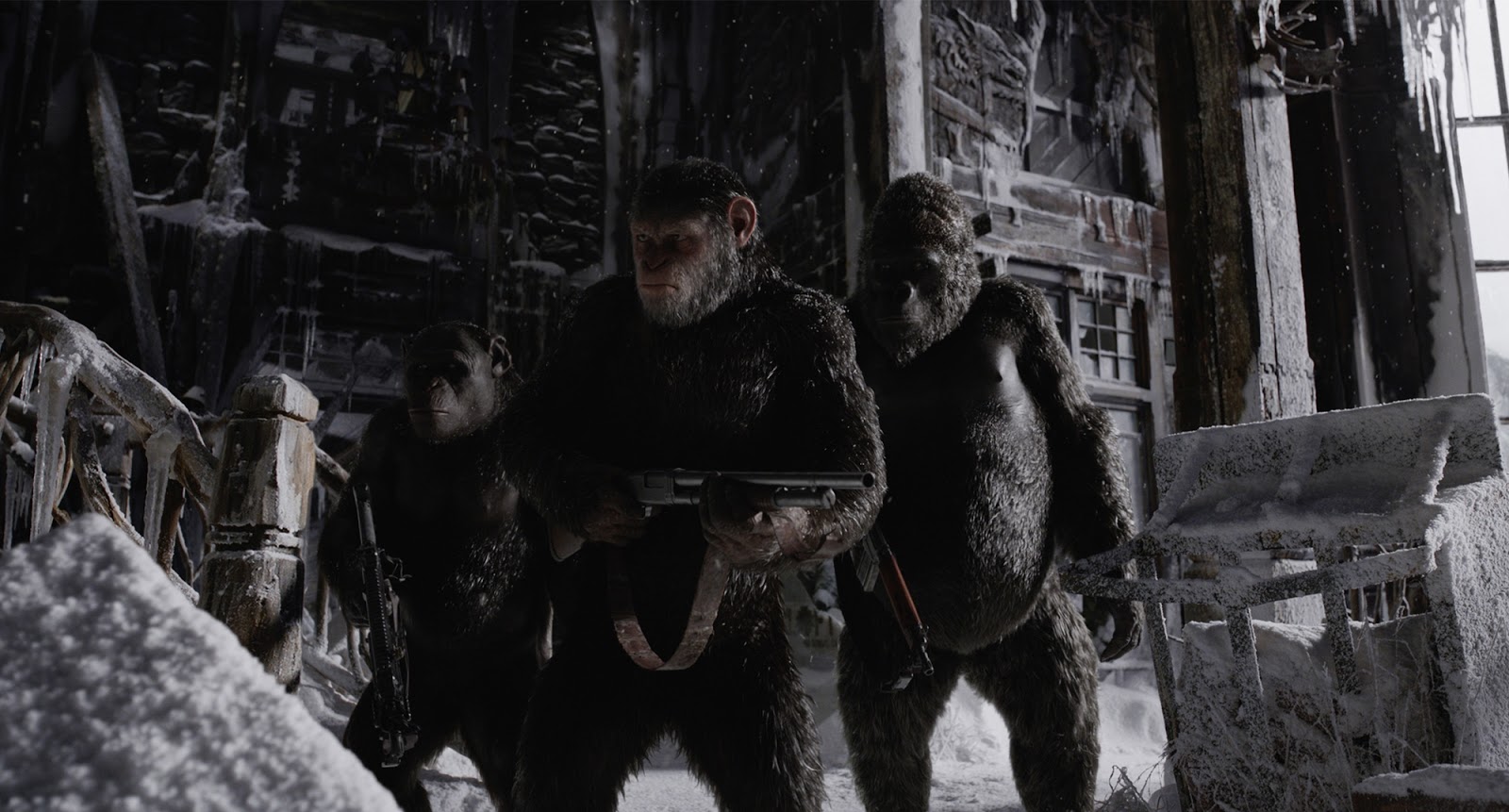
Trilogies don't always land on solid ground with their third installments, but War for the Planet of the Apes cemented the Ceasar trilogy as one of the greatest cinematic trilogies ever made. It was epic, emotional, and never lost sight of the series' values. Andy Serkis delivers one of his best motion-capture performances yet while the WETA visual effects team presented some of their best work ever. After it was over, I couldn't fight the desire to bow down and hail Caesar.  

The Shape of Water is such a beautiful film in so many ways. It's got an attractive aesthetic, important messages to impart, and most impressively, it tells a surprisingly deep love story without either of the two love interests uttering a word. It's simply one of those films that reminded me why I ever fell in love with cinema.

4. Logan

I grew up watching Hugh Jackman's Wolverine for seventeen years. He's genuinely one of the best cast comic book movie characters ever... Knowing he was leaving the role for good was saddening in and of itself. However, Logan was everything Hugh Jackman's sentimental send-off needed to be. It was raw, emotional, and character driven all the way through. It upended the comic book genre by going the way of the Western and it worked extraordinarily well. I'm not even a huge fan of the character of Wolverine, but I consider it to be the greatest comic book movie ever made, and the only one aside from The Dark Knight to truly be deserving of major awards contention.

In a year filled with sequels, reboots, and comic book adaptations, Baby Driver was something entirely original from the brilliant mind of Edgar Wright. It had a tank full of heart, humor, and unpredictability that made it stand out as something truly special amongst the hub-bub of summer blockbusters. I can't say it enough, but this film floored me. Wright's determination to meticulously match the diverse soundtrack full of rockin' tunes with all the insanity occurring onscreen is commendable alone. The fact he managed to pull that off while telling an engaging story about such charming characters only goes to show he's not a creative force to be reckoned with.

Few directors can consistently deliver intellectually and emotionally stirring work, but Denis Villeneuve kept up his streak with Blade Runner 2049. Blade Runner 2049 is simply a masterwork in more ways than one. It's one of the most beautiful films I think I've EVER laid eyes on thanks to Roger Deakins, it features my favorite film score of the entire year from Hans Zimmer and Benjamin Wallfisch, and it expands its world in organic ways while telling a fascinating story. I'm absolutely positive Blade Runner 2049 will become an influential source for many up-and-coming filmmakers.

Star Wars: The Last Jedi split the fanbase right down the middle, and surprisingly wound up being one of the year's most divisive films. You all know where I stand by now, but I was completely taken aback by the rift between fans. It's weird because I watched something that was utterly astounding on so many levels, while others talk about it like they saw something straight out of a trash compactor. Writer and director Rian Johnson dared do to be different and deconstruct Star Wars like no one ever had, and I think it paid off in spades.

Tuesday, December 26, 2017

'Blade Runner 2049' Review

It's difficult to discuss Blade Runner 2049 without diving into spoilers. However, I have the luxury of publishing this review well after the theatrical release date, so I will indeed be including a spoiler discussion in this review. In order to preserve the plot for those who have yet to watch Blade Runner 2049, I'll indicate the beginning of the discussion with a clear spoiler warning. I'll be detailing specifics of the performances inside the spoiler section, because it's tricky to dance around that aspect of the film without simply saying "Ryan Gosling was really good" or something like that.

[This review was originally written in October 2017 and is now being published to coincide with the digital home media release. For an explanation of this, visit my Fall 2017 Important Update post.] 

Nominated For: Best Cinematography, Best Production Design, Best Visual Effects, Best Sound Editing, and Best Sound Mixing.

When Blade Runner 2049 begins, it has been thirty years since the events of the 1982 sci-fi masterpiece Blade Runner. The older replicant models are still being hunted down and retired by the Blade Runner task force. While on assignment, the youthful Officer K stumbles across a long-buried secret that sets him on a path of self-discovery as he's forced to locate a long-retired runaway Blade Runner, Rick Deckard, for answers. 
Legacy sequels are a hot commodity in Hollywood right now. For those that don't know what a "legacy sequel" is, they're basically sequels that pick up several years after the last film in the context of the franchise with a new core cast of characters taking the torch from the previous protagonists (think Jurassic World, Creed, Star Wars: The Force Awakens, and Independence Day: Resurgence). Blade Runner 2049 easily falls into this category, although it stands apart from the aforementioned examples because it doesn't attempt to lay groundwork for future franchise entries.
Anytime it's announced a beloved film will be receiving a sequel, it's understandable that fans will have their fair share of skepticism. It's a tall order to release a sequel thirty five years after the original that's strong enough to stand toe-to-toe with the first, especially when that first film is Blade Runner. However, Denis Villeneuve, whom you may be familiar with for directing the fantastic films Sicario and Arrival, takes the reigns from Ridley Scott to solidify himself as one of the greatest working directors today. It's simply remarkable how Villeneuve was able to recapture the futuristic science-fiction noir's tone, style, and sensibilities without retracing any steps.
For those readers who have kept up with my blog for some time, you may recall me making a comment in my Arrival review that Denis Villeneuve had the potential to be the next Christopher Nolan... Well he's gone out and proven my point... Blade Runner 2049 cements Villeneuve as a master filmmaker. It'd be an understatement for me to say I anticipate buying a ticket for every film spanning his directorial career.
On a technical level, Blade Runner 2049 astounds from beginning-to-end with an exquisite aesthetic. Roger Deakins' sensational cinematography seamlessly integrates with the exuberant neon-flourecent lighting, peak production design, and extraordinary visual effects to bring audiences one of the most visually-arresting productions ever made. Deakins has been nominated for thirteen Oscars, but still doesn't have a single golden statuette on his mantle. However, I suspect Deakins will get his due next February because it seems absurd not to award someone at the top of his craft.
Speaking of sneaking suspicions, I'm guessing general audiences will say Blade Runner 2049 is "slow," "boring," and "too long," but I think that'll only be the case if you a) aren't a fan of the original Blade Runner or b) refuse to put your thinking cap on. Blade Runner 2049 isn't a popcorn movie. Don't expect to see copious scenes of mind-boggling action, or you'll probably be enormously underwhelmed. While I can agree that the two hour forty-three minute runtime seems lengthy, it didn't feel three hours long because I was absolutely engrossed in all the events unfolding onscreen.
Everything about Blade Runner 2049 is quite mesmerizing for that matter. The film escalates at a slow burn, but the developing story (which I'll touch on in a second) is totally transfixing. This is only enhanced by the spellbinding score accompanying said events. On that note, there's an interesting story behind this soundtrack. Villeneuve's frequent collaborator Jóhann Jóhannsson was first attached to compose the score, but wound up being entirely replaced by Hans Zimmer and Benjamin Wallfisch about a month before the film's release. Zimmer and Wallfisch were already on-board throughout the post-production process, but it alarmed me to see a composer depart the project considering how much I loved his Arrival compositions. It's needless to say I absolutely adored the end result though, because it was reminiscent of Vangelis' electric ambiance yet sounded entirely unique.
Like Star Wars: The Force Awakens, Blade Runner 2049's marketing campaign was shrouded in mystery and offered no clues as to what the actual plot was. At press screenings, Warner Bros. and Villeneuve even issued a statement requesting critics to refrain from including revealing specific plot details in their reviews. I absolutely adore this approach, because oftentimes we as an audience know way too much about movies before we've even seen it because of some spoiler-inclusive marketing material and indifferent journalists. Anyways, if you want to get the most out of Blade Runner 2049, I would actually advise to watch Blade Runner beforehand to have a better understanding of everything that's going on. Although it's certainly possible for to glean from the surface level without watching it, you'll get a better grasp of the true significance if you've seen it.

**Spoiler Warning**

The screenplay whipped up by Hampton Fancher and Micheal Green offers an incredible expansion on the ideas Blade Runner often came across, taking things a step further in regards to the blurred lines that separate man and machine. This is mostly achieved through Officer K, who's almost immediately revealed to be a replicant. K clearly has a beating heart, soul, and conscience beneath his synthetic skin, mechanical motors, and proven programming as evidenced by his reluctance to hunt down the miraculous replicant child. The concept is further fleshed out by K's wishful thinking and inner desire to be special as K projects the idea that he is the child in-question due to his implanted memories.
I'll say that K's conviction totally tricked me into thinking I had predicted the "huge twist" at the center of Blade Runner 2049, but Fancher and Green threw a huge curve ball instead that took me completely off-guard by revealing that the child was actually Dr. Ana Stelline. I especially appreciate how the turn-of-events deepened K as the aspirant replicant who was disappointed to learn he's just a replicant. Instead of going to kill Deckard as commanded, K realizes his potential to help reunite the father and daughter, and his commitment to doing the right thing causes him to sacrifice his own life so he can make a difference for others. The selfless nature of K's actions in the face of crushing adversity and Ryan Gosling's subdued performance only made his arc more impactful. 
Another fascinating exploration of these ideas is rooted in the romance between K and his holographic Artificial Intelligence Joi. Since Joi is an intangible visual projection, the romance is strictly relegated to an intellectual level similar to the storyline spread throughout Spike Jonze's Her. However, Blade Runner 2049 examines the material with enough of a unique spin to differentiate itself because it asks viewers the existential question of how agonizing it would be to fall in love with consciousness you could see, but never truly touch. To me, that idea is an entire level above the Her dynamic and even the romance central to the original Blade Runner.
What truly sells the relationship though is how Ana De Armas and Ryan Gosling authenticate the complex connection between an artificial consciousness and an android lover who are just longing for a physical connection. De Armas projects so much depth to a seemingly shallow character and establish the pivotal love scene to be a beautiful moment. In regards to that scene, I'm sure someone will come out and say it's sexist and demeaning, but it's really not... I felt the moment meant so much more. Joi is restricted from being able to foster a physical intimacy with K, so she hires a surrogate pleasure replicant model to step in as a vessel so she can merge herself and achieve just that.
Then I couldn't possibly complete this review without bringing up Harrison Ford's return as Rick Deckard. He doesn't show up till about two hours into the film, but Ford leaves a lasting impression with every second onscreen. Much like his reprisal of Han Solo in The Force Awakens, he steps right back into the shoes of the character he left behind thirty-five years ago. He especially astounded me in one particular scene where he's forced to encounter a replicant resembling Rachel. The mere reaction from Ford in this moment positioned him as one of the film's stand-outs. 
In the antagonistic camp, Jared Leto's suitably strange as technical tycoon Niander Wallace and had substantially less screen time than I was expecting, but honestly gave a great performance. It's his underling android assistant Luv that truly terrifies though. Sylvia Hoeks latches onto the menacing demeanor with complete conviction, and I hope this role perks the eyes and ears of many casting directors so I can see her play another villain once more.
It was also nice to see familiar faces Robin Wright, Dave Bautista, David Dastmalchian, Barkad Abdi, Edward James Olmos, and Sean Young show up and provide strong supporting turns, regardless of screen time.

**End of spoilers**

Blade Runner 2049 is the scarce spectacular sequel that brilliantly builds upon the wonderful world and profound philosophical pondering of the original, while maintaining the first film's integral atmosphere and standing strong on its own merit. I know it's been said-to-death at this point, but there's no other way to articulate it, Blade Runner 2049 is a master work of science-fiction that won't be soon forgotten and will inspire entire generations of filmmakers to come.

Film Assessment: A+