Thursday, December 28, 2017

'All the Money in the World' Review

Nominated For: Best Supporting Actor; Christopher Plummer.

All the Money in the World briefs audiences on the kidnapping of sixteen year old John Paul Getty III in July 1973 and his distraught mother's desperate attempt to convince the boy's wealthy grandfather J. Paul Getty to pay the ransom. Getty refuses and enlists former federal agent Fletcher Chase to find out what's happened to his grandson, so Chase and Gail Harris wind up in an unexpected alliance as they strive to rescue the boy by any means necessary. 
You may or may not have heard about all of All the Money in the World's behind the scenes drama, but after sexual harassment allegations arose surrounding Kevin Spacey, the decision was made to remove Spacey from the film, reshoot all his scenes with Christopher Plummer replacing him as Getty, and release the film as scheduled. While I'm not sure the decision to remove Spacey affected the finished product all too much, it paid off thanks to the wonderful work from director Ridley Scott and actor Christopher Plummer. By the way, it's not like Scott and his crew just reshot a couple scenes considering Getty is in a substantial amount of the film... The fact they did it all in two weeks AND managed to release the films a few weeks later is absolutely astounding to me.
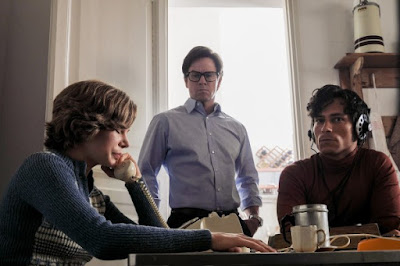
However, I must be completely honest in saying that otherwise I wasn't very impressed. There are a few exceptions to that statement of course, but don't be fooled into thinking All the Money in the World is truly one of the year's best films simply because they seamlessly subbed out Spacey... Ridley Scott is a director whom I especially admire for creating such fantastic films as AlienBlade Runner, and The Martian, but All the Money in the World lacks the director's unique style to differentiate it from any other bio-pic out there. Scott utilizes a desaturated color scheme that was terribly tiring to look at, and I'm honestly surprised it didn't put me to sleep when contemplating the film is also built around a dialogue-heavy screenplay. On the whole, the film's competently made, but it's a little long so the pacing drags and you start to realize this story may not have been meant for the film medium.
David Scarpa adapts John Pearson's book and still comes out short-changed after dramatizing things. What confounds me most though is how fascinating the story seems, yet how underwhelming Scarpa's script managed to be. The film's quite dialogue heavy, which is fine if the things said come across as interesting in execution, but there are large stretches that are boring or commonplace. There's unique elements in the kidnapping, but viewers are mostly left watching Harris wait for clues to find her son or beg Getty to pay the ransom, and that gets quite taxing after awhile. 
On the flip side of that coin, All the Money in the World features some fine performances. Michelle Williams brings both strength and vulnerability to the role of Gail Harris, shining as a determined mother against adversity. She's worried, but never frantic. Committed, but never unwavering. Williams discovers an effective balance between the extremes and ensures all her moments count so her acting prowess doesn't go unnoticed. Charlie Plummer (who is not related to Christopher Plummer) does well playing John Paul Getty III as a disparaged captive, while French actor Romain Duris imbues an unexpected humanity and warmth as the kid's captor, Cinquanta.
Elsewhere, Mark Wahlberg just kind of acts as an extension of himself and Christopher Plummer takes charge as J. Paul Getty. I never really saw much of Spacey from the trailers, but I think Plummer's the better casting choice. For one, it's age-appropriate casting (a rarity these days) and I didn't have to watch Kevin Spacey act with a peculiar facial prosthesis. Secondly, Plummer is commanding in the role. Plummer plays the cold, distanced, stingy old man perfectly. I'm not entirely sure how Spacey would have performed, but I'm kind of glad that the decision to remove him was made. I can only imagine how the scandal would have loomed over the film...
While I'm impressed by the peak performances and Ridley Scott's ability to reshoot a substantial amount of the film in about two weeks, All the Money in the World didn't have much else going for it to earn my interest. If you want my two cents, All the Money in the World isn't worth all the attention in the world. 

Film Assessment: C+

'Professor Marston and the Wonder Women' Review

[This review was originally written in October 2017 and is now being published that my internship is over. For an explanation of this, visit my Fall 2017 Important Update post.] 

Professor Marston and the Wonder Women tells the true story of the coupled psychologists William Moulton Marston and Elizabeth Marston as they become involved in an unconventional romance with their instructional assistant Olive Byrne. The film then tells how the polygamous relationship inspired the creation of the one of the most iconic female comic book characters ever created, Wonder Woman, and the forgotten controversies surrounding her existence.
Wonder Woman had a big year in 2017 as it marked her 76th anniversary and the release of her first feature film that blew the lid off the box office and garnered nearly unanimous praise from critics, Wonder Woman. It seems like the release of a film outlining the story behind her inception couldn't have possibly come at a better time. I'll admit the scoop on Wonder Woman's creation was the drastic draw for myself, as I'm sure it will be for most people who watch the film, but viewers approaching Professor Marston and the Wonder Women should be cautious of the fact that the film is more about the circumstance surrounding the creator than the creation of the comic itself.
Written and directed by Angela Robinson, Professor Marston and the Wonder Women centers on an unordinary romance, but refuses to treat it as such. I think that for the purposes of this film, it makes sense for Robinson to avoid ostracizing the trio because the character's predicament is normal from their own point-of-view. While this sort of relationship would still be deemed peculiar today, it was firmly frowned upon then. Despite not agreeing with the concept of polygamy myself, I can't deny that the film's exploration of it was fascinating.
Luke Evans, Rebecca Hall, and Bella Heathcote each are able authenticate the idea three different people could love each other equally. You buy into their love because they do too. While Evans' portrayal of William Moulton Marston is quite charming, Heathcote and Hall are the ones who run away with the movie. Heathcote imbues Olive with both shyness and strength so that it's understandable how multiple people could be easily infatuated with her. Hall, on the other hand, is afforded an opportunity to express some exceptional acting chops as Elizabeth, and she delivers.
One thing that can't be ignored anytime a film's "based on a true story" is just how accurate the adaptation is contrasted to the real events. Usually it's difficult to tell, but it's always a fair assumption that certain moments were dramatized for the purposes of invigorating the story. Well, it turns out that's the case here as Professor Marston and the Wonder Women's accuracy has fallen under question by William Marston's granddaughter and other family members. Apparently, the family wasn't consulted in the making of the film, a conscious choice on Robinson's behalf so she could explore the story through her own eyes. That decision just seems incredibly odd to me, because you think there'd be a lot of insight to gain from involving the family along the way. Plus, it'd spare you the trouble of hearing any of the family member's outcries against the film later on.
Professor Marston and the Wonder Women works well for what it is (even if that means it's a conventional bio-pic), but the film isn't quite as bulletproof as Wonder Woman's bracelets. The first two acts steam full speed ahead with the romance angle, but everything derails in the uneven third act. Once the film gets to the comic book's origin, the pacing gets all out of whack as some segments feel rushed and others are unnecessarily drawn out. The runtime itself is approximately an hour and forty-eight minutes, but it admittedly felt much longer than that because of superfluous material. One other thing that bothered me was how the actors didn't appear to age at all in the twelve years presented by the film. I understand aging makeup is tricky and all, but it's like as if no one even bothered. 
Professor Marston and the Wonder Women is certainly an interesting watch, in-spite of its unsure accuracy, but my greatest takeaway from Professor Marston and the Wonder Women was the realization that Wonder Woman has long since evolved past Marston's conceived notions to become a more fitting feminist icon for today. 

Film Assessment: B-

'The Killing of a Sacred Deer' Review

[This review was originally written in October 2017 and is now being published that my internship is over. For an explanation of this, visit my Fall 2017 Important Update post.] 

The Killing of a Sacred Deer opens with Dr. Steven Murphy performing an unsettling open-heart surgery. The patient dies, and it's not too soon afterwards that we're introduced to his son. The boy appears to approach the doctor out of nowhere, but it's soon revealed the two exchange gifts and Murphy has been going on walks with the boy. The nature of their relationship is shrouded in mystery at first, but the threads come undone and a more sinister plot unravels. Martin isn't just an average boy, he's an evil force seeking justice for the death of his father. Martin informs Dr. Murphy that he must kill either his wife or one of his two children, and if he doesn't then all three will slowly sicken and die.
The Killing of a Sacred Deer is written and directed by Yorgos Lanthimos, who some may be familiar with as the director of last year's The Lobster. I haven't seen The Lobster yet myself, but if it's anything like The Killing of a Sacred Deer, I imagine it would be extremely unique and off-kilter. Lanthimos has made a horror film, but not in the traditional sense. The imagery in The Killing of a Sacred Deer is just as grotesque, but the unease is largely derived from the viewer's own psyche. In fact, it's quite brilliant how the paranoia creeps up on the viewer. 
It's first established by the eerie dissonance that can be heard in the background (compliments of Johnnie Burn, Sarah Giles, and Nick Payne), which automatically generates a feeling of unease when combined with the detached cinematography (Thimios Bakatakis' fine work) and monotonous dialogue delivery. None of it feels right, and that's just what Lanthimos wants the viewer to be thinking. I'd find it difficult to imagine this will film will be embraced with open arms by general audiences. In fact, I wouldn't be surprised to see casual viewers skip out on the film entirely because it's simply too unusual. I don't really blame them because it's not meant for mass consumption anyways. However, The Killing of a Sacred Deer is probably one of the more interesting horror films I've seen all year because of its quirks. 
The central conflict posed by Lanthimos and second screenwriter Efthymis Filippou is compelling because it's a choice that lingers. As an audience member, you know there inevitably has to be a resolution. You just don't know what it will be or when it will happen, and Lanthimos draws out the suspense for as long as possible. An unexpected element that I found quite fascinating was witnessing Dr. Murphy's rationale throughout the entire ordeal as he seemed to consider the strangest solutions. In the beginning, he believes the boy is bluffing, but the doctor starts to realize what he's dealing with once illness strikes his family members one-by-one. He weighs insignificant human attributes against one another, and resorts to the oddest authorities to dictate how he should proceed. 
Almost every line of dialogue in The Killing of a Sacred Deer is spoken in deadpan, which is a precarious approach because it rarely pays off, but there are actors who are an exception to this rule. Thankfully for this film's case, the actors at Yorgos Lanthimos' disposal are more than up to the task. Colin Farrell and Nicole Kidman seem to be on the same wavelength as Lanthimos and Filippou as they channel complexity with limited expression. Farrell plays Dr. Murphy as a man of science grappling with an outwards confidence that science offers a solution for everything and an inner cowardice in the face of something he can't understand or ever hope to control. It's exceptional how Farrell walks the tightrope. Kidman, on the other hand, is utterly remarkable at exhibiting a cold demeanor, bottling up Anna's anger like nobody's business. Her external vacant expressions are perfectly matched with an inner intensity. 
However, it's Dunkirk's Barry Keoghan who will unnerve you at every turn. Simply hearing the teenage actor engage in such cynical conversation when it's spoken so softly and straight-faced is extremely unsettling to say the least. Keoghan successfully emits a drastic darkness and inhospitable aura so you'll inevitably be creeped out by the kid.
The Killing of a Sacred Deer isn't exactly something I'd recommend someone to see, unless I knew for certain they would appreciate the artistry on display. The film is a psychological horror in the strongest sense, and definitely not something for the faint of heart. The Killing of a Sacred Deer is a film that manages to be both insightful and perturbing, something I thought to be long lost to the studio system of pumping out an excess of ordinary horror every year.

Film Assessment: A

Wednesday, December 27, 2017

'The Shape of Water' Review

Nominated For: Best Picture, Best Director; Guillermo del Toro, Best Actress; Sally Hawkins, Best Supporting Actor; Richard Jenkins, Best Supporting Actress; Octavia Spencer, Best Original Screenplay, Best Film Editing, Best Cinematography, Best Costume Design, Best Production Design, Best Sound Editing, Best Sound Mixing, and Best Original Score.
Won: Best Picture, Best Director; Guillermo del Toro, Best Production Design, and Best Original Score.

The Shape of Water washes audiences ashore in the year 1962 to follow Elisa, a mute janitor currently cleaning a top secret research facility. One day, security officer Richard Strickland arrives to the government lab with a mysterious monster in tow from South America. As Elisa encounters the aquatic creature in her day-to-day work, she forms a bond with the beast and decides she must free the wrongfully imprisoned Amphibian Man for the sake of its survival. 
Guillermo del Toro dives into telling an unconventional story as both writer and director, receiving an assist from Vanessa Taylor in regards to screenplay. Del Toro is a visionary director who's perhaps most well known for writing and directing Hellboy, Pan's LabyrinthPacific Rim, and Crimson Peak. While I've only seen two of those films, I can say I'm quite familiar with hearing del Toro's name mentioned by cinephiles as a promising choice of director for countless peculiar projects. From the trailer alone, I could tell this film was coming from del Toro based on the picturesque production design and strange sensibilities of the story. My interest was peaked, but I didn't quite know what I was in for... Then the film stunned the festival circuit with standing ovations and took home many of the top audience awards... That was followed by a stream of critical acclaim and nominations out the wazoo in various critic circles and the Golden Globes... At that moment, I knew The Shape of Water had to be something special... and boy, was I right. 
The Shape of Water is simply a beautiful film in all regards. The sea-foam green and aqua blue color scheme evidenced in Dan Laustsen's striking cinematography and Paul D. Austerberry's attractive era-appropriate production design evokes the guise of an extraordinary underwater environment. The creature design in-of-itself is stupendous, while the make-up, prosthetics, and visual effects effectively integrated with one another to create a convincing creature. The film's not just visually arresting though, as del Toro pours out a story that is sweet, sometimes dark, and surprisingly timely in spite of an antiquated setting. All of which is then reflected in Alexandre Desplat's exquisite score as it's able to sweep you off your feet, strain itself in the tense moments, and even startle you when things get scary.
At the center of it all, del Toro explores a shared connection between a human and creature that's rather reminiscent of the romance in Beauty and the Beast. For some, that may seem a bit off-putting. I had my own doubts that I would actually be invested in such an unusual relationship, but was shocked to see del Toro fully fill that proverbial glass. However, I'm sure there will still be those weirded out by the very idea of such a thing, so it really depends on your willingness to suspend disbelief and reel in the fishy concept. On that note, I feel it's worth warning you that del Toro's grounded fairytale is probably more mature than you'll be expecting. I'm not providing further context than the fact it's rated "R" for sexual content, graphic nudity, violence, and language, so I don't want to hear that you weren't ready.
When it boils down to it, The Shape of Water is all about outcasts. Del Toro's story flows alongside a mute janitor, a merman, a closeted gay man, an African American woman, a kind-hearted scientist, and, sadly, the guy that fits in happens to be cruel, perverted, and racist. They each seek acceptance from others in their own unique way, and their longing looks for wish fulfillment can certainly be soul shattering at times. So naturally, it's comforting to see their desires realized in unique, unexpected ways. With that being said, some portions of the plot are pretty predictable because you've seen other fantasies elsewhere. However, del Toro and the crew have put so much love and care into their craft that the heart of The Shape of Water reverberates endlessly, and so the current still flows in their favor.
Leading the exceptional ensemble, Sally Hawkins works wonders in the role of the unspoken Elisa Esposito. Hawkins communicates an abundance of expression without uttering a word. Her physicality, mannerisms, and screen presence do all the talking, and I seriously think she'll earn an Oscar nomination and maybe even win so long as the tides remain in her favor. Opposite Hawkins, Doug Jones is caked in makeup and prosthetics as the Amphibian Man. Jones is basically the practical equivalent of Andy Serkis. Where Serkis rules the motion-capture acting arena, Jones has been known to impressively act under plenty of prosthetics in the past. Like Serkis utilizes the magic of mo-cap to strengthen his performances, Jones makes the most of his makeup and body suits to craft compelling creatures, and the Amphibian Man is no exception. The fact he and Hawkins were able to extract such a rich rapport from a relationship of a mute woman and a scale-covered creature speaks volumes to their astounding abilities as actors.
Playing Elisa's nice neighbor Giles, Richard Jenkins steals the spotlight in such subtle ways. Jenkins takes what could have purely been a cliché character and excellently imbues him with nuance and a rich essence, leading you to pity the man for facing appalling animosity on account of Giles' sexuality.  
Rounding out the endowed ensemble cast are Michael Stuhlbarg, Octavia Spencer, and Michael Shannon. Stuhlbarg's got another powerhouse performance in his unbelievable year as an actor (he's also been in The Post and Call Me By Your Name), playing the part of a tender, concerned scientist Dr. Robert Hoffstetler. Spencer is a swell supporting presence as Elisa's coworker and friend, Zelda Fuller, elevating an otherwise ordinary role. In my book, it's Michael Shannon who lights up the screen though. Shannon is scary good here, turning Richard Strickland from a scumbag security officer to a driven, malignant force of contempt. Shannon is totally terrifying as the true monster of the tale.
Just like H20, The Shape of Water has no definite shape. The Shape of Water takes many different forms as a riveting romance, a sinister creature feature, and an affectionate ode to cinema, but each phase is deeply satisfying on account of its own merit, so the spontaneous compound is quite captivating.

Film Assessment: A

'Three Billboards Outside Ebbing, Missouri' Review

[This review was originally written in December 2017 and is now being published that my internship is over. For an explanation of this, visit my Fall 2017 Important Update post.] 

Nominated For: Best Picture, Best Actress; Francis McDormand, Best Supporting Actor; Sam Rockwell, Best Supporting Actor; Woody Harrelson, Best Original Screenplay, Best Film Editing, and Best Original Score.
Won: Best Actress; Francis McDormand and Best Supporting Actor; Sam Rockwell.

Three Billboards Outside Ebbing, Missouri posts itself seven months after the awful abduction, rape, and death of Mildred Hayes' daughter, Angela Hayes. The police have yet to find the culprit responsible, so Hayes decides enough is enough, and purchases three billboards outside the small town of Ebbing, Missouri painted with accusatory messages towards the town's cherished chief of police, Willoughby. Naturally, Mildred's billboards stir up quite a bit of controversy amongst the townspeople so conflict brews between Mildred and the Ebbing Police.
Three Billboards Outside Ebbing, Missouri is written and directed by Martin McDonagh, and the film handles grief over family tragedy quite differently than last year's Oscar winning tear jerker, Manchester By The Sea (I probably drew a connection because of the shared casting of Lucas Hedges as well as the similarity of a protagonist struggling with grief over the loss of a child). Where Manchester By The Sea used solemn subtlety to steer its ship, Three Billboards wields overt anger, but thats not necessarily a bad thing. McDonagh has constructed a dark comedy that rides a very narrow line between being somber and hysterical while telling a worthwhile story detailing the adverse effects of anger. Despite the surrounding stigma of being a dark comedy, Three Billboards never undermines moments of drama or tension for a cheap laugh. This isn't Thor: Ragnarok folks... Oops did I let that slip... McDonagh lets dramatic moments breathe, invoking the necessary gravity and seriousness to leave an impression on audiences.
If you're easily offended by callous humor, this may not be the movie for you though. Characters in McDonagh's screenplay are completely uncensored and will say or do things that are incredibly uncomfortable to watch, in the sense that their actions are reprehensible. At first, you will be so shocked at what you've just seen and unsure of whether you should laugh or not, but as the shock value wears away, you'll realize that what you're seeing is actually hilarious in a seriously screwed up sense. That's not to say every erroneous decision made by these characters warrants a chuckle, but there were some messed up moments that had me dying of laughter because of their inherent awkwardness or because they caught me by surprise, and Three Billboards sure is full of surprises.
While Three Billboards accommodates for infinite unforeseen events, these character's don't just spring up out of left field and decide to do something unexpected for absolutely no reason. The causation of these unanticipated events is deeply rooted inside the film as reactionary endeavors in response to something else and you can clearly connect a correlation between each string of misdemeanors, which is precisely why I think McDonagh's screenplay is so fantastic. Everything about it feels realistic. Abrupt things happen, but a practical point of origin always exists. When you watch Three Billboards, you won't think to yourself that you're watching authenticated drama. Instead it feels like you're watching a few days of an actual small town struggle because you never know how things are going to play out.
In fact, almost every character in Three Billboards operates in a gray area. You won't watch and condone Mildred's actions because, quite frankly, her methods are mistaken, and I can't tell you how refreshing it was to see such a flawed protagonist. Mildred's motivations are intrinsically righteous, as she seeks justice for her daughter's killer, but her crude way of going about things is fallacious, not to mention unlawful at times. On the flip-side, there is Sam Rockwell's foul-mouthed racist Officer Dixon. Typically, there's no redemption imaginable for such a character, but I'm surprised to say Dixon's arc was my favorite.
In the beginning, these characters are placed on two opposite ends of a spectrum. Mildred's way of going about things seems ideal and Dixon is despicable at first, but it's their journey towards the other side that effectively emphasizes McDonagh's character study. McDonagh considers the differing results stemmed from approaching situations with unchecked anger and a hateful attitude as opposed to a compassionate demeanor, and he takes great care to ensure everything he has to say about love and anger isn't lost on audiences.
Three Billboards even ticks off all the technical boxes as as it's well-directed, well-shot, and well-edited. It's a competently made film, so there's no weak links in any of those departments. However, the categories that stood out to me most, as being awards worthy, were the hair & makeup (for reasons I can't get into without spoiling the film) and the score composed by Carter Burwell. Burwell's score intelligently incorporates a Spaghetti Western sound, a soulful ditty, and a marching beat that all eventually intertwine as Mildred progresses on her path to see justice. Burwell's themes not only make for insightful accompaniment, but also offer a swell, pleasant sound in and of themselves.
The film's ensemble firmly stand as one of the year's best casts with familiar faces all around, including the likes of Caleb Landry Jones and Lucas Hedges (who each have had a extraordinary year appearing in fantastic films like Get OutAmerican Made, and Lady Bird). Leading the charge, Francis McDormand forms Mildred with a hardened, human interpretation of bitterness and anger in the face of grief. She's committed to her cause and she won't let anyone stand in her way. It's authentic, raw, and truly one of the best performances from a lead actress all year.
As the well-intentioned Willoughby, Woody Harrelson is provided a ripe role to display his incredible acting range. Harrelson exceptionally imbues pain and tragedy under an outward exuberance, and it's truly terrific. However, it was Sam Rockwell who most surprised me. I'm used to seeing Rockwell play more likable characters, and seeing him step into the shoes of a scumbag was jarring to say the least. This role could have easily became an offensive stereotype in the hands of a less-skilled actor, but Rockwell makes it work and carries the character's compelling arc to fruition.
Three Billboards Outside Ebbing, Missouri simply speaks volumes about how unchecked aggression can ravage the most noble cause, and unfortunately, it's a message many need to hear right now.

Film Assessment: A

Tuesday, December 26, 2017

'Blade Runner 2049' Review

It's difficult to discuss Blade Runner 2049 without diving into spoilers. However, I have the luxury of publishing this review well after the theatrical release date, so I will indeed be including a spoiler discussion in this review. In order to preserve the plot for those who have yet to watch Blade Runner 2049, I'll indicate the beginning of the discussion with a clear spoiler warning. I'll be detailing specifics of the performances inside the spoiler section, because it's tricky to dance around that aspect of the film without simply saying "Ryan Gosling was really good" or something like that.

[This review was originally written in October 2017 and is now being published to coincide with the digital home media release. For an explanation of this, visit my Fall 2017 Important Update post.] 

Nominated For: Best Cinematography, Best Production Design, Best Visual Effects, Best Sound Editing, and Best Sound Mixing.

When Blade Runner 2049 begins, it has been thirty years since the events of the 1982 sci-fi masterpiece Blade Runner. The older replicant models are still being hunted down and retired by the Blade Runner task force. While on assignment, the youthful Officer K stumbles across a long-buried secret that sets him on a path of self-discovery as he's forced to locate a long-retired runaway Blade Runner, Rick Deckard, for answers. 
Legacy sequels are a hot commodity in Hollywood right now. For those that don't know what a "legacy sequel" is, they're basically sequels that pick up several years after the last film in the context of the franchise with a new core cast of characters taking the torch from the previous protagonists (think Jurassic WorldCreedStar Wars: The Force Awakens, and Independence Day: Resurgence). Blade Runner 2049 easily falls into this category, although it stands apart from the aforementioned examples because it doesn't attempt to lay groundwork for future franchise entries.
Anytime it's announced a beloved film will be receiving a sequel, it's understandable that fans will have their fair share of skepticism. It's a tall order to release a sequel thirty five years after the original that's strong enough to stand toe-to-toe with the first, especially when that first film is Blade Runner. However, Denis Villeneuve, whom you may be familiar with for directing the fantastic films Sicario and Arrival, takes the reigns from Ridley Scott to solidify himself as one of the greatest working directors today. It's simply remarkable how Villeneuve was able to recapture the futuristic science-fiction noir's tone, style, and sensibilities without retracing any steps.
For those readers who have kept up with my blog for some time, you may recall me making a comment in my Arrival review that Denis Villeneuve had the potential to be the next Christopher Nolan... Well he's gone out and proven my point... Blade Runner 2049 cements Villeneuve as a master filmmaker. It'd be an understatement for me to say I anticipate buying a ticket for every film spanning his directorial career.
On a technical level, Blade Runner 2049 astounds from beginning-to-end with an exquisite aesthetic. Roger Deakins' sensational cinematography seamlessly integrates with the exuberant neon-flourecent lighting, peak production design, and extraordinary visual effects to bring audiences one of the most visually-arresting productions ever made. Deakins has been nominated for thirteen Oscars, but still doesn't have a single golden statuette on his mantle. However, I suspect Deakins will get his due next February because it seems absurd not to award someone at the top of his craft.
Speaking of sneaking suspicions, I'm guessing general audiences will say Blade Runner 2049 is "slow," "boring," and "too long," but I think that'll only be the case if you a) aren't a fan of the original Blade Runner or b) refuse to put your thinking cap on. Blade Runner 2049 isn't a popcorn movie. Don't expect to see copious scenes of mind-boggling action, or you'll probably be enormously underwhelmed. While I can agree that the two hour forty-three minute runtime seems lengthy, it didn't feel three hours long because I was absolutely engrossed in all the events unfolding onscreen.
Everything about Blade Runner 2049 is quite mesmerizing for that matter. The film escalates at a slow burn, but the developing story (which I'll touch on in a second) is totally transfixing. This is only enhanced by the spellbinding score accompanying said events. On that note, there's an interesting story behind this soundtrack. Villeneuve's frequent collaborator Jóhann Jóhannsson was first attached to compose the score, but wound up being entirely replaced by Hans Zimmer and Benjamin Wallfisch about a month before the film's release. Zimmer and Wallfisch were already on-board throughout the post-production process, but it alarmed me to see a composer depart the project considering how much I loved his Arrival compositions. It's needless to say I absolutely adored the end result though, because it was reminiscent of Vangelis' electric ambiance yet sounded entirely unique.
Like Star Wars: The Force AwakensBlade Runner 2049's marketing campaign was shrouded in mystery and offered no clues as to what the actual plot was. At press screenings, Warner Bros. and Villeneuve even issued a statement requesting critics to refrain from including revealing specific plot details in their reviews. I absolutely adore this approach, because oftentimes we as an audience know way too much about movies before we've even seen it because of some spoiler-inclusive marketing material and indifferent journalists. Anyways, if you want to get the most out of Blade Runner 2049, I would actually advise to watch Blade Runner beforehand to have a better understanding of everything that's going on. Although it's certainly possible for to glean from the surface level without watching it, you'll get a better grasp of the true significance if you've seen it.

**Spoiler Warning**

The screenplay whipped up by Hampton Fancher and Micheal Green offers an incredible expansion on the ideas Blade Runner often came across, taking things a step further in regards to the blurred lines that separate man and machine. This is mostly achieved through Officer K, who's almost immediately revealed to be a replicant. K clearly has a beating heart, soul, and conscience beneath his synthetic skin, mechanical motors, and proven programming as evidenced by his reluctance to hunt down the miraculous replicant child. The concept is further fleshed out by K's wishful thinking and inner desire to be special as K projects the idea that he is the child in-question due to his implanted memories.
I'll say that K's conviction totally tricked me into thinking I had predicted the "huge twist" at the center of Blade Runner 2049, but Fancher and Green threw a huge curve ball instead that took me completely off-guard by revealing that the child was actually Dr. Ana Stelline. I especially appreciate how the turn-of-events deepened K as the aspirant replicant who was disappointed to learn he's just a replicant. Instead of going to kill Deckard as commanded, K realizes his potential to help reunite the father and daughter, and his commitment to doing the right thing causes him to sacrifice his own life so he can make a difference for others. The selfless nature of K's actions in the face of crushing adversity and Ryan Gosling's subdued performance only made his arc more impactful. 
Another fascinating exploration of these ideas is rooted in the romance between K and his holographic Artificial Intelligence Joi. Since Joi is an intangible visual projection, the romance is strictly relegated to an intellectual level similar to the storyline spread throughout Spike Jonze's Her. However, Blade Runner 2049 examines the material with enough of a unique spin to differentiate itself because it asks viewers the existential question of how agonizing it would be to fall in love with consciousness you could see, but never truly touch. To me, that idea is an entire level above the Her dynamic and even the romance central to the original Blade Runner.
What truly sells the relationship though is how Ana De Armas and Ryan Gosling authenticate the complex connection between an artificial consciousness and an android lover who are just longing for a physical connection. De Armas projects so much depth to a seemingly shallow character and establish the pivotal love scene to be a beautiful moment. In regards to that scene, I'm sure someone will come out and say it's sexist and demeaning, but it's really not... I felt the moment meant so much more. Joi is restricted from being able to foster a physical intimacy with K, so she hires a surrogate pleasure replicant model to step in as a vessel so she can merge herself and achieve just that.
Then I couldn't possibly complete this review without bringing up Harrison Ford's return as Rick Deckard. He doesn't show up till about two hours into the film, but Ford leaves a lasting impression with every second onscreen. Much like his reprisal of Han Solo in The Force Awakens, he steps right back into the shoes of the character he left behind thirty-five years ago. He especially astounded me in one particular scene where he's forced to encounter a replicant resembling Rachel. The mere reaction from Ford in this moment positioned him as one of the film's stand-outs. 
In the antagonistic camp, Jared Leto's suitably strange as technical tycoon Niander Wallace and had substantially less screen time than I was expecting, but honestly gave a great performance. It's his underling android assistant Luv that truly terrifies though. Sylvia Hoeks latches onto the menacing demeanor with complete conviction, and I hope this role perks the eyes and ears of many casting directors so I can see her play another villain once more.
It was also nice to see familiar faces Robin Wright, Dave Bautista, David Dastmalchian, Barkad Abdi, Edward James Olmos, and Sean Young show up and provide strong supporting turns, regardless of screen time.

**End of spoilers**

Blade Runner 2049 is the scarce spectacular sequel that brilliantly builds upon the wonderful world and profound philosophical pondering of the original, while maintaining the first film's integral atmosphere and standing strong on its own merit. I know it's been said-to-death at this point, but there's no other way to articulate it, Blade Runner 2049 is a master work of science-fiction that won't be soon forgotten and will inspire entire generations of filmmakers to come.

Film Assessment: A+