Showing posts with label Giancarlo Esposito. Show all posts

Thursday, February 15, 2018

'Maze Runner: The Death Cure' Review

I'm well aware of that this review is ridiculously late, but I figured it would be worth it for me to share my thoughts regardless. I saw Maze Runner: The Death Cure two Saturdays ago, but I've neglected to write anything about it because I was working on a few other posts that demanded a higher priority of attention. For those curious, I'm seeing Black Panther tonight and will quickly get to work on uploading a review before I go out of town for the weekend. 

'Maze Runner: The Death Cure' Review


In Maze Runner: The Death Cure, Thomas leads his group of escaped Gladers to save their friends in a daring rescue. To do so, they'll have to break into WCKD's seemingly impenetrable base of operations known as the Last City. Meanwhile the organization desperately searches for a cure for the Flare virus inside the city's heavily fortified walls.
The Death Cure functions as a final farewell to both the Maze Runner series and America's fleeting love affair with the dystopian young-adult genre. In 2012, the success of The Hunger Games lead Hollywood to rampantly adapt other dystopian YA book series to the big screen. This YA craze brought us a few film franchises (Maze Runner, Divergent), but Hollywood soon learned their lesson when Allegiant flopped and caused the final flick in the Divergent series to be banished to the realm of television where it'd never be made... With all this being said, I commend 20th Century Fox and Wes Ball for sticking it out and finishing what they started with The Maze Runner and Maze Runner: The Scorch Trials, but I'm even more impressed that they didn't follow that obnoxious trend of splitting the final book into two parts!
While I didn't read any of the Maze Runner books, I enjoyed the first film for what it was and felt the franchise had a lot of potential till I was tremendously disappointed by The Scorch Trials... Therefore, I didn't know what to expect with this third entry, seeing as the first had an intriguing premise which essentially married Lord of the Flies with a dystopian setting and abundant instances of exciting action while the sequel squandered all that with a story that hopelessly meandered once the characters made it out of the maze. My biggest gripe with the previous two installments though was that they each ended with lingering, unanswered questions. However, I'm unsure whether this complaint should be levied against the respective movies or the source material itself since I never read the books. Nevertheless, I had hopes The Death Cure would tie up these loose ends, and screenwriter T.S. Nowlin seems to have made it a priority to resolve just about every character and story arc that had previously been introduced.
However, this brings about another problem all together. The issue being that the story is simply overcrowded with dangling plot threads (new and old), which in turn meant that quite a few of their respective resolutions were half-baked in execution. There's also an odd sense of importance placed on wrapping everything up, to the extent that the most important arcs don't really receive their proper due and I felt rather apathetic about the whole thing. Maybe this all worked much better in the book, but a sound send-off was lost in the translation to the big screen.
On that note, it's perplexing that the finale depends on a relationship between two characters that it hardly touched on previously. Although there were certainly inklings of a romantic connection between Thomas and Teresa, the shared history between these characters was a little unclear and wishy-washy because of their amnesia. Yet Nowlin and Ball expect audiences to take a leap of faith and invest themselves in a relationship where most of the interaction between love interests occurred off-screen, which is an even heftier task because the leads lack a convincing chemistry and their characters are fairly flat. Notwithstanding a lifeless love affair, Dylan O'Brien and Kaya Scodelario are quite committed on their own. The romance fails more on account of the inadequate set-up than because of the two actors. 
With that being said, it's such a shame that there's an IMMENSELY entertaining action film trapped inside the confines of an unnecessarily, overcomplicated story structure. If the preceding chapters of the series demonstrated anything, it was that Wes Ball is well-capable of delivering on all the riveting action you could possibly ask for. Sadly this came at the expense of a serious on-set injury for O'Brien that delayed the film's release an entire year, but I can foresee Ball shepherding a solid action franchise if he had a more established screenwriter working alongside him. 
In regards to the sprawling ensemble, everyone brings a quality performance to the table based on what they're given to work with. Front and center in the role of Thomas, O'Brien makes for a solid action star so it's a shame to see his talent go to waste starring in mediocre action movies rather than leading higher-callibur projects. Scodelario is also sufficient as Teresa and equally deserving of better work. Filling out the supporting roles is an interesting mixture of youthful actors and recognizable veterans including the likes of Ki Hong Lee, Thomas Brodie Sangster, Dexter Darden, Rosa Salazar, Giancarlo Esposito, Aidan Gillen, Patricia Clarkson, Barry Pepper, and Walton Goggins.
I'd say that Maze Runner: The Death Cure is comparable to a sprinter trying to run a marathon. While The Death Cure starts off strong, it doesn't have the stamina to entertain and invest audiences for two and half hours. Even though the senseless spectacle can certainly be enjoyable in the moment, The Death Cure lost most of its momentum two hours in and is fairly forgettable afterwards. Too bad Wes Ball wasn't able to offer audiences a remedy for that...

Film Assessment: C+

Wednesday, January 17, 2018

'Okja' Review

The year is 2007 and Lucy Mirando has overtaken her family's large livestock company known as the Mirando Corporation. Lucy desires to restore the corporation's image in the wake of the disreputable one put forth by her father and twin sister, so she announces the implementation of a Super Pig project as a means of revolutionizing the food industry. Essentially, the Miranda Corporation has "naturally bred" a special super pig and distributed twenty six super piglets to be raised by farmers all across the world for a competition. Ten years later, Okja accompanies Mija, a young South Korean girl who lives with her grandfather in the mountainous rainforest area as a committed caretaker and steadfast companion to one of the super pigs she's affectionately named Okja. When the Miranda Corporation takes Okja away, Mija embarks on an insane adventure to rescue her best friend by any means necessary. 
Okja is an original Netflix production written and directed by South Korean filmmaker Bong Joon-ho. The film made a substantial debut at last year's Cannes Film Festival and was later released that summer in select theaters as well as the esteemed streaming service to widespread critical acclaim. I've heard a lot online about Netflix's marvelous motion pigture since its late June debut, but only got around to watching it earlier today due to Houston's icy roads and school closures. As a massive fan of Joon-ho's work on Snowpiercer, I was quite excited to see what he'd do with Okja. 
Thankfully, Joon-ho delivers by telling a sweet story about a young girl and her genetically engineered super pig. Everyday stuff, right? Not quite what you'd see on a regular basis in your day-to-day life, but fascinating nonetheless. Despite some unnecessary poo jokes, I did find Okja to be a quirky, enjoyable watch. I think parents should be forewarned that despite the kid-friendly look of Okja, the film's a little liberal with the F-bomb and other curse words. So just know when perusing through Netflix that this probably isn't the best thing for your kid to be watching. While the script penned by Joon-ho and Jon Ronson revolves around an unconventional friendship, there are relatable subtexts to be found regarding corporate greed, animal cruelty, the ethics behind food production, and public relations. 
Although Okja's themes held the potential to compromise the narrative in favor of presenting a PETA  PSA, Joon-ho and Ronson point to the extremes of each ideology and suggests neither side of this disputed topic is morally resolute (even though the the film's clearly against animal cruelty and processed food). Mija has no agenda in the story beyond an overwhelming urge to save her friend, and I think that's precisely why Okja functions so well as social commentary on corporate ethics. If Mija was firmly against corporations from the start rather than standing in as an unbiased lens to tell this story through, the messages would have come across as heavy-handed and overbearing. 
Joon-ho and Ronson wisely gravitated towards Mija's purity as a protagonist to fairly communicate their ideas, and I was quite appreciative of that since it made the film more enjoyable to watch. The film's also bristling with beautiful imagery from cinematographer Darius Khondji and Jaeil Jung's musical score was especially pleasant to hear as an illustrious accompaniment to the film's outrageous ongoing events. Okja also partakes in the one of the most peculiar film trends from 2017 by prominently featuring a song from John Denver. From what I've seen, the list currently includes Free Fire, Alien: Covenant, Logan Lucky, Kingsman: The Golden Circle, and now Okja.
At the center of it all is the benevolent friendship between Mija and Okja. Just on the cusp of looking believable, the visual effects used to create Okja are immensely impressive. I say so with a bit of apprehension because Okja didn't fully function as an authentic animal for me the ENTIRE time I was watching. That's not to say that the vfx are shabby at all because I truly thought they were terrific, but I do think Okja does appear to be a distinct digital creation in certain moments. It goes without saying though that Okja would not have worked as a visual effect if it weren't for an actress who could convincingly act alongside a CG-rendered creature, which Okja has with An Seo Hyun. 
Hyun skillfully captures Mija's innocence while conveying an underlying tenacity and fierce determination in her pursuit of Okja. Hyun has primarily worked in the space of Korean film and television, but I think her impressive acting in Okja may enable her to find success in other markets. Although she scarcely spoke English, I can picture American audiences warming up to her for whatever reason. Random, I know, but somewhat relevant to the review I suppose.
In regards to the remaining cast, Okja brought together a wealth of well-regarded acting talent who are all deserving of a mention. Paul Dano, Steven Yeun, Lily Collins, Daniel Henshall, and Devon Bostick stand in as respective members of the Animal Liberation Front Jay, K, Red, Blond, and Silver. Of the bunch, Dano and Yeun are provided the most material to work with and both actors leave a favorable impression when all is said-and-done.
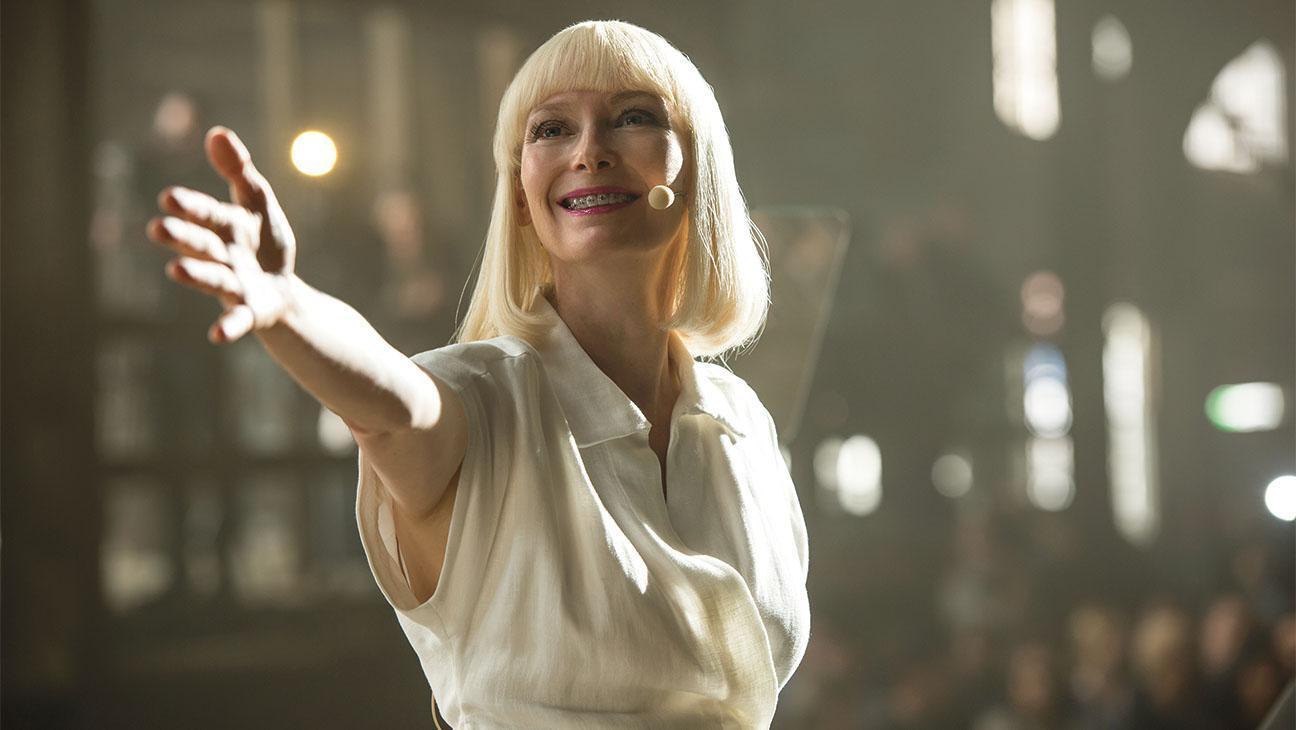
As for more recognizable A-list talent, Jake Gyllenhaal and Tilda Swinton each provide an interesting offering of zany personalities to add to the mix. Gyllenhaal's at his quirkiest in the role of an eccentric  zoologist and formerly beloved TV personality, and it's certainly a drastic departure from his normal array of characters that I wasn't expecting.
Joon-ho must have watched Hail, Caesar! and felt particularly inspired afterwards because Tilda Swinton is once again portraying a pair of twin sisters. This time, it's Lucy and Nancy Mirando, and the two couldn't be more different. Lucy's glowing with optimism and a peppy personality while Nancy's comes across to be... a negative Nancy... Anyways, Swinton proves once again to be a chameleon by adding these two roles to her longwinded, impressive acting resume.
Despite focusing around a genetically modified super pig, Okja is not a prime example of cinematic swine. Okja instead exemplifies the value of focusing a story on character and sentiment rather than piggybacking an obvious agenda. 

Film Assessment: B+

Tuesday, May 17, 2016

'Money Monster' Review

Money Monster is a suspenseful hostage drama directed by Jodie Foster. The film showcases a hostage situation on the set of a financial television show called "Money Monster." Money Monster, like the recent film The Big Short, focuses on the fallout of a financial crisis. The difference being that Money Monster's financial crisis is fictional and jumps straight into the public reaction rather than showing the real events as they occur. 
Jodie Foster manages to weave it all in quite well and Foster's direction allows the suspenseful thriller aspect of the film to thrive amidst the tense situation taking place. Unfortunately, every time the film cut away from the claustrophobic hostage crisis the pace of the film slowed down. This is large part to the phenomenal performances that engage the audience into the tense atmosphere that's been expertly executed. 
George Clooney nails the personality of the zany wisecracking host of "Money Monster". Clooney gets to fool around a bit in the beginning, but also gets some terrific opportunities to explore more of the earthly vulnerable humanity of Lee Gates as is to be expected in a tense environment. 
Julia Roberts also does quite well as the director of the show, Patty Feen. Roberts' role primarily finds her advising Gates on how to carefully defuse the situation and she handles the "voice of reason" role nicely. 
Jack O'Connell also gets to showcase a wide range of emotion as Kyle Budwell. Budwell is certainly the most relatable character in the film as the everyman. O'Connell's performance is one of the highlights of the film. My favorite aspect of the film was seeing him slowly build a necessary friendship with Gates that allowed for a very emotional scene towards the film's conclusion. Those three performances really elevated the film overall, but weren't able to save the lackluster elements outside the "Money Monster" set.
Giancarlo Esposito is one of my favorite television actors, but really didn't add any depth or intrigue to his character that any other actor wouldn't be able to do and just seemed to do a serviceable job. Really any actor could have played the role of that police captain and it would have been just as effective.
One actor that caught me off guard was Christopher Denham who was the producer of "Money Monster", Ron Sprecher. Denham added a surprising bit of comedic relief that never took away from the seriousness of the situation, making for a nice standout among the supporting cast. On a side note, IMDB is a very reliable source I use when writing a review and I caught something quite hilarious that I had to share with my readers. There are multiple anchormen in the film and instead of crediting them as "Anchorman #1," "Anchorman #2," and so on, they are credited as "An Anchorman," "Another Anchorman," and "Yet Another Anchorman."
Anyways, Money Monster is best looked upon as a performance piece, the technical elements are just fine but the cinematography and editing never really wowed me. The heart of the film is the standout performances and intensity of the hostage situation. I found the financial elements of the film to never be fleshed out as much as they could or should have been. In comparison to The Big Short, Money Monster never quite explained the economic jargon to the audience. The answers to the questions being asked of this financial crisis were a bit cliché, so I feel the film failed itself and the audience in that regard.
Money Monster is a well-acted and well-directed suspenseful experience that's not necessarily best seen in cinemas. If you're interested in the film I would recommend waiting for it's home video release and either rent or buy the film.

Film Assessment: C

Tuesday, April 19, 2016

'The Jungle Book' (2016) Review

Nominated For: Best Visual Effects.
Won: Best Visual Effects.

The Jungle Book is the latest adaptation of Rudyard Kipling's book, and I'll outright say that it's the best adaptation to date. Some of you are probably thinking that I'm insane declaring this to be superior to the 1967 animated The Jungle Book, but hear me out. This is the latest of Disney's push to make live-action adaptation of some of their classic films, but I don't think this film classifies as live-action since the entire film was shot on a sound stage in Los Angeles. 
The only real, tangible aspects to the film are Neel Sethi as Mowgli and small portions of the set for Sethi to interact with. Aside from that, the remainder is entirely CGI. Yes, EVERYTHING. The jungle environments, the sky, the water, and the animals. All animated.  And it's breathtaking, especially in 3-D. Now while we have seen this previously in films like Avatar or Life of Pi, this film progresses the technology going one step forward and not only making these environments and creatures seem lifelike, but also making the delivery of dialogue from the animals actually look believable as well. It's clear that the crew spent plenty of time researching the animals integral to the narrative. The animators include subtle movements for the animals that make them seem all the more real such as Shere Khan's stealthy stroll, Baloo's slow bear trod, and Bagheeera's ears flicking every now and then.
The crew even took it a step forward by ensuring to find animals quite similar to those found in the story that would actually be found in that part of the Indian Jungle. For example, instead of making King Louie an orangutan, they decided to make him a Gigantopithecus. This serviced the film in two ways by providing an over looming ape that monkeys would obviously be subservient to and also finding a creature close enough to an orangutan that actually could be found in India, although Gigantopithecus are extinct. Now many of you are probably thinking I was merely wowed by the animation, but there is so much more to this film. 
First and foremost, Jon Favreau went above and beyond as director. Since Neel Sethi was acting opposite virtually nothing, he made sure to create a comfortable atmosphere for the child star by utilizing animal puppets and even acting in place of the animals himself in some cases, to be taken out in postproduction of course. Favreau did a phenomenal job stitching together all of the terrific work from each respective department to create a truly terrific movie. 
Secondly, the screenwriter, Justin Marks, ensures that he adds much more depth and sophistication to the tale (or at least the animated version, I can't speak for the actual book since I haven't read it). We're all quite familiar with the basic story itself and so I won't really delve into that, especially since I included that in my Throwback Thursday Review of the animated incarnation. In comparison to Disney's other live-action fairytales and how close they stuck to their respective animated sources of inspiration, I'd say it falls somewhere between Cinderella, which was largely a clear cut live-action version of the animated film with relatively few changes, and Maleficent, which almost completely ignored the continuity of Sleeping Beauty. So for those expecting something along the lines of a clear-cut shot for shot remake of the animated version, you may be disheartened. Favreau does however take into account the love general audiences have for the animated classic and includes plenty of visual imagery homaging the animation. 
One new aspect I really liked was that the jungle is treated as a society of it's own (More along the lines of what can be found in The Lion King rather than Zootopia though). The various characters are also fleshed out much more than the animated version, placing emphasis on their relationships with Mowgli, whether they be friendly or antagonistic. Also, the film captures a whirlwind of emotions with something for everyone. The film captures the lighthearted fun of the original, snippets of action and adventure in some intense moments, thanks to Shere Khan, that may scare some young children, and provided scenes with a gripping emotional core. 
In regards to performances, The Jungle Book assembled quite an impressive cast. The one element that was going to make or break this film was the actor portraying Mowgli and Neel Sethi delivered. Sethi managed to act opposite the CGI creatures quite convincingly and also gave a great performance as well. Sethi embraced the innocence of Mowgli and really brought out the most of his childlike persona and sold it. I loved that his character was written so that he asked questions any child would ponder but while refraining from making it obnoxious. 
Bill Murray comes into the role of Baloo injecting tons of fun into the film with his sarcastic one liners that definitely earned some laughs and he doesn't stray from the zany personality either. I also really bought into the brotherhood between Mowgli and Baloo thanks to both performances and the chemistry between the two actors (even though it's only Murray's voice). Sir Ben Kingsley manages to expertly balance Bagheera's overprotective demeanor with a mixture of responsibility and pride in Mowgli brilliantly conveyed through merely his voice. 
Lupita Nyong'o is the emotional core as Raksha and serves the story as best she can in her limited screen time. Opposite her, Giancarlo Esposito makes for a believable leader and father figure albeit his limited screen time. Christopher Walken balances charisma with a looming menace as King Louie, who's much more of a mob boss this time around as opposed to the zany king. Scarlett Johannson captivates the audiences as Kaa, utilizing the snake hisses to the fullest even though she's in the film for about five minutes. Regardless, a terrific choice for Kaa. 
Last, but certainly not least, Idris Elba makes a masterful villain of Shere Khan, projecting his malevolent gravitas so far that you can feel the terror when his name is mentioned. Shere Khan is introduced much earlier in this version, which I prefer because it adds gravity to the situation, giving audiences a taste of what Shere Khan is capable of. 
Lastly, I'll discuss the use of music in the film. The score takes the classic songs everyone knows and loves and expands upon them by converting them into full orchestral epics. The score is embedded to match the scenes with each perspective character, such as "Trust In Me" being paired with Kaa. Don't worry though as the film doesn't cower away from any singing like Disney's previous live-action fairytales. In fact, the renditions of "I Wanna Be Like You" and "Bare Necessities" were a ridiculously fun time. If you stick through the credits you will be rewarded with a nifty credits sequence utilizing these songs, no post credits scene though. Looking forward, I really hope The Jungle Book is remembered during awards season, and it's no wonder the sequel was greenlit before the film opened.
In summary, The Jungle Book seems to be the best incarnation of the source material possible with fun for everyone providing content all ages can enjoy and I only wonder how the upcoming Warner Bros version directed by mo-cap exert Andy Serkis will fare. Now, can we get a version of The Lion King using this technology?

Film Assessment: A+

Sunday, September 27, 2015

'Maze Runner: The Scorch Trials' Review

After thoroughly enjoying The Maze Runner, I had high expectations for its sequel and must say Maze Runner: The Scorch Trials didn't quite live up to its predecessor. The Scorch Trials is certainly as action packed, features quality perforamnces, and the cinematography is stunning at times, but there are a few problems with the latest installment.
First off, the film didn't really resolve any questions it left audiences with at the end of The Maze Runner. Instead, it asked even more questions. While I wasn't too bothered by this in the first film since I suspected my questions would eventually be resolved and I liked the sense of mystery, I didn't want that carried over to the sequel.
Director Wes Ball also tried a little too hard to create suspense and while he succeeded a few times, it grew excessive. In a few scenes they tried to draw out suspense and it just didn't quite work for me as it wasn't a surprise to have one of the cranks chase them for example. So the film also was kinda predictable in some moments and I felt that the ending could have been adjusted for a better cliffhanger by cutting out about five minutes. On top of that, The Scorch Trials lacked any drama aside from the mystery as to what was going on, and that's about all I have in terms of nitpicks.
The cinematography was especially gorgeous when characters were in the Scorch as some interesting camera effects enhanced the experience. I felt the visual effects looked great and the fast-paced action sequences were entertaining. One of the most enjoyable aspects was watching the actors run with such intensity. Dylan O'Brien, in particular, has an especially energetic run that's well-captured on camera, like Tom Cruise. As for the cast, Dylan O'Brien, Kaya Scoderlario, Thomas Brodie-Sangster, Ki Hong Lee, and Giancarlo Esposito all provided great performances.
I'd say the film was entertaining, but lacked the substance I was hoping for. If you were a fan of The Maze Runner then you should enjoy The Scorch Trials, but I personally prefer the first film. I am especially excited for the final installment because it's rumored not to be split into two films as commonly done with the adaptation of a final book of a series.

Film Assessment: C-