Showing posts with label Michael Shannon. Show all posts

Tuesday, November 26, 2019

'Knives Out' Review

Nominated For: Best Original Screenplay.

Synopsis: A detective investigates the death of a patriarch of an eccentric, combative family.

Runtime: 130 minutes

MPAA Rating: PG-13 (for thematic elements including brief violence, some strong language, sexual references, and drug material)

Who should see it? Fans of whodunnits and murder mysteries.
Written and directed by Rian Johnson, Knives Out is an ode to the work of Agatha Christie set amidst today's contentious political climate. A Thanksgiving release is quite fitting considering the volatile nature of family get-togethers, so once you finish scarfing down turkey this Thursday, visit your local multiplex to solve a uniquely entertaining murder mystery. Knives Out offers all the fun of Clue without the insufferable board-game bickering. 
Johnson kicks things off by thrusting viewers straight into the scene of the crime. He then efficiently characterizes the members of the Thrombey family while establishing each of their potential motives through a series of police interviews seamlessly strung together by editor Bob Ducsay. The board has been set with an audience understanding of the prime suspects, and we're only fifteen minutes in. An elaborate unwinding of truth and justice follows closely behind. In the search for a killer, Johnson deceptively tinkers with the truth. When the family members lie, he ensures the audience remains sure of the facts rather than steering them away to elude suspicion. However, there's undoubtedly a sleight of hand at play behind the camera as Johnson shifts your focus from figuring out whodunnit to more pressing matters. 
As a result, the narrative of Knives Out is wildly unpredictable since each twist changes the course of the story and, by extension, the mystery. On second viewing, I noticed that Johnson drops clues without calling direct attention to them. The hints may be disguised as an innocent joke or irrelevant happenstance, but, as any detective knows, every detail matters. Contributions from Johnson's frequent collaborators further fortify his efforts in the form of Steve Yedlin's stately cinematography and an engrossing score composed by Rian's cousin Nathan Johnson. Not to mention, superb work from production designer David Crank, as the Thrombey mansion provides an intricate, embellished setting for the sleuthing shenanigans. At the center of it all, Johnson's sharp screenplay leads audiences down a winding path of absurdity, animosity, and intrigue that amounts to one of the year's most entertaining moviegoing experiences. 
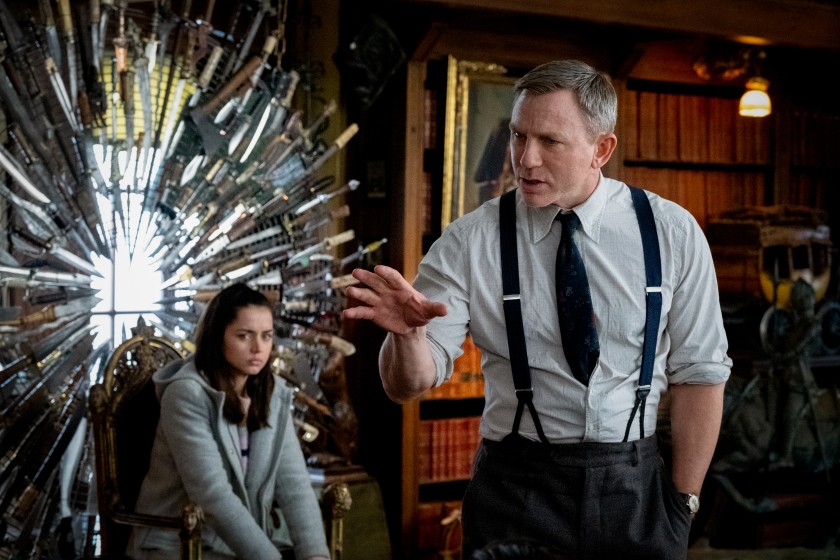
Heading the star-studded cast, Ana De Armas and Daniel Craig are the two breakthrough performers. De Armas continues to impress while Craig's clearly having the time of his life as renowned detective Benoit Blanc, hamming things up with his Southern drawl and kooky disposition. The shared moments between their characters tend to be among the film's best, though the eccentric personalities in the Thrombey family give them a run for their money. 
Comprised of veteran actors and up-and-comers, the A-list ensemble assuredly inhabits their roles of entitled A-holes and make the most of every morsel Johnson sends their way. This includes the likes of Christopher Plummer, Chris Evans, Jamie Lee Curtis, Michael Shannon, Don Johnson, Toni Collette, Jaeden Martell, and Katherine Langford, who each relish in the Thrombey family's argumentative nature and distinct attributes. On the other side of the investigation, LaKeith Stanfield and Nathan Segan portray an amusing pair of police officers dead set on closing this peculiar case. 
Gripping murder mysteries don't reveal themselves too often, but Knives Out is guilty as charged. To no surprise, Rian Johnson's dunnit again! One can only hope it's successful enough to warrant further exploits with Detective Blanc.

Film Assessment: A

Sunday, January 21, 2018

'12 Strong' Review

12 Strong declassifies the incredible true story of the first Special Forces deployment in Afghanistan after 9/11 where a total of twelve U.S. soldiers are sent on a daring mission to help the Northern Alliance rid the area of Taliban. Outgunned and outnumbered, the team of twelve must face overwhelming odds in the fight of a lifetime. 
12 Strong is directed by Nicolai Fuglsig and features a screenplay from Ted Tally and Peter Craig which adapts Doug Stanton's book Horse Soldiers. When watching 12 Strong, other Afghan war flicks may come to mind such as Lone Survivor and the similarly titled 13 Hours. This is largely because it's difficult to distinguish Fuglsig's film from the modern selection of movies focusing on the War on Terror. While I don't necessarily expect every war film to be as immersive as Dunkirk or as character-driven as Saving Private Ryan, it's disheartening to see how disposable films in this genre can become when they're lacking a clear objective. The dialogue's full of the typical military jargon and the soldiers do little more than pal around with one another so there aren't any fleshed out individuals to invest yourself in. 
You're much more likely to gravitate towards characters based on what recognizable actors are portraying them rather than anything Tally or Craig do as writers to earn your interest. You'll probably think, "Hey, that's the guy that plays Thor! I like him!" or "I remember seeing that guy in that one movie that won that Best Picture at the Oscars last year... What was it again? Oh yeah... Moonlight." That's the extent of how little the writers develop these characters, which is kind of sad in considering these men are war heroes and couldn't even be depicted as anything beyond surface level soldiers... I'm sure someone reading this review is thinking, "But David... Dunkirk didn't do much to develop its characters either, and you praised THAT film!" Well, you are correct. However, there's a HUGE difference between the two. Nolan chose to focus on the experience of war and essentially made his film a heart-pounding pressure cooker. Fuglsig doesn't really focus on the experience or the characters. Instead, all he offers is visual noise. 
While the combat sequences are quite exhilarating, they all blend together and begin to feel repetitive so the film quickly loses its luster and grows rather tiring. In fact, 12 Strong comes to mind as one of the most exhausting theatrical experiences I've had in recent memory. The film feels overlong and just wears on your patience after awhile, even at a respectable runtime of two hours and ten minutes. Towards the tail-end of the film I kept wondering to myself when it would all be over, but was disappointed time-and-time again to see the events further prolonged.
Not everything is mediocre though, as Chris Hemsworth proves to once again be a likable lead in the role of Captain Mitch Nelson. Hemsworth rarely gets to flex his acting muscles in the Marvel movies, so it was really reassuring to see him demonstrate some acting range here. Despite Nelson's lacking characterization, Hemsworth's charisma and dedication are able to carry the character all the way to the finish line. Strategizing opposite Hemsworth, Navid Negaban portrays General Dostum as an insightful warrior and leader willing to impart wisdom whenever possible. 
12 Strong flourishes most whenever capturing the convincing camaraderie between its focal brotherhood though. While the A-list talent are largely responsible for this, the actors filling in for the remaining twelve soldiers aren't half bad. Respected actors Michael Shannon, Michael Peña, and Trevante Rhodes each elevate their stock soldiers with a captivating screen presence while the other actors joke around with one-another in an effort to remain relevant. It works in the moment, but you'll find it difficult to remember anyone who wasn't billed on the poster afterwards. 
12 Strong should have galloped into this weekend championing a harrowing and inspirational true tale of heroism and bravery, but instead, it stumbled and wound up being a dispensable military motion picture. Don't let my criticism discourage you from watching the film if you had your heart set on seeing it though. I still think the story itself is truly remarkable and actually deserving of a better translation to the big screen. If war films like Lone Survivor and 13 Hours are your thing, then by all means, go and see it! I'm sure you'll be more blown away than I was. 

Film Assessment: C+

Wednesday, December 27, 2017

'The Shape of Water' Review

Nominated For: Best Picture, Best Director; Guillermo del Toro, Best Actress; Sally Hawkins, Best Supporting Actor; Richard Jenkins, Best Supporting Actress; Octavia Spencer, Best Original Screenplay, Best Film Editing, Best Cinematography, Best Costume Design, Best Production Design, Best Sound Editing, Best Sound Mixing, and Best Original Score.
Won: Best Picture, Best Director; Guillermo del Toro, Best Production Design, and Best Original Score.

The Shape of Water washes audiences ashore in the year 1962 to follow Elisa, a mute janitor currently cleaning a top secret research facility. One day, security officer Richard Strickland arrives to the government lab with a mysterious monster in tow from South America. As Elisa encounters the aquatic creature in her day-to-day work, she forms a bond with the beast and decides she must free the wrongfully imprisoned Amphibian Man for the sake of its survival. 
Guillermo del Toro dives into telling an unconventional story as both writer and director, receiving an assist from Vanessa Taylor in regards to screenplay. Del Toro is a visionary director who's perhaps most well known for writing and directing Hellboy, Pan's Labyrinth, Pacific Rim, and Crimson Peak. While I've only seen two of those films, I can say I'm quite familiar with hearing del Toro's name mentioned by cinephiles as a promising choice of director for countless peculiar projects. From the trailer alone, I could tell this film was coming from del Toro based on the picturesque production design and strange sensibilities of the story. My interest was peaked, but I didn't quite know what I was in for... Then the film stunned the festival circuit with standing ovations and took home many of the top audience awards... That was followed by a stream of critical acclaim and nominations out the wazoo in various critic circles and the Golden Globes... At that moment, I knew The Shape of Water had to be something special... and boy, was I right. 
The Shape of Water is simply a beautiful film in all regards. The sea-foam green and aqua blue color scheme evidenced in Dan Laustsen's striking cinematography and Paul D. Austerberry's attractive era-appropriate production design evokes the guise of an extraordinary underwater environment. The creature design in-of-itself is stupendous, while the make-up, prosthetics, and visual effects effectively integrated with one another to create a convincing creature. The film's not just visually arresting though, as del Toro pours out a story that is sweet, sometimes dark, and surprisingly timely in spite of an antiquated setting. All of which is then reflected in Alexandre Desplat's exquisite score as it's able to sweep you off your feet, strain itself in the tense moments, and even startle you when things get scary.
At the center of it all, del Toro explores a shared connection between a human and creature that's rather reminiscent of the romance in Beauty and the Beast. For some, that may seem a bit off-putting. I had my own doubts that I would actually be invested in such an unusual relationship, but was shocked to see del Toro fully fill that proverbial glass. However, I'm sure there will still be those weirded out by the very idea of such a thing, so it really depends on your willingness to suspend disbelief and reel in the fishy concept. On that note, I feel it's worth warning you that del Toro's grounded fairytale is probably more mature than you'll be expecting. I'm not providing further context than the fact it's rated "R" for sexual content, graphic nudity, violence, and language, so I don't want to hear that you weren't ready.
When it boils down to it, The Shape of Water is all about outcasts. Del Toro's story flows alongside a mute janitor, a merman, a closeted gay man, an African American woman, a kind-hearted scientist, and, sadly, the guy that fits in happens to be cruel, perverted, and racist. They each seek acceptance from others in their own unique way, and their longing looks for wish fulfillment can certainly be soul shattering at times. So naturally, it's comforting to see their desires realized in unique, unexpected ways. With that being said, some portions of the plot are pretty predictable because you've seen other fantasies elsewhere. However, del Toro and the crew have put so much love and care into their craft that the heart of The Shape of Water reverberates endlessly, and so the current still flows in their favor.
Leading the exceptional ensemble, Sally Hawkins works wonders in the role of the unspoken Elisa Esposito. Hawkins communicates an abundance of expression without uttering a word. Her physicality, mannerisms, and screen presence do all the talking, and I seriously think she'll earn an Oscar nomination and maybe even win so long as the tides remain in her favor. Opposite Hawkins, Doug Jones is caked in makeup and prosthetics as the Amphibian Man. Jones is basically the practical equivalent of Andy Serkis. Where Serkis rules the motion-capture acting arena, Jones has been known to impressively act under plenty of prosthetics in the past. Like Serkis utilizes the magic of mo-cap to strengthen his performances, Jones makes the most of his makeup and body suits to craft compelling creatures, and the Amphibian Man is no exception. The fact he and Hawkins were able to extract such a rich rapport from a relationship of a mute woman and a scale-covered creature speaks volumes to their astounding abilities as actors.
Playing Elisa's nice neighbor Giles, Richard Jenkins steals the spotlight in such subtle ways. Jenkins takes what could have purely been a cliché character and excellently imbues him with nuance and a rich essence, leading you to pity the man for facing appalling animosity on account of Giles' sexuality.  
Rounding out the endowed ensemble cast are Michael Stuhlbarg, Octavia Spencer, and Michael Shannon. Stuhlbarg's got another powerhouse performance in his unbelievable year as an actor (he's also been in The Post and Call Me By Your Name), playing the part of a tender, concerned scientist Dr. Robert Hoffstetler. Spencer is a swell supporting presence as Elisa's coworker and friend, Zelda Fuller, elevating an otherwise ordinary role. In my book, it's Michael Shannon who lights up the screen though. Shannon is scary good here, turning Richard Strickland from a scumbag security officer to a driven, malignant force of contempt. Shannon is totally terrifying as the true monster of the tale.
Just like H20, The Shape of Water has no definite shape. The Shape of Water takes many different forms as a riveting romance, a sinister creature feature, and an affectionate ode to cinema, but each phase is deeply satisfying on account of its own merit, so the spontaneous compound is quite captivating.

Film Assessment: A

Tuesday, December 13, 2016

'Nocturnal Animals' Review

Nominated For: Best Supporting Actor: Michael Shannon.

In Nocturnal Animals an affluent art gallery owner Susan Morrow receives her ex-husband Edward's manuscript for an upcoming novel "Nocturnal Animals" dedicated to her. As Susan reads the horrifying tale of revenge she reflects on her past with Edward and the film sphincters off into three stories that are more interconnected than one would first suspect. 
I won't explain much else because the less you know going into the Nocturnal Animals, the more confused you'll be leaving the theater spurring on an intellectual train of thought that will allow you to eventually put all the pieces into place and see the big picture of Nocturnal Animals. Nocturnal Animals like Arrival, another film that was released this year starring Amy Adams based on obscure literature, is a thought-provoking cinematic experience. 
Viewers will be baffled by the shock value found in the film's bonkers slo-motion opening sequence of nude morbidly obese women dancing while the opening credits slowly creep onscreen, thankfully giving the audience something else to focus on, and from that point on will likely be striving to understand exactly what is happening and struggle to find connections between the splintered narratives. This is a film that will probably be more enjoyable to watch with successive viewings because the viewer will have already digested the crazy proceedings once. They then might be able to better understand what it all means and believe me, Nocturnal Animals warrants plenty of analysis. 
Former fashion designer Tom Ford writes and directs the insightful revenge thriller, taking the viewer on a ride that first exposes them to a refined, elegant environment before plunging them into a fictional take on West Texas that's truly got grit. One of the more interesting aspects of Nocturnal Animals is how fabricated Susan's reality seems and how realistic Edward's fiction appears and Ford further brings out visual juxtaposition between the two as cinematographer Seamus McGarvey brilliantly frames gorgeous picturesque imagery while editor Joan Sobel expertly cuts between the trio of tales. I haven't read Austin Wright's novel on which the film is based, but can say Ford's screenplay is an excellent adaptation for the screen and it's also worth noting that Abel Korzeniowski calamitous compositions are a great underlying accompaniment. 
Nocturnal Animals also features a seasoned cast of A-list actors who bring a strange blend of understated and overstated performances that will likely garner praise this coming awards season. Amy Adams' Susan Morrows is simultaneously hopeful in her past and calculating as a result of her long-winding life while Jake Gyllenhaal also gets to inhabit dual personas as Susan's recollections of her past lover Edward Sheffield and the protagonist of "Nocturnal Animals" (Sheffield's novel) Tony Hastings bringing serene sensitivity to one and a brewing venomous longing vengeance to the other. 
Two supporting performances steal the show though as Michael Shannon plays an unhinged officer with some Southern drawl and Aaron Taylor-Johnson's deranged redneck sociopath Ray Marcus will make your skin crawl. Other familiar faces including Isla Fisher, Armie Hammer, and Laura Linney are to be found in bit-supporting roles and are serviceable for their minuscule screen-time. 
The ending of Nocturnal Animals will leave many unsatisfied but the longer my mind dwelled on it, the more appropriate the ending seemed to be considering the overarching theme of revenge. Many will probably be turned off by Nocturnal Animals' oddities, only taking everything at surface level and refusing to dig any deeper, but I found the thriller to be intellectually engrossing and would highly recommend it to anyone that likes to solve puzzles or leave a film pondering the plot. 
With that being said, there were some things that don't quite fall into the big picture yet in my mind and I'm sure that once I revisit Nocturnal Animals enough I could decipher the meaning but I'm interested in acquiring it on Blu-Ray for a director's commentary alone. Nocturnal Animals takes a chaotic approach to it's three-pronged story structure and I found bringing order to the chaos through thought processes the most satisfying part of the viewing experience, but the slick cinematography, exceptional editing, mixture of nuanced and exaggerated performances, and concentrated direction amidst the insanity alone make Nocturnal Animals worth a watch.

Film Assessment: A-

Thursday, March 24, 2016

Throwback Thursday Review: 'Man Of Steel'

This week's Throwback Thursday Review is over Man Of Steel, the film that launched DC's Extended Universe and will be further propelled with this week's Batman v Superman: Dawn of Justice. Man Of Steel is an interesting film to review because of the decisively mixed reactions from both critics and the general public and you will soon learn what end of the spectrum I lie on. Just a warning, there will be some spoilers for some major plot points in the film that I feel need to be discussed. Next week I will continue my series of reviews of the Bourne series with the second installment The Bourne Supremacy. In the meantime, I will certainly have a Batman v Superman: Dawn Of Justice review uploaded very soon.

'Man Of Steel' Review


Man Of Steel is probably one of the most divisive films in recent memory, with critics either hailing it as a masterpiece or labelling it to be a sloppy mess, and the audience's just as evenly split. I'll admit I lie more in the middle ground, as there are elements in Man Of Steel I would consider brilliant and there are portions of the film that irked me, and I feel most problems were with the creative team and not the performances or the technical aspects.
For one, the film has this bleak, dreary, grayscale filter applied for a majority of the lengthy 2 hours and 23 minute runtime that honestly looks like it was ran through some filter on Instagram. Now there is technically "color" in the film of course, but most of the sets, environments, and costumes are in a darker gray, black, or blue color palette that makes the film all the more bleak and dreary. That's another point of discussion altogether, the film attempts to emulate Christopher Nolan's Dark Knight Trilogy and it's not all too surprising since Nolan produced the project.
Now, I don't mind Warner Bros. trying to emulate their previous success with the Dark Knight Trilogy, which also helps to differ their comic book cinematic universe from Marvel's, but I don't think that everything needs to be so dark and gritty. I think a happy medium of both a dark and light tone would probably work better but Warner Bros. certainly know how to execute a darker, gritty film, and Man Of Steel is that exactly.
Man Of Steel is visually a masterpiece. This is large part to director, Zack Snyder, whose talents mostly lie with visual iconography and not the actual story itself. The cinematography feels very natural and when combined with the editing makes for a smooth viewing experience doing justice to the visual iconography Snyder brilliantly imagined. The film's visual effects are a mixed bag in my opinion. The effects for Superman's powers at times can look very fake, but for the most part seem quite authentic and are well realized. When Superman first gets his suit and flies around for a bit, the effects are remarkable and the cinematography adds to the authenticity incorporating some shaky-cam and gorgeous shots both behind and in front of Superman.
However, there is one brief moment where it is apparently clear a green screen is being utilized. In this brief moment, Superman's flight just seems mismatched with the background and there's a lighting issue where Superman looks darker than the surrounding brighter lighting and it annoys me every time I watch the film. I feel the effects for Superman's strength, heat vision, and X-Ray vision are handled exceptionally well and the sound mixing and editing are also well executed throughout. In particular, Superman's super-hearing and the Krypton technology sound effects are two of the best showcases of the excellent sound design.
One odd sound design choice though was that the weapon utilized by the Kryptonians to attempt to harvest the Earth for a new generation of Kryptonians, the World Engine, sounds like a dub-step cannon. Amidst the subject of sounds, I feel that I must comment on Hans Zimmer's fantastic score. Zimmer manages to create this grand, epic score that seems to be a perfect embodiment of the ideals of Superman but expressed in music.
The performances across the board are quite exceptional, and I have to say that both young actors portraying the younger Clark Kent, Dylan Sprayberry and Cooper Timberline, impressed me in their brief screen time. Henry Cavill makes for a very capable lead as Kal-El (Superman), although he's no Christopher Reeves, but he certainly fills all the requirements I think an actor needs to portray Superman. One thing I think he does remarkably well is his facial emoting, where he really sells that he's struggling or frustrated when using his powers and whatnot. Unfortunately, the film doesn't make time to explore the duality and pressures of balancing his normal life as Clark Kent and his super heroics as Superman but that's one element I can't wait to see explored in these future DC films, whether it be Batman v Superman: Dawn of Justice or Justice League.
Amy Adams makes for a solid Lois Lane and actually does quite a bit to drive the story, but unfortunately at times becomes too much of the damsel in distress trope because of her willingness to plunge herself into danger. Aside from those little nitpicks, Lois comes across as a strong, developed female character, whose purpose isn't purely to be a love interest.
Russell Crowe and Kevin Costner both make for great father figures to Kal-El/Clark Kent as Jor-El and Jonathan Kent respectively and you can instantly feel their connection to Kal-El due to the incredible chemistry they have with Cavill and the gravitas of both actors. Diane Lane serves as Kal-El's mother figure as Martha Kent and is terrific in that capacity but she is very much a supporting character that's relegated to a few scenes sprinkled throughout. Laurence Fishburne gets to play Perry White, and I think he was terrific in the small capacity used.
Meanwhile for our antagonists, we have Michael Shannon, who makes for a great villain as General Zod. At times he seems a bit over the top and chews the scenery, not that that's necessarily a bad thing though. I liked that he had a genuinely believable motive and like most great villains believed what he was doing was just. Antje Traue is truly awesome as Zod's lieutenant, Faora, who kicks a lot of butt and is honestly everything the character Captain Phasma should have been in Star Wars Episode VII: The Force Awakens. 
In summary, I think that Zack Snyder certainly presents a film that's very much style over substance, as the first half of the film is phenomenal but it finds itself in a sticky situation with it's grand finale that I will discuss in great detail soon. The scenes that I enjoyed watching were primarily in the first half of the film when Superman is actually saving people or the flashbacks where he's adjusting to life on Earth. I really like how the film stays primarily in the present day and jumps back to flashbacks to fill in for some crucial parts of Superman's origin story instead of wasting an hour on a young Kal-El growing up on Earth. The story is quite lacking in some moments towards the end and there are creative decisions made regarding Superman that seem out of character for the Son of Krypton that I personally see as an abundance of issues.
The action sequences are all grand and epic in scale but while they are quite awesome, I have a number of issues with a few in particular. One really small nit-pick is that these fights use the most blatant, obvious product placement although I don't see how Kryptonians destroying a Sears would convince anyone to shop there? The fights between Superman and the Kryptonians feature copious amounts of collateral damage, that just seems way too excessive. I understand that two people with these powers would destroy tons of property but the fight between Superman and Zod almost levels Metropolis.
What annoyed me to no end regarding this was that throughout the fight, Superman rarely makes any attempts to stop Zod from destroying any buildings or save any civilians, but rather actually even pushed Zod into some of these buildings. This was amidst a fight where buildings were collapsing. I feel that this interpretation of Superman was pretty reckless and there was tons of collateral damage as a result. The one time Superman did save people during this fight was when he snaps Zod's neck to prevent him from using heat vision to kill people. So yes, Zod's death was a necessary evil but it seems even more out character for Superman to kill someone, regardless of what they've done or plan to do, but this version of the hero clearly doesn't take much issue with cracking necks. The screenwriters should have avoiding putting the character of Superman, whose supposed to have a higher morality, in a position where he's forced to kill his villain. In fact, it's kinda hard to even call this interpretation a true hero and I think that is the film's biggest problem. 
Now to sum all of this up, if someone came and asked me to give a one-word review of Man Of Steel, I'd have to say that it's "meh." It's not great, but it certainly isn't terrible either, it's honestly just okay and I feel that Warner Bros. shouldn't accept something that's passable if they ever hope to truly compete with Marvel's Cinematic Universe. 

Film Assessment: C+