Thursday, August 10, 2017

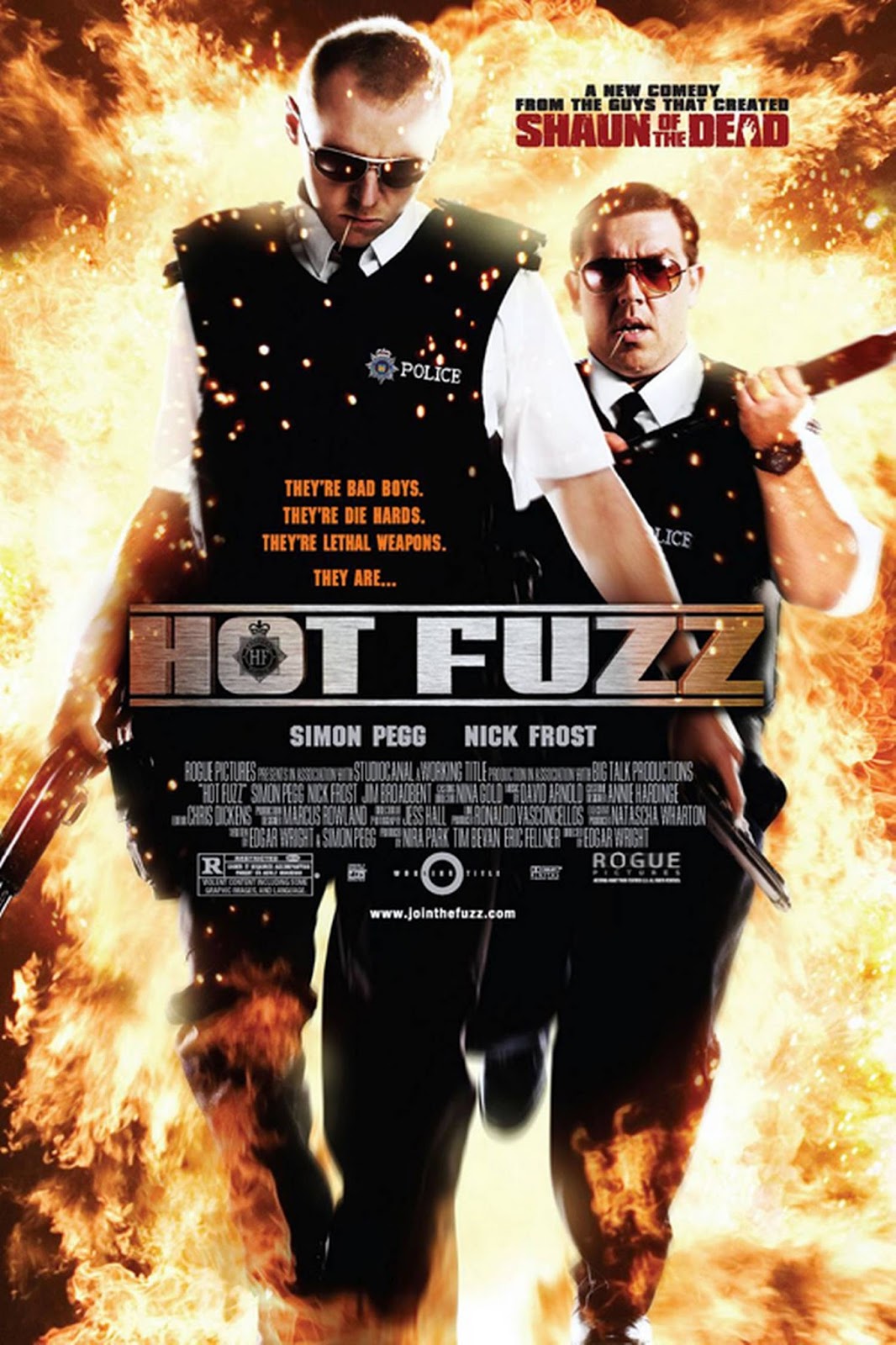
Throwback Thursday Review: 'Hot Fuzz'

Yes, the Throwback Thursday Review of Inception and the Triple-R over Interstellar from three weeks ago are still not published. I'll do what I can to get both reviews online shortly, but in the meantime I'm continuing my series of Edgar Wright reviews with my thoughts on Hot Fuzz. In case you were not already aware, I'm alternating between reviewing Edgar Wright movies and Steven King adaptations for the next month or so. If you want an idea of what else I'm reviewing for the remainder of August, I intend publishing Throwback Thursday Reviews of Stand By MeThe World's End, and The Shining in addition to reviews of new releases KidnapWind RiverThe Glass CastleLogan Lucky, and The Hitman's Bodyguard

'Hot Fuzz' Review


Hot Fuzz escorts hot-shot London officer Nicholas Angel as he's reassigned to the small, humdrum countryside village of Sanford because he outshone the entire London police force. Angel has a difficult time adjusting to the quieter surroundings till he discovers a series of conspicuous killings that enables him to rock back into action.
Hot Fuzz is the second chapter in Edgar Wright's Three Flavours Cornetto trilogy, an anthology series of parody films directed by Wright, written by Wright and Simon Pegg, produced by Nira Park, and starring Pegg and Nick Frost including Shaun of the Dead, Hot Fuzz, and The World's End. The films that make up the Cornetto trilogy have virtually no relation to one another aside from director Edgar Wright helming each installment, some common cast members, and notable use of Cornetto ice cream. The Three Flavours signify the three different genres in the trilogy (Zombie romantic comedy, a buddy cop comedy, and an apocalyptic sci-fi comedy) and each film actually utilized a different flavour to represent these three genres (Shaun of the Dead- strawberry for gore, Hot Fuzz- the classic blue wrapper for the police element, and The World's End- green mint chocolate chip to represent aliens). 
Now that I've explained the fundamentals of the Cornetto trilogy, Hot Fuzz is Wright's take on American buddy cop action flicks. Only Wright blends the essential elements with an English environment and some good ol' fashioned British humour to mix things up. Pegg and Wright construct clever circumstances for the jokes to arise and this film never fails to grant me an incessant giggle. The deadpan dialogue's witty, the comedic timing's dead on, and the situational spoof's are ridiculously riotous. I challenge you to get through Hot Fuzz without cracking a smile. It's simply impossible, unless the humor's flying straight over your head. However, that's extremely unlikely.
Wright tips his hat towards American buddy cop features like Point Break and Bad Boys II with not only cheeky references, but in the film's structure. Hot Fuzz is shot and edited to lovingly tease the unnecessary jump-cut edits Michael Bay often employs and Wright even pokes fun at the over-the-top elements these action flicks engage with in their thrilling third acts. Hot Fuzz is a hoot from start-to-finish and you'd be hard pressed to find another spoof as ambitious and endearing as this one. I won't go into the insane shenanigans the film unravels, as to avoid spoiling these events for those who have not yet seen Hot Fuzz.
Simon Pegg plays the straight cop as try-hard, workaholic Nicholas Angel, a complete reversal of the slacker sensibilities he displayed in Shaun of the DeadNick Frost on the other hand offers another immature sidekick audiences won't be able to get enough of. Even though dynamic was dynamite to start with, Hot Fuzz proved a significant shake-up could only improve their interactions. An eccentric English ensemble featuring the likes of Jim Broadbent, Timothy Dalton, Edward Woodward, Martin Freeman, and Bill Nighy elevate the stock nature of their archetypal characters to stand as consequential characters by the time the yellow tape's been lain out. 
At the end of my investigation, I've found Hot Fuzz to be one of a couple comedies that I can watch endlessly and never grow tired of. The film is currently on Netflix, so sound your sirens and go check it out if you missed out on the hubbub. After a hard-pressed interrogation, I can say Hot Fuzz has locked itself in as my favourite of the Three Flavors Cornetto trilogy, and second favourite Edgar Wright film following Baby Driver

Film Assessment: A+

Wednesday, August 9, 2017

'Wind River' Review

Wind River follows U.S. fish and wildlife agent Cory Lambert as he discovers a frozen corpse in the frigid forest of the Wyoming Wind River Indian Reservation. When he reports it into the local authorities, FBI agent Jane Banner is sent in to investigate the murder alongside the reservation's police force. Due to her unfamiliarity with the harsh landscape, Banner teams up with Lambert in hopes they can find the culprit. 
Wind River is written and directed by Taylor Sheridan, the screenwriter behind the recent strong Sicario and Hell or High Water screenplays. All three films are crime thrillers and Sheridan has steadily traversed sketchy subject matter ranging from Mexican drug cartels to Texan bank robberies to a murder in a Wyoming Native America reservation. Sheridan's advanced north geographically and slowly made his way further west in regards to his crime dramas. Sicario relished in suspense, Hell or High Water delighted in moral conflict, and Wind River savors an unforgiving environment. Wind River is first and foremost a crime thriller, but the underlining western sensibilities ring true.
In conjunction with his cinematographer Ben Richardson, Sheridan frames the icy surroundings as bleak and lifeless as if to say the weather affected the attitude of the inhabitants. Despite the destitute demeanor of the domain, Richardson still manages to muster together some beautiful shot compositions akin to Lubezki's illustrious images from The Revenant (albeit, without the constraints of filming purely with natural light). An element of the camerawork that I found particularly fitting was how some shots were taken from amidst the brush to mimick a predator's point-of-view. While Wind River is hardly the first film to utilize secluded shots like this, it tied in exceptionally well considering Lambert is a hunter. Lambert and Banner are on a hunt to find the person responsible for this heinous act, and throwing in the possibility that the characters are being watched added an element of intrigue.
Nick Cave and Warren Ellis' score then reflects this aesthetic with a a haunting, ethereal sound evoking the toll an inhospitable territory can take on one's soul. The story's quite straightforward, but I won't really go into that because the best part of a crime drama is watching the investigation unfold. Sheridan's screenplay follows the suit of his preceding scripts as he once again captures the intricate actualities of his characters' humanity. Sheridan's quite gifted in that regard, and so it goes without saying that I can't wait to see what he does next!
Jeremy Renner imbues Cory Lambert with plenty of emotional nuance, making him out to be a man hardened by the experiences he's endured. Renner plays the part exceptionally well as one of his more complex roles to date. Alongside him, Elizabeth Olsen accentuates a determined spirit in spite of Jane Banner's inexperience that throws her straight into the action. Olsen isn't afforded as much to do when compared to Renner, but her established rapport with the Avengers costar carries over nicely. Meanwhile, Gill Birmingham and Graham Greene also turn in proficient supporting performances as the victim's father Martin and the head of the reservation police Ben. 
In summary, Taylor Sheridan seems to be well in his element for his second directorial feature, and I won't be surprised to see Wind River accumulate some awards love later in the year. In line with the snowy surroundings, Wind River's harsh and relentless storytelling paints a harrowing, realistic picture audiences would be hard-pressed to forget. 

Film Assessment: A

Tuesday, August 8, 2017

Throwback Thursday Review: 'The Shawshank Redemption'

Yes, I'm well aware that I still have not posted either my Throwback Thursday Review of Inception or the Triple-R over Interstellar from two weeks ago, but they're coming soon. This review's also a little late because I primarily focused on putting out timely reviews for two of this weekend's major releases The Dark Tower and Detroit. Anyways, this week I kick off my series of reviews over Stephen King adaptations to coincide with the release of both The Dark Tower and It (2017) with my thoughts on The Shawshank Redemption. Fun fact: I have not previously seen The Shawshank Redemption so I'm going in fresh. In case you didn't know, I will be alternating between reviewing Edgar Wright movies and Steven King adaptations for the coming weeks. If you want an idea of what else I'm reviewing for the remainder of August, I intend publishing Throwback Thursday Reviews of Hot FuzzStand By MeThe World's EndThe Shining, and Scott Pilgrim vs. the World in addition to reviews of new releases KidnapWind RiverThe Glass CastleLogan Lucky, and The Hitman's Bodyguard

'The Shawshank Redemption' Review


Nominated For: Best Picture, Best Actor; Morgan Freeman, Best Cinematography, Best Film Editing, Best Adapted Screenplay, Best Sound, and Best Original Score. 

The Shawshank Redemption sees a wrongfully convicted banker sentenced for life in the Shawshank State Prison for the murder of his wife and her lover. Upon arrival, Andy Dufresne meets Ellis Boyd 'Red' Redding, a pleasant procurer of things and fellow "lifer." The two befriend one another to inevitably find inner peace and redemption over their tenure.
People may not realize it, but The Shawshank Redemption actually has a peculiar history. Today, The Shawshank Redemption is widely regarded as one of the greatest films ever created. However, Columbia Pictures was unsure how to market it at the time of release due to a vague title, so it barely skimmed the surface of the box office. When the Academy Award nominations were announced that year, The Shawshank Redemption was bestowed a startling seven nominations which caught people's attention and allowed The Shawshank Redemption to thrive on home media.
The Shawshank Redemption was written and directed by Frank Darabont, adapting one of Stephen King's novellas Rita Hayworth and the Shawshank Redemption from his 1982 short story collection Different Seasons. It may surprise you to learn that The Shawshank Redemption was actually Darabont's feature film directorial debut, although he'd previously dabbled in the realm of television and started off as a production assistant that slowly, but surely learned the ropes and climbed the ranks of Hollywood. Darabont's direction isn't showy, but you can feel his steady presence in the background ensuring everything goes according to plan. Though, Darabont's greatest accomplishment is how he imbues The Shawshank Redemption with the element of the human spirit.
Darabont juxtaposes a despondent environment with glimpses of hope, something that's perfectly paralleled in Roger Deakens' captivating cinematography and Thomas Newman's spectacular score. The surrounding circumstances are bleak and filled with despair, but there's enough optimism in the little things that everything balances out well tonally. 
One of Shawshank's greatest strengths though is the ambiguous storytelling and exceptional editing. Blanks are purposely left in the narrative, but the story flows smoothly enough that you don't notice the gaps till later on when Darabont revisits these moments. Once the viewer has the additional information, the context of those events carry even more weight that I feel will make The Shawshank Redemption ripe for rewatches.
The performances across the board are outstanding. Tim Robbins communicates a complex portrayal of Andy Dufresne that allows Andy to seem detached from reality, but also approachable as a friend. Meanwhile, Morgan Freeman's able to authenticate Red's shameful tiredness along with the more amiable aspects of Red's personality. William Sadler, Gil Bellows, Clancy Brown, and James Whitmore also throw in some solid supporting turns as Heywood, Tommy, Captain Hadley, and Brooks. Last but not least, Bob Gunton's Warden Norton is the consummate crooked head of Shawshank. Gunton's portrayal projects an outward cleanliness contrary to his inner swindler that fits the character like a glove. 
I'll confess The Shawshank Redemption sat on my shelf of Blu-Rays for many months before I finally watched it for the first time, but I can assure you it won't be too long before I decide to pick it up again and give it a rewatch. I wasn't expecting to admit this, but The Shawshank Redemption actually lived up to the hype. I can't quite say it will join the top of my all-time favorites list, but The Shawshank Redemption is certainly deserving of its classic status nevertheless.

Film Assessment: A+

Friday, August 4, 2017

'Detroit' Review

Detroit is set amidst the Detroit riots of 1967. Racial tensions are high as the Detroit Police Department, Michigan State Police, and Michigan National Guard patrol the streets for crowd control and keeping the peace. Shots are heard from the Algiers Motel, so the police and guardsman search the premises for a weapon. When they are unable to find a gun, an intense police investigation unravels. The predominantly African American males residing in the hotel are then maliciously interrogated until a confession is retrieved. Those are the terrifying events depicted in Detroit.
Detroit is the latest project from the Academy Award winning director Kathryn Bigelow and her frequent collaborative screenwriter Mark Boal. The two previously worked together on both The Hurt Locker and Zero Dark Thirty, each earning a few Oscar nominations and even a win for those films in their respective categories (Both received two Oscars for Hurt Locker in the categories of Best Picture and Best Director/Best Original Screenplay). Deviating from her trajectory of war films, Bigelow thrusts audiences straight into the chaotic atmosphere of the '67 Detroit riots. 
Bigelow re-teams with Barry Ackroyd, her cinematographer from The Hurt Locker, and utilizes a handheld camera to ensure viewers feel submersed in these appalling events. Large portions of Detroit are shot in a documentary style, but the camera is maneuvered differently as it gets up-close, and personal to these actors so the viewer can distinguish beads of sweat and discern heavy breathing. This technique turns out to be incredibly effective, because audiences will be nauseated by every cruel kill and the brutal beatings will rattle viewers throughout this uncomfortable watch.
Detroit's a rude awakening to the hidden horrors of America's racist past of police brutality that is unfortunately still relevant today in some instances. Thankfully, Mark Boal knew better than to victimize all cops or dignify those in open rebellion. It's shown that some rioters were woefully ignorant as they ransacked businesses owned by blacks, and even the most virtuous enforcers fouled up by not reporting heinous acts because they didn't want to deal with all the red tape. Boal's screenplay is a dramatization of the events, but the actions occurring onscreen can't help feeling eerily realistic (with the production and costume design only adding further authenticity).
However, it's the performances on display that bring it home. John Boyega's security officer Dismukes will probably irk some viewers for his lacking support, but there's nothing he could have done in that situation when you stop and think about it. Boyega's subtle performance communicates an inner sense of unease that's drastically different from his costar's intense emotional outpours, but still impressive. Jacob Latimore, Algee Smith, Anthony Mackie, Jason Mitchell, and Payton Alex Smith all accentuate fundamental fear in this startling situation and manage to extract some unexpectedly extraordinary range. Algee Smith, in particular, flexes his acting chops quite a bit over the course of the two-and-a-half hour runtime. 
Will Poulter, on the other hand, extrapolates a refined hatred as the racist cop Krauss. Viewers will find themselves so wrapped in Poulter's despicable behavior that they'll even hate his lawyer for sticking his neck out for the guy. Guess who the lawyer's played by? John Krasinski. Never in my life did I think I could possibly direct malintent towards Jim from The Office, but it happened. I would not be surprised in the slightest to see Poulter be a major contender for Best Supporting Actor this awards season. At his side, Jack Reynor and Ben O'Toole put in some solid work as accompanying policeman, but neither are anywhere near the contemptible heights Poulter reaches. 
Despite an off-kilter animated opening that took me off guard and a crawling conclusion, Detroit's a film that will definitely be joining the awards conversation this year. I will warn those intent on seeing Detroit that it's a harrowing watch, but a necessary one nonetheless. Detroit is about an event fifty years ago, but its relevance to ongoing issues today underscores this is a difficult discussion that the human race still needs to have.

Film Assessment: A-

Thursday, August 3, 2017

'The Dark Tower' Review

In The Dark Tower, opening text informs the viewer that a Dark Tower exists at the center of our universe, holding everything together and shielding all worlds from persisting, external dark forces. The viewer is also told that it's believed the mind of child is powerful enough to bring the tower down. Walter O' Dim, the Man in Black, seeks to destroy the tower and unleash evil upon the universe, while the Gunslingers, an order of warriors brandishing .45 revolvers, are pledged to defend the tower with their dying breaths. Unfortunately the Gunslingers are mostly gone, so the lone surviving Gunslinger, Roland Deschain, remains locked in an eternal struggle with the Man in Black in hopes he can prevent Walter from demolishing the Dark Tower. 
All the while, the Man in Black has been kidnapping children to power a super-weapon he hopes can topple the Dark Tower, but none of the children's minds are powerful enough. However, Jake Chambers begins seeing glimpses of the Tower, the Gunslinger, and the Man in Black in his dreams, so the Man in Black sends his cronies after Jake in hopes he could be the one to decimate the Dark Tower. Jake, intent on learning the truth behind his visions, journeys to Roland's world and the two team up to take down the Man in Black once and for all. 
That may be the longest plot synopsis I've ever devised, because the mythology and world-building Stephen King's novel simply can't be condensed. Unfortunately, the director and team of screenwriters behind this movie never got that memo. For those who didn't know, The Dark Tower adapts a series Stephen King's novels. Yes, I said SERIES. The Dark Tower draws inspiration from not one, but EIGHT different books. While I have not had the pleasure of reading any of these, the friend who I brought to the screening had at least read The Gunslinger and he said the movie was VERY different from the book. Therefore, I feel this film will be quite divisive and receive plenty of hatred from fans of the source material, and you only have to look at the Rotten Tomatoes score for an indication of it (currently at 18%).
However, I'll come to this movie's aid and say I didn't think The Dark Tower was THAT bad (yet another example of the unjust implications of the Tomato-meter). Director Nikolaj Arcel and his stunt coordinators were at least able to put together some entertaining action sequences showcasing the Gunslinger's impeccable accuracy, and while the visual effects aren't the greatest, they're forgivable when you see the meager budget the filmmakers had at their disposal. Even though the Dark Tower supposedly holds the universe together, the film itself doesn't have a solid foundation. 
There's some serious pacing problems as it took awhile to get things going and the script was rather weak. Arcel had a hand in the screenplay alongside Akiva Goldsoman, Jeff Pinkner, and Anders Thomas Jensen, but the story concocted can't help but feel underdeveloped. The worlds in The Dark Tower are supposed to feel epic and expansive, but the lacking explanation will leave non-readers a bit confused. We understand who's good, who's bad, and their basic motivations, but beyond that the audience never gets to really know any of the characters. The points that are actually established end up biting the bullet, because they're comfortably conventional.
It's also worth noting that The Dark Tower is yet another attempt to get a franchise off the ground. Just yesterday, news surfaced that The Dark Tower television series had set Glenn Mazzara as the series showrunner and the film's advertising has also relied heavily on teasing the possibilities of a shared Stephen King cinematic universe. I'm not necessarily against these ideas, but am simply curious if Sony's invested the time in properly planning it all out before seemingly jumping headfirst into the franchise field. Studios no longer wait to judge a movie's critical reception before investing heavily in them. Instead, they go ahead and announce all the inevitable details. There's rarely much thought put into franchise filmmaking these days and I personally find that a tad disheartening. 
Despite The Dark Tower's story shortcomings, the lead actors consistently managed to elevate the proceedings. Tom Taylor proved to be a perfectly adequate child actor, considering he displays an exceptional emotional range. Taylor's not exactly in the league of the young talent to emerge of late, but he's never overshadowed by his experienced costars either. Idris Elba, on the other hand, can really do no wrong as he deftly wields western weaponry with the aim of John Wick. Elba carries the attitude of an outlaw haunted by the horrors of his past, trudging through the thick of everything. Once Jake and Roland return to New York, there's a fish-out-of-water element that gets some mileage from their onscreen chemistry.
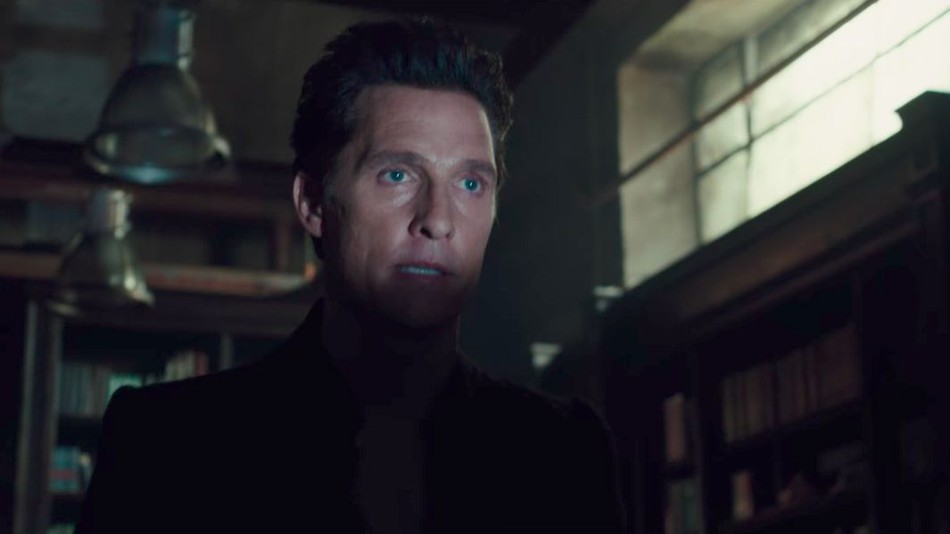
On the flip side, Matthew McConaughey summons enough gusto to grant the Man in Black a dastardly demeanor. McConaughey's calm, collected speech comes across as really creepy in the manner utilized and he confidently comes across as the intimidating, unstoppable force the movie's trying to sell you on. I can guarantee those Lincoln commercials won't come to mind while he graces the screen. Sadly, the other actors don't leave much of an impression since they mostly embody stock characters that are given much to say-or-do. 
While I'd love to say The Dark Tower stood strong amidst adversity, I can't quite offer that vote of confidence. The foundation's sloppy and it's only help up by the terrific trio of leads and a some select, rousing action scenes. The Dark Tower would be an adequate experience at the theater, but it doesn't demand to be seen in theaters. There are so many better alternatives still out there such as Baby Driver, The Big SickSpider-Man: Homecoming, War for the Planet of the Apes, and Dunkirk. If you're really gung-ho on seeing The Dark Tower, go ahead and check it out at a matinee showing. Otherwise, I'd wait it out to rent or catch on cable. 

Film Assessment: C+

Throwback Thursday Review: 'Shaun of the Dead'

You may notice that I've yet to upload the intended Throwback Thursday Review of Inception or the Triple-R over Interstellar from two weeks ago and I promise that is for good reason. An idea came to me when I started writing the Inception review that I simply had to deliver on and I only found time to watch Interstellar this Sunday and have found myself busy since then. You'll understand in due time and I'm sorry that this review is also delayed by about a week. In the meantime, my other reviews should be published around the intended schedule. Last week began my Edgar Wright review series that was initially intended to correspond with the announced release date of Baby Driver. Baby Driver got bumped up to June and I couldn't really find any alternatives to fill the gap so I decided to jump back and forth between reviewing Edgar Wright movies and Steven King adaptations for the coming weeks to tie in with the release of both The Dark Tower and It (2017). So to give you an idea of what else I'm reviewing in that span, I intend publishing Throwback Thursday Reviews of The Shawshank RedemptionHot FuzzStand By MeThe World's EndThe Shining, and Scott Pilgrim vs. the World in addition to reviews of new releases The Emoji MovieAtomic BlondeDetroitKidnapWind RiverThe Glass CastleLogan Lucky, and The Hitman's Bodyguard.

'Shaun of the Dead' Review


In Shaun of the Dead, the titular character Shaun is nearly thirty and lives a relatively regular life. He works at an electronics store, bunks with his lethargic best friend Ed, and makes routine visits to his favorite pub, The Winchester. This irks his girlfriend Liz, who merely wishes he'd get his life together, so when Shaun refuses to abide by her request, she calls it off. However when a sudden zombie apocalypse risks the lives of those Shaun holds dear, he races to win back his ex-girlfriend, save his mum, and wait it all out in The Winchester.
Shaun of the Dead is not your average zombie movie or even a run-of-the-mill rom-com, but rather the most interesting mixture of all those genres. For those familiar with the name Edgar Wright, this would be the project that truly jumpstarted his career and launched him to becoming the king of cult comedies. Wright previously had directed a number of television series and short films in addition to A Fistful of Fingers, a film I didn't even know existed till I perused through his IMDB page, but Shaun of the Dead put him on the map. 
Wright's direction imbues a sense of satire and suspense to keep the ongoing affairs fresh, while the script he penned alongside star Simon Pegg has plenty of excitement to maintain audience engagement. Both Wright and Pegg hail from England so British humour is inventively ingrained into Shaun of the Dead's DNA. The duo mock the monotonous routine of life by practically portraying ordinary citizens as lifeless zombies before any the living dead ever step into frame and then ensuring Shaun remains oblivious to the outbreak because he's too self-centered to notice anything awry. That's just one example of the social satire to be found in Shaun of the Dead, but I guarantee there's loads more!
One of the most impressive aspects about Shaun of the Dead is how well it rides the line between horror and humor.  There are moments of trepidation, but Wright and Pegg understand when it's time for a laugh. When the occasional opportunity arises, Wright and Pegg have a ball playfully parodying George A. Romero's classic zombie movies and interject their own social commentary. The two create instinctive outlets for the comedic relief to burst from, and these jokes land exceptionally well. Elsewhere, Shaun of the Dead succeeds in utilizing practical prosthetics to fabricate eerily realistic zombies, and more importantly investing you in these schmucks. 
Simon Pegg plays Shaun to be an unconventional leading man, he's just an an average guy thrust into an extraordinary situation. Pegg secures a nice niche in being incredibly immature alongside Nick Frost's egregiously lazy Ed, but still comes out as the more level-headed leader among the group. Alongside Pegg, Frost instills a charming demeanor in Ed that really resonates when he's at his silliest. When paired together, Pegg and Frost have a delightful dynamic with killer comedic timing and bang-up rapport that definitely drives the film forward.
Amongst the ensemble, Kate Ashfield's the disapproving ex-girlfriend, Lucy Davis and Dylan Moran are the tag along couple,  Nicola Cunningham is Shaun's dear old mum Mary, and Bill Nighy plays Shaun's despondent stepfather. On paper, the roles come across as caricatures but the actors imbue enough personality to click things together. 
Shaun of the Dead may revolve around the living dead, but it managed to triumphantly breathe new life into spoof movies by deftly handling the precarious balance between horror and humor. Once you evaluate all its accomplishments, it's no surprise that Shaun of the Dead helped position Edgar Wright to be one of the most unique creative voices around. 

Film Assessment: A-

Tuesday, August 1, 2017

'The Emoji Movie' Review

The Emoji Movie... was actually released into theaters across the world last Friday...

Let's just take a moment and let that sink in...

According to the dictionary, emojis are classified as small digital icons used to express ideas, emotion, etc. in electronic communication.

An actual movie was made about these...

**Breathe in** (1, 2, 3, 4)

**Hold breath** (1, 2, 3, 4, 5, 6, 7)

**Exhale** (1, 2, 3, 4, 5, 6, 7, 8)

Okay. Now that everyone's calm, we can discuss this "film." I'm sure many of you are wondering why I would put myself through watching this. Well, I received some requests to review it and I simply had to see it after it opened to a 0% Rotten Tomatoes score (it's unfortunately risen to 6%). When this "movie" was announced, I was astounded. Studio executives really resorted to structuring an entire animated movie around emojis... I simply had to see it...
For those who have the fortunate resolve to read all of this, I commend you. The Emoji Movie takes place in Textopolis, the messaging app inside a teen's smartphone. In Textopolis, all the emojis are living entities whose purpose is to give one general expression and be ready for the their inevitable use by the smartphone owner. However, the "Meh" emoji is different because he's able to express many emotions. On Meh's first day working on the phone, he goofs up and ruins the text Alex sent to his crush. Alex notices the glitch so he schedules an appointment to have his phone examined and debugged, putting all the inhabitant's lives at risk for deletion. Facing the threat of deletion, Meh flees with the "Hi-5" emoji to meet Jailbreak, who can hopefully recode Meh once they reach Dropbox. The three then journey to Dropbox for Meh to be recoded properly, Jailbreak to escape into the Cloud, and Hi-5 to be a popular emoji again.
If that plot description sounded contrived, convoluted, and flat-out stupid, that's because The Emoji Movie is all of those things. The movie's core concepts are basically a mixture of Wreck-It RalphThe LEGO Movie, and Inside Out but The Emoji Movie lacks the charm, intelligence, or heart of any of those three outstanding animated films. You can just tell that a screenwriter was plopped down and forced to develop some semblance of a plot centered around emojis. I don't think that task is impossible, but I certainly don't think it was a good idea either. Now I'll be the first to admit I wasn't sure The LEGO Movie seemed like a good idea either, but that movie succeeded in ways I could have never possibly imagined at the time so I tried my hardest to keep an open mind with The Emoji Movie.
On record, The Emoji Movie was directed by Tony Leondis with a screenplay written by Leondis, Eric Siegel, and Mike White but it's easily apparent The Emoji Movie was studio-made by Sony Pictures Animation. This is clear because of how heavily smartphone apps (ie. Candy Crush, Twitter, Instagram, Youtube, and Dropbox) factored into the plot. The Emoji Movie was an outright advertisement for these apps when The Emoji Movie consistently deviated from the story at hand. It was almost like The Emoji Movie had a short attention span comparable to many millennials today. The movie constantly swapped storylines but lacked focus on any of them.
The animation style's substandard, the editing is atrocious, the script is stupid, and the cast was fairly one note. T.J. Miller was appropriately "meh" as Meh, failing to bring any real distinct personality to the character even when we're told this is the most expressive emoji. Anna Faris fell flat as Jailbreak, James Corden's Hi-5 was incredibly obnoxious, and Maya Rudolph's Smiler was just strange. Meh's parents Mel and Mary Meh are voiced by Steven Wright and Jennifer Coolidge and stand to reason as some of the most lifeless characters in cinema. 
Those behind the film even had the audacity to cast Sir Patrick Stewart as the "poop" emoji and an actor who delivered one of the greatest supporting performances of the year in Logan ACCEPTED this?!? WHYYYY?!?!.. Stewart essentially just throws out pitiful poo puns and the entire time you're wondering why this was even necessary... I can't possibly comprehend why he'd want himself attached to this in any way, shape, or form...
At this point, I don't know what else I could possibly express to you via words. I'd love to be able to have something profound to say about The Emoji Movie but I honestly don't. Therefore, I will utilize the emojis at my disposal to rip this thing to shreds. 

Overdramatic Emoji Decryption Review


😐😕😖😡- I think this would accurately describe the progression of my facial expressions throughout this movie's runtime. I was genuinely disinterested, then repulsed at how this stupid ridiculous product placement made it's way to cinemas.

📵📵📵- This movie was so bad that I considered boycotting the use of my own iPhone afterwards.

🔪✂🔌- About a quarter of the way through, I figured cutting the cord to the digital projector seemed like a viable option to just get it to end. On one hand, I might electrocute myself. On the other, I would spare the poor souls in the theater from this cheap soulless cash-grab. Sometimes sacrifice is necessary if the needs of the many outweigh your own.

🔥💩🚽- I don't believe this requires an explanation but yes, explosive diarrhea would be much more enjoyable than watching The Emoji Movie.

🚨❗❌🗑🗑🗑🚨❗❌- Whatever you do, do NOT support this garbage with a vote of confidence at the box office. Literally anything else out would be more worth your time. I think scrolling through all the emojis on your keyboard would be even more entertaining than The Emoji Movie and take far less time. I don't even think kids will like this. It's that bad.

Film Assessment: 🔥💩🚽 (F)