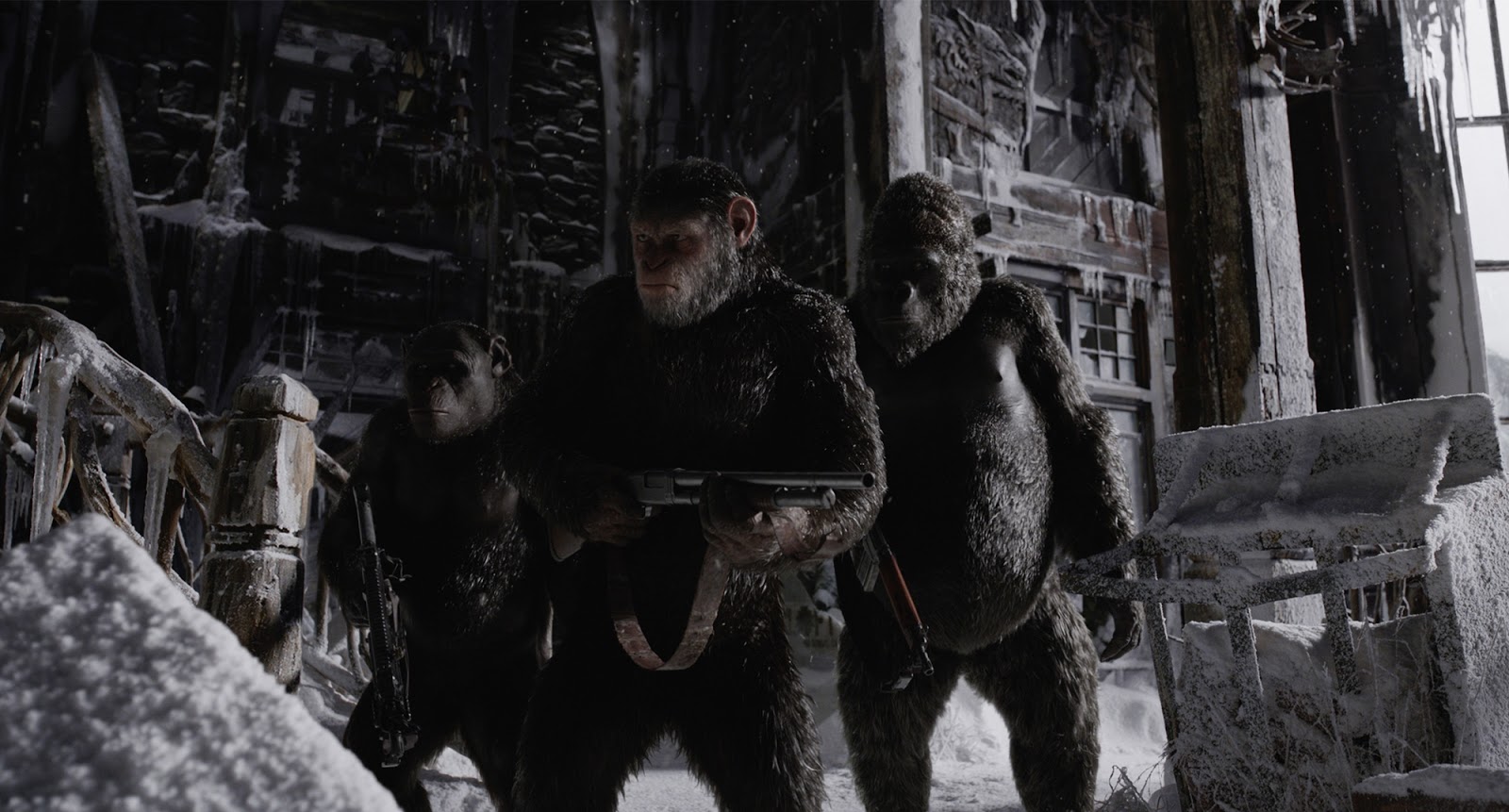
Nominated For: Best Visual Effects.
War for the Planet of the Apes picks up two after the events of
Dawn of the Planet of the Apes. Caesar and his tribe of apes are now engaged in guerrilla (or gorilla) warfare against the remains of the U.S. military called in at the end of Dawn. The contemptible
Colonel leading the heinous humans is relentlessly searching for Caesar's well-hidden encampment to wipe out the ape leader once and for all
. However
once an unforgivable act of violence is committed
, Caesar sets off on a vengeful quest to end this war and determine the fate of humanity and ape-kind once and for all.

Matt Reeves returns to direct, even taking a hand penning the screenplay alongside veteran franchise writer Matt Bomback, and if one thing is clear from the get-go, it's that Reeves crafted an unabashedly intense work of cinema that will likely subvert viewer expectations. The marketing push promises an all-out war film but War for the Planet of the Apes is a vastly different animal. War for the Planet of the Apes wasn't necessarily what I expected but I'm absolutely okay with that. Instead of relying on the spectacle, Reeves relishes in exploring the characters with a keen focus on the trilogy's thematic undercurrent that war can corrupt virtue. Reeves understands longtime viewers are along to see the end of Caesar's chapter in this saga so he rewards them with a brutal, unforgiving examination of one of cinema's most captivating characters in recent memory.

The Christ allegories are strong with this ape installment, but they're executed in a tasteful manner. Caesar has to put everything on the line if he's going to commit to the survival of his species and naturally some existential questions are derived from that choice. "How far is Caesar willing to go before he loses his soul?" is one of War for the Planet of the Apes's hair-raising questions and I found the subsequent exploration to be utterly fascinating. Now if only all of today's onscreen storytelling could be so sophisticated!
It's this level of sensational storytelling paired with Reeves' insistence on allowing the camera to linger on the moments of beauty and Michael Giacchino's soulful score that raises the bar for other blockbusters in this day-and-age. I'm a huge fan of Giacchino and his other work but this may very well be his significant collection of compositions yet!
Meanwhile, the tech-wizardry going on over at Weta has gotten out of hand. I'm absolutely certain that every single digital rendering was seamlessly woven into the breath-taking backdrops. I never once questioned the authenticity go anything occurring onscreen because it all looked so lifelike. If War for the Planet of the Apes doesn't pick up the gold statuette for Best Visual Effects this coming awards season, then perhaps humanity deserves to be governed by apes.

Speaking of awards talk, I think it's about time Andy Serkis received some recognition for his outstanding accomplishments as the most dedicated motion-capture performers around because his performance as Caesar is exceptional. I know it's a highly-contested discussion about how much of a motion-capture performance comes from the visual effects artist and the actor but I don't see why both don't deserve to be awarded. Serkis put in the work and it's his potent performance that demonstrates his radical range as not only a performer, but an actor. It's truly the marriage of ground-breaking vfx and extraordinary acting that allows the character to come together and my, how far Serkis and Caesar have come since
Rise of the Planet of the Apes. Oddly enough, I feel the most powerful performances of the year thus far have come from genre-driven film such as
Logan, Get Out, and Wonder Woman. Of course we haven't made into the thick of awards season yet, but I've got my fingers crossed that these unconventional choices are rewarded come next February.

One of the unsung heroes of these Planet of the Apes prequels I'm not sure I've adequately acknowledged in my last two reviews is Karin Konoval as the unperturbed orangutan Maurice. Maurice has been with Caesar through thick-and-thin and his sagely advice has kept Caesar on-course so I've always had a soft-spot for the tranquil ape for serving the role of the non-verbal voice of reason. Returning primates worth acknowledging include Rocket, Luca, Red Donkey, Blue Eyes, Cornelia, and Cornelius portrayed by Terry Notary, Michael Adamthwaite, Ty Olsson, Max Lloyd-Jones, Judy Greer, and Devyn Dalton respectively. Amiah Miller also deserves a shout-out for delivering a physical performance on-par with the emerging young-talent of late without uttering a single word. The mute Nova is a serene, uplifting presence who shines in Reeves' brighter blemishes.

Another newcomer Steve Zahn served as an unexpected source of comedic relief in the role of Bad Ape that could have felt out-of-place in this brutal blockbuster, but Zahn nails the comedic timing as quite the unusual ape.

Where I felt the film fell a little short was with the depiction of it's antagonist. The Colonel could have served as a perfect foil to Caesar, and he does to some degree, but Woody Harrelson doesn't have enough time onscreen to really measure up to the menace of Toby Kebbell's Koba. Harrelson projects a callous conduct onto the Colonel and all of his unspeakable actions carry weight so you understand Caesar's drive for revenge, but the Colonel still comes across as a zealot when things are said-and-done. There's one extensive exposition dump in the entire film that explains the Colonel's motivations and makes him somewhat understandable but never on-par with the former threat. Despite all of the constraints lain by the script, Harrelson does manage to evoke the gravitas of being a formidable foe and his ultimate comeuppance is poetic and played out beautifully by Harrelson.

If you have not seen War for the Planet of the Apes yet, I'd highly recommend the trip to the theater so you can bow down and hail, Caesar! War for the Planet of the Apes isn't just a terrific trilogy closer, War for the Planet of the Apes is a compelling conclusion to the Planet of the Apes simian-flu story that cements the series' stance alongside not only other sci-fi epics, but some of the greatest trilogies ever created.
Film Assessment: A


 Additionally, Lean on Pete bolsters some phenomenal performances from an ensemble of topnotch actors. Charlie Plummer, whom you may remember as J. Paul Getty's grandson in December's All the Money in the World, is absolutely brilliant in the lead role of Charley. Plummer demonstrates a vast emotional range and exceptionally communicates much of the character's inner frustrations through subtle, nuanced expressions. Like many young actors of late, Plummer promises to be another rising talent to watch in the coming years. An ensemble of established names including Steve Buscemi, Travis Fimmel, Chloë Sevigny, Steve Zahn, and Allison Elliott all support Plummer as varying influences on Charley throughout his journey. Buscemi, Fimmel, and Zahn being notable stand-outs of the bunch.