Bright illuminates a fictional reality where fantasy creatures and humans coexist. In Bright, orcs are looked down upon while humans, centaurs, and elves are widely accepted by society. Bright follows Daryl Ward, a human LAPD officer who recently recovered from an orc attack, who now must work alongside his orc partner Nick Jakoby to prevent a magical wand from getting into the wrong hands. Otherwise, an ancient evil will be unleashed and end the world.

Bright is directed by David Ayer, written by Max Landis, and represents Netflix's first foray into big budget blockbusters. The streaming service-turned-studio pumped a whopping $90 M budget into the fantasy-crime epic and has already announced plans for a sequel, but Bright wasn't well-received by critics, with some calling it one of the worst films of 2017. However, Bright was met with a much warmer reception by the streaming service's dedicated binge-watchers. Average audience members turned out in droves to watch Bright once it was released since they could simply stream from home, as it was reported that 11 M people watched it in the first three days. In addition, the film currently holds a favorable 87% audience rating on Rotten Tomatoes and many people I've spoken to have had good things to say.

While I didn't allow those factors to influence my opinion, I wasn't overly optimistic on
Bright due to the talent involved. Many members of the cast and crew carried over from director David Ayer's last film,
Suicide Squad, and my opinion has on that film REALLY soured since I first saw it. I was willing to give Ayer another chance though, because I really liked
Fury and it seems like Warner Bros really skewered his vision of
Suicide Squad in post-production. With that being said, I'm not overly fond of the film's screenwriter Max Landis either. Landis often takes to Twitter to nitpick nearly every blockbuster, and I find many of his comments to be absolutely absurd (namely his "Rey is a Mary Sue" argument, but you can visit my
Is Rey A Mary Sue? article for more on that topic specifically). At the risk of sounding biased, I was prepared for the possibilities that
Bright might be good, great, mediocre, or even awful. However,
Bright fell into the category of "laughably terrible." Landis often acts like he knows best, so frankly, I find it ironic and a bit funny when he fails so spectacularly... To add insult to injury, Landis boasted that
Bright would be his
Star Wars.

Perhaps the most disappointing aspect of Bright was how Ayer and Landis squandered a promising premise with such lackluster execution. The fictional world these characters are living in could have been incredibly interesting, but everything is scattershot because Landis aimed to accomplish an immense agenda. It's apparent that Landis had a lot of ideas on his plate while writing this movie, but one can only feasibly tell so much of a story in under two hours. Landis clearly wanted to flesh out a fascinating fictional reality where humans lived alongside orcs, elves, fairies, and centaurs. He takes time to contemplate the social structure of this world and how that could differ from our reality, but in execution, not that much is changed. The dichotomy between their world and ours should be drastic, but it really isn't that different aside from all the fictional creatures roaming around. Maybe this was for budgetary reasons, but this alternate reality looks and feels just like real life Los Angeles, albeit during some sort of comic convention.

Landis also attempts to interweave a subtle and smart allegory for rough race relations, but his efforts are horribly ham-fisted when all is said-and-done. I don't take issue with the idea of incorporating allegorical undertones, but this should never overtake the characters or story. Oddly enough,
Zootopia (of all things) has equivalent ambitions, but
Zootopia managed to actually accomplish its goal while telling a worthwhile story.
Bright can't lay claim to either feat because the dialogue is cringeworthy, characters are wildly inconsistent, and the events are incomprehensible.
Bright doesn't take the time to carefully setup certain events or actions, so expositional dialogue is oftentimes provided after the fact. By that point, you honestly won't care why something happened, but Landis feels an obligation to try and explain anyways. Even with an over reliance on exposition, ample unanswered questions and trivial sequences remain.
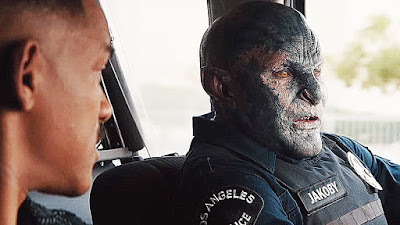
One consistency of Bright was that it implored me to ask myself time-and-time again "What am I even watching?..." The characters say one thing, but their actions suggest otherwise, and then most of what transpired didn't make a lick of sense. You'd think that the buddy cop dynamic might be a redeeming aspect, but the constant bickering between the characters was not an interesting interplay whatsoever. I also hoped the technical execution might make matters slightly more enjoyable, but even that wasn't enough. Some action sequences were kind of cool I guess, the makeup effects were proficient but ugly, and the cinematography from Roman Vasyanov was competent.
Leading Bright, Will Smith adds another piece of hot garbage to his resume. Recently, it's seemed as though Smith has been cashing in his success as an actor for some quick paychecks, and Bright is no exception. Smith's natural knack for charm shines through of course, but the man doesn't seem to be trying too much these days.
Joel Edgerton surprisingly manages to act his way through the orc prosthetic, so I applaud him for that, but his character was immensely egregious at times. As I touched on earlier, the chemistry between Smith and Edgerton wasn't quite there so I genuinely didn't care about either of them. Other members of the ensemble include Noomi Rapace, Edgar Ramírez, Ike Barinholtz, Jay Hernandez, and Lucy Fry, but their respective roles are hardly worth mentioning because of their characters' insignificance and lacking screen-time.
If Bright is indicative of what we should expect from Netflix's upcoming onslaught of original content, then we're looking towards a dark and gloomy future of substandard streaming material. I suppose the end of net-neutrality won't be so bad after all if it means we'll only be missing out on pathetic projects such as Bright.
Film Assessment: D


